
What Is Slip Solution?
If you’re new to the nail world, you might be running into a lot of terms you are unfamiliar with.
Polygels, acrylics, slip solutions, dual forms – there is a lot to learn.
Today, we’re diving into polygel nails and specifically the role of slip solution during application.
So what is a slip solution?
Slip solution is a liquid used while shaping polygel. It lightly wets the brush so the thick gel does not stick as easily, making it easier to press, spread, and smooth before curing.
If you’re still confused, that’s normal. Slip solution is simply a shaping aid, not a primer, cleanser, or curing product.
Below, we’ll explain what polygel is, how slip solution is used, which application steps matter most, and what to know before trying it at home.
What Is PolyGel?
First, it helps to understand polygel, Gelish PolyGel, and similar hybrid nail-extension systems.
Polygel-style products were developed as an alternative to traditional acrylic and hard-gel enhancement systems.
They combine a thick, moldable texture with a lamp-cured gel chemistry, allowing the technician more working time than traditional acrylic.
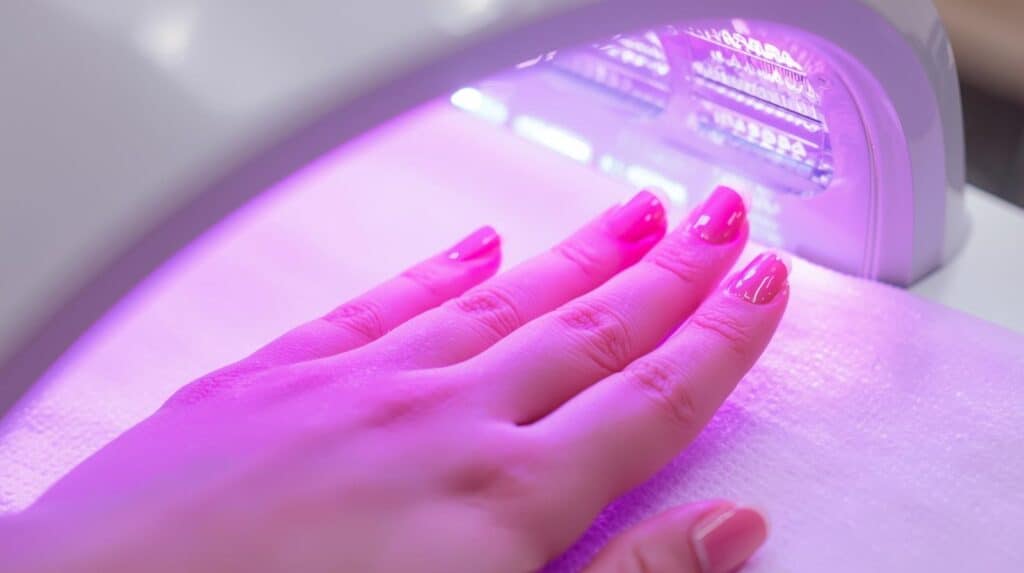
Like gel polish, polygel remains workable until it is cured under a compatible nail lamp.
This gives the technician time to press and shape the product before curing it in place.
The polygel system relies on a compatible UV/LED nail lamp and the manufacturer’s specified cure time.
That longer working window can be easier for beginners than fast-setting acrylic, although polygel still requires careful prep, structure, and curing.
Unlike regular gel polish, polygel is very thick, closer to a putty-like gel.
It typically comes in a tube and can be used to overlay the natural nail or build additional length with forms or tips.
It can add length and structure while still being shaped before curing, but it does not permanently strengthen the natural nail underneath.
PolyGel is a trademarked product name associated with Gelish, while “polygel” is also commonly used more broadly for similar hybrid extension gels.
Other brands sell similar products, including Gelish, Makarrt, and others.
What these products share is a thick moldable consistency, brush shaping, and lamp curing.
The Purpose Of Slip Solution
When working with many polygel systems, a small amount of slip solution can make shaping easier.
It is important because the product is intentionally thick and can stick to a dry brush.
Slip solution lightly wets the brush so the polygel is easier to press and smooth without sticking.
Without enough slip, the brush can grab the product and leave ridges, dents, or uneven edges.
With a small amount of slip solution on the brush, you can move and shape the polygel more smoothly before curing.
The goal is a controlled, even surface. Too much liquid can make the product difficult to control, so the brush should be damp rather than dripping.
Slip solution is mainly intended for polygel or similar hybrid-gel extension products, not standard gel polish.
Regular gel polish is already fluid enough to level on its own and generally should be applied without slip solution unless the manufacturer specifically says otherwise.
Slip solution may be used with several polygel application methods, including:
- Applying polygel as an overlay over the natural nail
- Building length with dual forms
- Building an extension over a nail form
- Applying polygel over full-cover or partial extension tips, depending on the system
How To Use Slip Solution
Here is the general process for using slip solution while shaping polygel.
Keep in mind that product systems vary, so the safest approach is to follow the cure times and prep steps listed for the specific polygel, base, top coat, and lamp you are using.
You can buy supplies as part of a polygel kit or individually.
What You Will Need:
- A compatible UV/LED nail lamp
- Isopropyl alcohol for cleansing, if recommended by the system
- Lint-free wipes
- Nail primer, only if required by the system
- Gel base coat and top coat compatible with your polygel system
- Polygel in your choice of color (this set on Amazon has 12 colors)
- Slip solution
- (Optional for added length) dual forms, nail forms, or nail tips
- A suitable polygel or gel brush
How To Do It:
- Start with clean, dry, properly prepped nails.
Remove old product, gently push back the cuticle area, and lightly remove surface shine only if your product instructions call for it. Avoid aggressive filing that thins the natural nail. - Apply dehydrator or primer only if your system requires it. Primer is not the same thing as alcohol, so do not substitute one for the other unless the manufacturer specifically allows it.
Allow the prep products to dry as directed. - Apply the compatible base coat if your system requires one and cure it for the exact time specified by the manufacturer.
Do not assume every product cures for 60 seconds or that any lamp will work. - Squeeze a small bead of polygel onto the nail, dual form, or nail form depending on your chosen method.
- Lightly dip your brush into the slip solution, then remove excess so the brush is damp rather than saturated.
- Use the dampened brush to press and spread the polygel into the desired shape.
- Re-wet the brush with a small amount of slip solution only when the product begins sticking to the bristles.
- Once you are happy with the shape, cure using the exact lamp and timing recommended for your product.
- If you used a dual form, remove it after the polygel has fully cured. If you used a traditional nail form, remove the form once the extension is cured and stable.
File and refine the shape gently as needed. - If additional structure is needed, add another thin layer of polygel and shape it with a lightly dampened brush.
Cure again according to the product instructions. - Finish with the compatible top coat if required and cure for the recommended time.
Slip solution is mainly a shaping aid. You do not need to flood the nail with it, and using more does not improve curing or strength.
If you prefer a visual tutorial, this video from Gabby Angelique on YouTube demonstrates a polygel application.
The Best Slip Solution For Polygel
You can buy slip solution on its own or as part of a polygel kit. Check that the product is compatible with the system you are using.
1. Morovan PolyGel Nail Kit
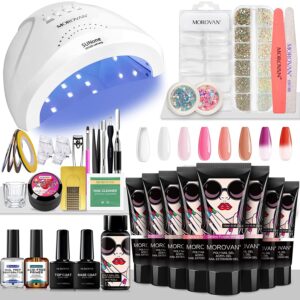
The Morovan PolyGel Nail Kit includes several of the basic tools used for at-home polygel application, including slip solution, base coat, top coat, primer, lamp, polygel colors, and dual forms.
For beginners, a complete kit can be convenient because the included products are designed to work together, although you should still follow the manufacturer’s instructions carefully.
2. Louinstic PolyGel Slip Solution
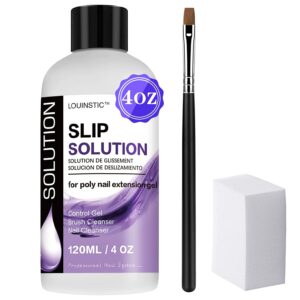
If you already have the main tools for your polygel application,
you can buy slip solution separately instead of purchasing another full kit.
This option also includes a brush and lint-free pads.
Those extras can be useful if you are replacing worn tools or starting with only the basic polygel products.
The main purpose of the solution is to reduce sticking between the brush and the polygel while you shape it.
Results will still depend on how much solution you use, how evenly you build the nail, and whether the product is cured correctly.
A larger bottle can be useful if you do polygel manicures regularly, but value depends on how often you use the product.
3. Morovan PolyGel Slip Solution
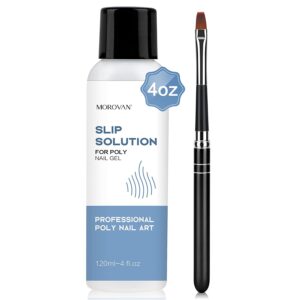
If you like the slip solution included with the Morovan kit,
the brand also sells a standalone bottle for restocking.
A larger standalone bottle can be more practical than rebuying a complete kit when you only need slip solution.
The cap can also function as a small dish while you are working, which helps keep the brush from picking up too much liquid.
Discard used solution rather than pouring contaminated liquid back into the bottle, especially if the brush has touched uncured product or skin.
Alternatives To Slip Solution
If you run out of slip solution, do not automatically substitute random household liquids.
Acetone is not a good substitute because it can soften or break down some uncured gel products and may affect consistency or adhesion.
Isopropyl alcohol is sometimes used as a slip alternative with certain polygel systems, but only if the manufacturer specifically says it is compatible.
Some commercial slip solutions are alcohol-based, while others use different solvent blends. The exact formula varies by brand.
The safest choice is the manufacturer-recommended slip solution because it is less likely to interfere with shaping, curing, or adhesion.
Now you know what slip solution is, what it does, and how to use it more safely with polygel nails.
Related Articles