
What Do You Need For Polygel Nails?
PolyGel nails are a popular choice for anyone who wants the sculpting control of acrylic with the lightweight feel of gel. The product comes premixed, stays workable until it is cured, and can be used for overlays or extensions. The most useful starter kit is a compatible product system, not necessarily the box with the most accessories.
What do you need for PolyGel nails?
To apply PolyGel at home, you will need PolyGel, a PolyGel brush and spatula, slip solution, forms if you are adding length, nail-prep tools, the base and top coat specified by your system, a manufacturer-recommended curing lamp, and lint-free wipes.
Some of these items may already be in your nail kit. A double-ended tool covers both the brush and spatula on this list, and a natural-nail overlay does not need forms. You also do not need an electric nail drill to get started.
Good preparation and correct curing matter more than using a large number of products. Always follow the curing time and lamp requirements provided by the PolyGel manufacturer, keep uncured product off the skin, and remove the enhancement gently to reduce the risk of nail damage.
What Are PolyGel Nails?
PolyGel is Gelish’s name for its thick, moldable nail-enhancement system; similar products are often sold as polygel or acrygel. They are commonly described as hybrids between gel and acrylic, but their preparation, curing, and removal instructions can differ. Unlike traditional acrylic, it arrives premixed in a tube and does not harden until it is cured under a compatible nail lamp.
Because the product remains workable before curing, you can take your time shaping the apex, sidewalls, length, and free edge. The apex is the raised area that helps support the enhancement, rather than an evenly thin coating across the whole nail. Maintenance timing depends on the product, nail growth, length, and wear; do not wait for a nail to break before arranging a fill or removal.

Benefits of PolyGel Nails
PolyGel is useful because it gives you more time to shape the product than traditional acrylic. There is no liquid-and-powder ratio to mix, and the product will not set until you place it under the correct lamp.
It can also feel lighter and more flexible than some acrylic enhancements. However, no enhancement is automatically harmless. Excessive filing, skin contact with uncured gel, incorrect curing, and forceful removal can still cause irritation or damage.
You can apply PolyGel with dual forms, paper forms, or as an overlay on the natural nail. Dual forms provide a ready-made shape, although fitting them to your nail curve and keeping product off the skin still take practice. A short overlay can be a simpler first project than a long extension.
Essential Supplies vs. Optional Extras
| Supply | When you need it |
|---|---|
| PolyGel, brush, spatula, and approved shaping liquid | For applying and shaping the enhancement. One double-ended tool can cover both tool functions. |
| Prep products, base, top coat, and compatible lamp | As specified by the product system. Select these together rather than mixing products at random. |
| Dual forms or paper forms | For the extension method you choose. Neither is needed for a natural-nail overlay. |
| Hand file, buffer, cleanser, dust brush, and lint-free wipes | For preparation, refinement, and cleanup, using the grades and liquids the system specifies. |
| Color gel, decorations, and electric nail drill | Optional. An electric file requires training and is not a beginner necessity. |
9 Tools You Need for PolyGel Nails
1. PolyGel Nail Brush
A firm, flat brush helps you press, smooth, and shape the product without dragging it away from the nail. A double-ended tool such as this PolyGel brush and spatula is convenient because you can scoop the product with one end and sculpt it with the other.
Lightly dampen the brush with slip solution while shaping. The brush should be moist enough to prevent sticking, but not saturated, since too much liquid can make the product difficult to control.
2. Basic Nail-Prep Tools
Proper nail preparation helps the product adhere evenly and reduces premature lifting. Depending on your system, your kit may include primer or dehydrator, cuticle clippers, nail files, and nail buffers.
A cuticle pusher and a dust brush are also useful. Gently move back the nail fold without cutting living skin, shape the free edge, and buff only as directed. Cuticle clippers are optional, not an essential beginner step. Brush away dust and use the specified nail cleanser before applying any required prep products.
Avoid aggressive filing or using a coarse enhancement file on the natural nail. Thinning the nail does not improve adhesion and can leave it weak or sensitive. Dehydrator, primer, and base coat have different jobs; do not add all three unless the system calls for them.
3. Compatible Base and Top Coat
A compatible base and top coat helps complete the system. The base coat improves adhesion, while the top coat seals the finished enhancement and adds shine.
The linked products are examples of supplies, not confirmation that different brands work together. Use products that are designed to work with your PolyGel and lamp. Some systems require a separate base coat, while others have different instructions, so check the manufacturer’s directions instead of assuming every brand uses the same process.
4. PolyGel
You will, of course, need the actual PolyGel product. It is available in clear, nude, pink, white, and other shades, allowing you to wear it alone or apply gel color on top.
Choose a shade and consistency that suit the service you want to perform. Natural shades are versatile for simple overlays, while pigmented products can reduce the need for a color layer. Do not assume that a clear product is automatically cured properly or that every shade uses the same instructions.
Do not substitute ordinary builder gel unless the instructions specifically describe the same application method. Builder gel and PolyGel are both enhancement products, but they have different textures and may require different techniques.
5. Dual Forms
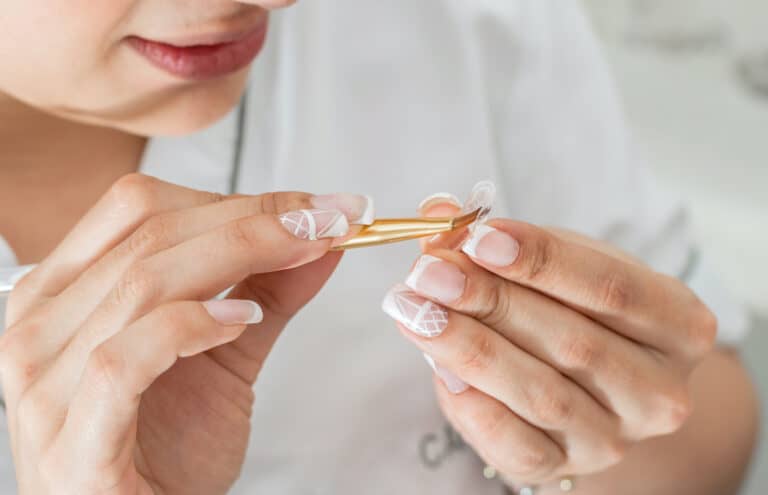
Dual forms resemble clear press-on nails, but they are temporary molds rather than permanent tips.
Select a form that fits from sidewall to sidewall without pinching the nail or needing force to lie in position. Its curve matters as much as its width. Place a small amount of PolyGel inside the form, spread it into the desired shape, and keep the cuticle area thin. Press the form onto the prepared nail carefully so the product does not flood the skin.
Check the edges and underside for squeeze-out before curing, and remove any product touching skin. Follow the system’s sequence for curing, releasing the form, and any additional underside cure. A short flash cure may only hold the shape in place; it does not replace the full required cure. Do not force a form that will not release.
6. Nail Spatula
A spatula lets you remove a controlled amount of product from the tube and place it inside the form or directly on the nail. A double-ended PolyGel application tool combines the spatula and brush in one piece.

Start with a modest amount and build the shape to the system’s recommended thickness. Too much product creates bulky edges and makes curing harder to judge, but too little support can leave an extension prone to breaking.
7. Slip Solution
Slip solution prevents the brush from sticking to the uncured PolyGel while you shape it. It does not cure or dissolve the product, and it should not be used to heavily thin the enhancement.
Pour a small amount into a separate, stable dish, dip the brush lightly, and blot away excess liquid before touching the product. Do not pour used liquid back into the bottle. Using too much slip solution may cause the PolyGel to move, spread, or become difficult to control.
Some systems permit a specific percentage of isopropyl alcohol as an alternative, but you should follow the instructions for your chosen brand rather than using an unapproved liquid.
8. Compatible UV/LED Lamp
PolyGel remains soft until it is cured under a compatible UV/LED nail lamp. The lamp also cures the base coat, gel color, and top coat when those products are part of the service.
Curing requirements depend on the formula, lamp output, thickness, and shade. Wattage alone does not establish compatibility, and there is no universal 45- or 60-second rule. Confirm the exact lamp with the product manufacturer, including before buying the linked option.
Apply the product in a controlled thickness and keep uncured gel off the surrounding skin. A hard-feeling surface does not prove a complete cure underneath. The British Association of Dermatologists warns that an unsuitable lamp and skin contact with uncured nail products can increase allergy risk. Do not touch uncured product to test it.
9. Lint-Free Nail Wipes
Lint-free nail wipes are useful for cleansing the natural nail, removing dust, wiping tools, and removing the inhibition layer when the product instructions require it.
Ordinary cotton pads can leave fibers on the surface, which may become trapped under the next layer. Use a clean wipe for each stage so you do not transfer dust or uncured product back onto the nail.
Do You Need Dual Forms for PolyGel?
No. Dual forms can help create a consistent surface, but they are not the only application method. You can also use paper forms to sculpt extensions or apply PolyGel directly over the natural nail as an overlay.
Dual forms are useful when their size and curve fit your nails well. Paper forms offer more control over custom lengths and shapes, while overlays are suitable when you want strength without adding much length.
Can You Apply PolyGel Without Slip Solution?
You need a compatible liquid to stop the brush from sticking while you shape the product. The manufacturer’s specified slip solution avoids guesswork about compatibility, but it still needs to be kept off the skin and used as directed.
Some manufacturers allow isopropyl alcohol as an alternative, but the permitted concentration can vary. Avoid acetone, monomer, water, or random household liquids, since they may affect application or product performance.
How Long Do PolyGel Nails Last?
PolyGel enhancements can last several weeks, but there is no guaranteed three- or four-week wear time. Follow the maintenance schedule for your system and nail condition. Longer nails and faster growth may need attention sooner as the supported area grows away from the cuticle.
Do not pick, peel, or glue down lifted product. Have lifting assessed and removed or repaired correctly rather than sealing over the gap. Pain, discoloration, or a separating natural nail needs attention before another application.
What Else Should You Plan Before Starting?
Set up a stable, well-lit workspace with ventilation and keep your lamp away from open tubes and brushes so stray light does not harden the product. Practicing on a training hand first can help you learn how much product and slip solution to use without risking skin contact.
Many LED nail lamps also emit UV light. The American Academy of Dermatology recommends broad-spectrum, water-resistant SPF 30 or higher on the hands before gel manicures, or dark opaque gloves with the fingertips cut off. Keep the nail plate prepared as your system directs.
How Will You Remove the PolyGel?
Check this before your first application. Gelish’s PolyGel removal instructions involve filing down the product; do not assume that every product sold as polygel will soak off like gel polish. Follow the instructions for your exact formula.
If you cannot distinguish the remaining enhancement from your natural nail, book professional removal rather than filing deeper. Never pry off an enhancement or force dental floss underneath it. Removal tools and skill belong in your plan just as much as the application kit.
The Takeaway
To create PolyGel nails, you need the product itself, a brush and spatula, slip solution, forms if adding length, basic preparation tools, the required base and top coat, a compatible curing lamp, and lint-free wipes.
The application becomes easier with practice, but careful preparation, controlled product thickness, correct curing, and appropriate removal are more important than speed. Follow the instructions for your specific system and stop using the product and seek medical advice if you develop redness, swelling, itching, or persistent irritation around the nails.
Beginners who prefer to buy the main products together can start with one of the available at-home PolyGel kits. Check the contents, curing instructions, and removal method before ordering. A kit may omit the lamp or include one without clear compatibility information. Choose a system with instructions you can follow and support you can contact.
Related Articles
How Long Should a Woman’s Fingernails Be?
Side Effects of Not Combing Hair