
7 Best Nail Primers Of 2026
A fresh manicure that starts lifting after a few days is frustrating. Nail primer can help with adhesion, but the best choice depends on whether you use gel, acrylic, or another nail system.
Not every manicure needs the same primer, but the right prep product can help reduce premature lifting, peeling, or chipping when it is compatible with the system you are using.
What is the purpose of a nail primer?
Primers are formulated to prep the natural nail for a particular service. Their main role is to improve the way the next product bonds to the nail plate, helping reduce early lifting when the primer is used correctly.
Dehydrators are used to reduce surface oil and moisture on the nail plate, while primers are designed to improve adhesion. The two products can work together, but they do not perform exactly the same job.
Before adding another bottle to your routine, check whether your nail system actually calls for primer. More prep products do not automatically mean better wear.
So, what are the best nail primers?
Choose a primer approved for your nail system. Young Nails Protein Bond is an option for gel and acrylic users, while Mia Secret Xtrabond is worth considering for an acrylic routine. Gelish pH Bond serves a different purpose: it is a dehydrating prep product, not a replacement for an adhesion primer or base coat.
The products below include both standalone primers and dehydrator-and-primer sets. Knowing which step you need helps you avoid buying a duplicate or skipping an essential base product.
Compare compatibility, application directions, and the contents of the pack before price. A two-bottle set is useful only if you need both products.
This guide compares intended uses and practical limitations; it does not claim hands-on wear testing or promise a fixed number of chip-free days.
Choosing The Right Primer
How do you determine which primer is best suited to your needs?
First, decide what problem you want to solve (like lifting) or what type of nail set you love to apply (like acrylic).
Start with the instructions for your base gel or acrylic liquid-and-powder system. They are more useful than a general “extra strong” claim on a primer bottle.
Address Your Concern
Look at where the product lifts. Lifting near the cuticle is a reason to check for product touching skin or residue left on the nail plate before buying a different primer.
If the free edge chips, review nail length, application thickness, and the system’s instructions for finishing the edge. A primer cannot correct every application problem.
Primers are formulated to improve adhesion between the natural nail and the enhancement system. They are not a fix for every texture problem, since bubbling, wrinkling, or shrinking can also come from thick coats, incompatible products, or improper curing.
Let’s say you love acrylic nails; you may be dealing with your nails lifting right after a fresh set. What primer should you go for?
In this scenario, choose a primer that is specifically compatible with your acrylic system and follow the manufacturer’s instructions for prep and application.
Also check the amount you apply. A primer is a prep layer, so follow its directions rather than painting on a thick coat like coloured polish.
Some prep products are also marketed for regular polish or press-on wear, although not every nail primer is designed for every service.
For example, a compatible prep product may help reduce premature lifting or chipping. It does not physically strengthen a weak natural nail or guarantee that breakage will not occur.
If lifting keeps returning despite following the full system instructions, ask a qualified nail professional to review your technique instead of layering several primers.
Address Your Preferred Nail Set
What type of nail service is your favourite? Unfortunately, not all primers are universal.
Even a product described as universal needs to be checked against your particular system. Brand-to-brand compatibility should not be assumed.
For gel polish or builder gel, check whether the base product requires a separate primer and whether that prep step air-dries or needs curing.
For acrylic nails, choose the primer specified for the liquid-and-powder system. A primer advertised for gel is not automatically suitable for acrylic.
For press-ons and regular polish, follow the adhesive or polish brand’s prep instructions. Do not add an enhancement primer simply because it helped with a different manicure.
When buying a dehydrator and primer set for acrylic nails, check the label carefully. The dehydrator may work across several systems while the primer may be intended for a narrower range of products.
For dip powder, use the system’s specified prep liquids. Products called “bond”, “base”, and “activator” have distinct roles and are not interchangeable with gel primer.
This is why it is important to purchase the correct primer for your nail service and follow the directions for the full system you are using.
Dehydrator Vs. Primer
A dehydrator, primer, and base coat may all appear in the same routine, but they do different jobs.
While it is easy to confuse the two, they serve distinct purposes. A dehydrator helps remove temporary surface moisture and oil from the natural nail before product application.
If the nail plate has oil, lotion, dust, or moisture on the surface, adhesion can be less reliable.
Remove visible dust during cleansing; a dehydrator is not a substitute for cleaning the nail.
A dehydrator helps reduce temporary surface oil and moisture that may be hard to see. A clean, properly prepped nail plate can give the next product a more consistent surface to bond to.
Dehydrator usually comes after the nail has been shaped, prepared, and cleansed, rather than being the first step of the entire manicure.
Primer is applied after basic nail prep when the system calls for it, helping the next enhancement or base product adhere more reliably.
A primer’s job is primarily to support adhesion between the natural nail and the next product. It is not meant to level the nail surface in the same way a base coat or builder product can.
A primer will often follow the dehydrator in a nail prep routine. Depending on the formula, it may dry tacky or nearly invisible before the next product is applied.
Do not touch the prepared surface with your fingers. That can transfer oils back onto the nail just before you apply the next layer.
Primers and dehydrators are different prep products, and they should not automatically be treated as interchangeable.
A common sequence is nail preparation and cleansing, dehydrator, primer, then the system’s base or enhancement product. Omit or change steps only as the manufacturer directs.
Many primers air-dry, while some bonding gels require a lamp. Check the exact product instructions instead of using the words “primer” and “bonder” as curing instructions.
Keep prep liquids off the skin and use them only on healthy, intact nails. Stop if a product causes discomfort, and do not cover a painful or visibly damaged nail with enhancements.
An acid-free label does not mean a product is suitable for every person or every system. Follow the handling warnings and avoid using a stronger primer to compensate for over-filing or poor prep.
The Best Nail Primers
| Rank | Product | Key Features |
|---|---|---|
| 1. | Young Nails Protein Bond Nail Primer | Universal, prevents lifting, noncorrosive |
| 2. | Gelish Basix Polish pH Bond Primer | Gel compatible, prevents shrinking |
| 3. | Tachibelle Professional Nail Primer | Primer + base coat, no-burn, acid-free |
| 4. | Modelones Professional Natural Nail Primer | Dehydrator + primer set, prevents lifting |
| 5. | Azure Beauty Professional Nail Primer | Dehydrator + primer set, disinfectant |
| 6. | Mia Secret Nail Prep Xtrabond Primer | Acrylic compatible, dehydrator + primer |
| 7. | Aimeili Nail Prep Bond Primer | Gel compatible, prevents breakage |
1. Young Nails Protein Bond Nail Primer
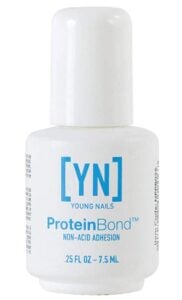
Young Nails Protein Bond is a versatile adhesion primer designed to help reduce problems such as premature lifting.
It is marketed for multiple nail applications, including gel and acrylic systems, which makes it one of the more versatile options in this roundup.
According to Young Nails’ product information, Protein Bond provides an adhesion layer for gel, acrylic, and gel polish. Despite its name, it is not a treatment that repairs or strengthens the natural nail.
The goal of Protein Bond is to create an adhesion layer that helps gels, polishes, and acrylic products bond more reliably to the prepared nail.
Best fit: someone using a compatible Young Nails enhancement system who needs a separate bonding step.
Prepare and cleanse the nails according to the service instructions, then apply Protein Bond in the specified amount. Do not use a blanket rule that gel needs primer only at the tips; coverage and coat count should follow the instructions for your service.
This Protein Bond Nail Primer may appeal to at-home users who work with more than one enhancement system and want a single adhesion product.
Young Nails markets the primer as a bonding step designed to create a tacky adhesion layer for compatible nail products.
No primer can guarantee zero lifting, but one advantage of this product is its compatibility with several common nail applications.
Limitation: it does not replace the system’s base gel or proper surface preparation. Use the matching service instructions even when all your products come from Young Nails.
2. Gelish Basix Polish pH Bond Primer
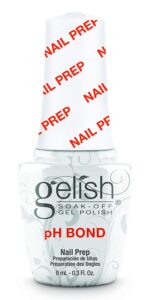
Best fit: the dehydrating step in a Gelish routine. Although pH Bond appears in primer roundups, it belongs in the nail-prep category.
Their pH Bond Nail Prep is designed as a preparatory step for gel applications, particularly when you want to remove surface oil before the base coat.
Do not treat a wear-time claim for an entire gel manicure as a promise made by this prep liquid alone.
Apply it to the natural nail plate as directed, before the next product in the system.
Gelish describes pH Bond as a prep product that removes surface oils. It should not be confused with Foundation base gel.
It prepares the surface rather than filling ridges or creating a smooth, built-up layer.
Gelish’s pH Bond is intended to support adhesion, which may help reduce premature chipping or peeling when the rest of the system is applied correctly.
It prepares the nail surface for the next gel products in the system rather than acting as a traditional strengthening treatment.
Good prep may reduce adhesion issues, but shrinking or bubbles can also come from thick coats, contamination, incompatible products, or improper curing.
Follow the complete Gelish application sequence, including the correct base product and lamp instructions.
Limitation: if you specifically need an adhesion primer, buying pH Bond alone may not fill that role. Check which prep step is missing from your routine first.
3. Tachibelle Professional Nail Primer
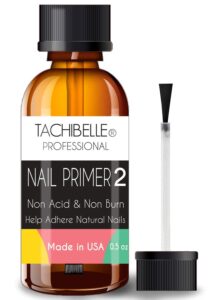
Tachibelle Professional Nail Primer is another option to compare when your nail system calls for a separate adhesion product.
Its usefulness depends on the exact formula and service listed on the bottle, so check those details before choosing it over the primer recommended by your system.
A bonding primer works between the prepared natural nail and the next compatible product. It is not the layer that provides the manicure’s structure or colour.
Do not assume it replaces your base coat. Keep the required base step unless the instructions for both products explicitly say otherwise.
Confirm that the current bottle lists your intended service, whether that is gel or acrylic. A broad reference to “nail art” does not establish compatibility with every enhancement product.
Best fit: a routine whose product instructions specifically allow this primer. If compatibility is unclear, the system’s own recommended primer is the more straightforward choice.
Check the ingredient information and handling warnings rather than relying on an “acid-free” description alone. Keep the brush away from cuticles and surrounding skin.
Complete the nail system’s preparation steps without aggressive buffing, then use a dehydrator if the directions require one.
Apply the primer sparingly as directed and follow its drying instructions before moving to the compatible base or enhancement product.
4. Modelones Professional Natural Nail Primer
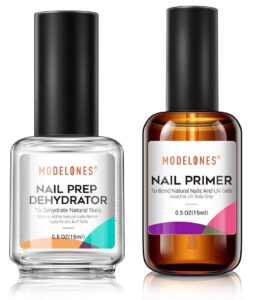
Best fit: shoppers who need both a dehydrator and an adhesion primer. This Modelones set separates the two jobs into clearly ordered steps.
The dehydrator reduces temporary surface oil and moisture on the nail plate. It does not absorb oil from the nail bed underneath.
A primer acts as a tacky surface for other products to adhere to.
This duo is designed to support adhesion, but it cannot guarantee that a nail set will never lift, crack, or break.
Modelones’ acid-free primer information lists both gel and acrylic uses, so describing the brand’s primer as gel-only is too restrictive.
Check the labels in the linked bundle, however. The formula and directions on the exact bottles you receive take priority over instructions for another Modelones version.
For gel polish, these prep liquids come before the required base coat. For acrylic, follow the liquid-and-powder system’s sequence.
Apply the dehydrator first and let it evaporate as directed. Follow with the specified amount of primer without flooding the nail folds.
Limitation: a bundle adds little value if your routine already includes a suitable dehydrator or does not require a separate primer.
5. Azure Beauty Professional Nail Primer
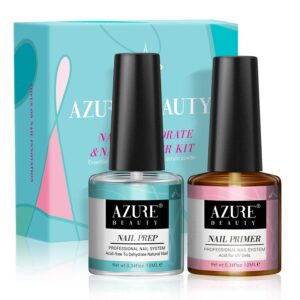
Azure Beauty markets its Professional Nail Prep Dehydrator and Bond Primer as a two-step prep system intended to support longer wear.
The nail prep duo combines a dehydrating step with a bonding step, helping prepare the nail surface before compatible enhancement products are applied.
Best fit: someone replacing both prep liquids for a system that confirms compatibility with this set.
Read each bottle separately. The drying directions and supported services for a dehydrator need not be the same as those for the accompanying primer.
Meanwhile, the Nail Bond Primer is intended to improve adhesion, which may help reduce premature lifting when used with a compatible system.
Do not assume the dehydrator is universal or the primer is gel-only. Confirm the service listed on the current pack, particularly before using either product with acrylic or dip powder.
The Nail Prep Dehydrator is intended to remove surface oil and moisture. It should not be treated as a disinfectant unless the current product label specifically makes that claim.
Limitation: if the seller does not provide clear directions for your nail system, choose a prep product with documented compatibility instead of guessing.
6. Mia Secret Nail Prep Xtrabond Primer
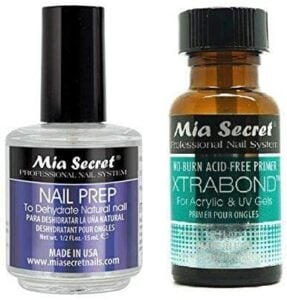
If you prefer acrylic nails, this duo from Mia Secret is worth considering because both products are marketed for acrylic prep.
Mia Secret describes Xtrabond as an acid-free primer for acrylic and gel applications. It is not limited to acrylic alone.
Like other dehydrators, this one from Mia Secret is intended to reduce surface oil and moisture so the following products have a cleaner nail plate to adhere to.
It’s formulated for natural nails and features a quick-dry formula.
The Xtrabond Nail Primer is the adhesion-focused step in the duo.
Mia Secret markets this primer as acid-free. Even with an acid-free formula, keep it off the surrounding skin and stop use if you notice irritation.
Its role is to improve the bond, not to guarantee a particular wear time or replace correct acrylic application.
This duo from Mia Secret may suit experienced at-home users who already work with acrylic systems and understand proper nail prep.
Working with acrylics can be difficult, but compatible prep products can make the application more consistent.
Good prep can help reduce lifting, but technique, product ratios, nail condition, and aftercare still affect how an acrylic set wears.
7. Aimeili Nail Prep Bond Primer
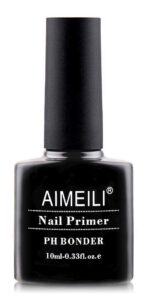
Best fit: an air-drying primer for a compatible gel routine. Aimeili’s Nail Prep Bond Primer adds a bonding step before the base product.
Oil or moisture left on the natural nail plate can interfere with adhesion, so this step still needs proper preparation beforehand.
The Aimeili primer instructions describe an air-dry product used before base coat and gel polish.
This Nail Prep Bond Primer doesn’t need a UV/LED nail lamp. However, your UV/LED gel polishes require light to cure correctly.
The primary goal of this primer is to support adhesion and reduce premature lifting.
Aimeili also lists acrylic and dip powder uses. Check the directions for your complete system before mixing prep products from different brands.
Limitation: an air-dry primer does not turn gel polish into an air-dry manicure. The gel layers still need the lamp and curing schedule specified by their manufacturer.
Prepare and cleanse the nail as directed, then apply a thin layer of primer without touching the surrounding skin.
Allow the drying time stated on your bottle. Do not add extra coats just because an adhesion layer still feels tacky, and avoid touching it to check.
Once the primer is applied, you can use your base coat and favourite nail colour.
This is a single-primer option to compare if you already have the other prep products your system needs.
It may help reduce peeling or lifting, but no primer can compensate for poor prep, incompatible products, or incorrect curing.
Related Articles
13 Best Setting Powders For Dry Skin
Eyeliner On Lower Lid Only (What To Do + What To Avoid)