
Nulastin Vs Latisse
Choosing between Nulastin and Latisse? The biggest differences are their regulatory status, active ingredients, supporting evidence, and medical oversight, not simply “natural” versus “medical.”
False lashes and extensions offer an immediate change, but their upkeep can make a daily lash product appealing.
Before switching, it helps to separate cosmetic appearance claims from an approved treatment for inadequate eyelashes.
Lash serums do not all contain the same kinds of ingredients.
Some mainly condition lashes; others contain prostaglandin-related ingredients, which deserve closer attention because they are used repeatedly near the eyelids and eyes.
The application schedule, possible side effects, and commitment also vary by product.
Latisse is a prescription bimatoprost treatment. Nulastin LASH is sold without a prescription, and the published formula cited in this article lists isopropyl cloprostenate, a prostaglandin analogue.
That means Nulastin should not be described as prostaglandin-free, risk-free, or automatically safer simply because it is sold as a cosmetic.
What is the difference between Nulastin and Latisse?
In the US, Latisse is FDA-approved for eyelash hypotrichosis, or inadequate lashes. Nulastin is marketed as a cosmetic and is not an FDA-approved lash-growth medicine. Their active ingredients, evidence, application schedules, warnings, and oversight differ.
Neither “natural” branding nor prescription status alone tells you whether a product is suitable for your particular eyes, eyelids, medications, or medical history.
Here’s how to compare ingredients, realistic timelines, maintenance, and risks before deciding.
What Is Nulastin?
Nulastin LASH Follicle Fortifying Serum is a nonprescription product marketed to improve the appearance of lash length and fullness.
The brand publishes product-study claims, but those do not establish equivalence to Latisse, prove the same level of evidence, or guarantee that a user will avoid irritation.
Nulastin describes its products as vegan and cruelty-free. Those are purchasing, formulation, and sourcing claims, not measures of eye safety or clinical effectiveness.
Its brush-on format may fit easily into a routine, but ease of use should not replace reading the warnings.
The company sells separate lash and brow products. Use the product intended for the area you are treating.
Do not assume a cosmetic serum can restore follicles lost through scarring or treat unexplained lash thinning, patchy loss, or eyelid disease.
Also, the accompanying article image should not be treated as verified evidence of an individual’s response to Nulastin.
How Does It Work?
The current Nulastin LASH instructions call for a thin application to clean, dry upper lash lines, morning and evening.
Keep it off the lower lash line and out of the eyes. Follow the label on your bottle if the instructions change.
Using more than directed is not a shortcut to faster growth and may increase unnecessary eye-area exposure.
Apply before makeup, keep the applicator clean, and do not share it.
If redness, burning, swelling, or persistent irritation occurs, stop rather than trying to build a tolerance. The brand advises rinsing with cool water if the serum enters the eyes.
What Are The Main Ingredients?
The full ingredient list matters more than the headline ingredient story because performance and tolerability depend on the complete formula.
Nulastin highlights elastin-related proteins and peptides in its proprietary Elastaplex blend.
Keratin is also listed, but its presence alone does not prove a particular amount of lash growth.
The published LASH ingredient list cited here includes isopropyl cloprostenate. It is not the same molecule as bimatoprost, but both are prostaglandin analogues and should not be treated as interchangeable ingredients.
Nulastin’s FAQs explain the brand’s protein-based approach. Read that alongside the complete formula, not as evidence that elastin and keratin are its only relevant ingredients.
If your aim is to avoid prostaglandin analogues, the Nulastin LASH formula cited in this article does not meet that preference. Check the manufacturer’s current ingredient list and the packaging you actually receive in case the formula changes.
What Results Should You Expect?
Expect gradual changes rather than an overnight effect.
Nulastin markets visible changes over roughly six to twelve weeks, with individual variation.
Treat that as a brand expectation rather than a guaranteed result, an independently established response rate, or a direct comparison with Latisse.
According to Nulastin, results depend on consistent use and individual factors. Not everyone will notice the same change.
For a useful comparison, take a baseline photo without mascara, then repeat it with the same lighting and angle.
Avoid judging progress from a different camera distance, lash curl, or coat of mascara.
Brand-selected testimonials can show individual experiences, but they cannot establish average effectiveness or tell you how likely you are to get the same result.
How Long Is The Treatment?
Nulastin is marketed for ongoing use rather than as a short course that permanently changes your natural lash growth.
That makes the long-term cost and the practicality of its routine worth considering before you start.
Continuing indefinitely is not a guarantee of improvement if the product is not working for you.
The brand says visible benefits may diminish when use stops.
For maintenance, follow the current product guidance rather than inventing a new schedule from someone else’s experience.
Do not add extra applications to compensate for missed days or to chase faster growth.
Reassess if the routine is uncomfortable, unaffordable, or not producing a change you value.
What Is Latisse?
Latisse is bimatoprost ophthalmic solution 0.03%, a prescription medicine approved in the US for eyelash hypotrichosis, or inadequate eyelashes.
Its approved purpose is increasing eyelash growth, including length, thickness, and darkness.
That is a more specific claim than general cosmetic conditioning or healthier-looking lashes.
A licensed prescriber needs to assess whether it is appropriate for you.
Prescription status does not mean it is risk-free. It means the product has an approved indication, established prescribing information, and defined warnings that should be reviewed with a clinician.
How Does It Work?
Use your prescription label and the supplied patient information as the application guide.
Latisse is applied once nightly to the skin at the base of the upper lashes after removing makeup and contact lenses.
Use the supplied sterile applicator, discard it after one eyelid, and use a fresh one for the other. Do not apply it to the lower lid, and blot away excess solution beyond the upper lash margin.
Wait at least 15 minutes before reinserting contact lenses. More frequent application will not improve growth.
Avoid touching the bottle tip to surfaces, and do not reuse applicators.
This is an upper-lid-margin treatment, not an instruction to place the solution directly into the eyes for cosmetic lash growth.
The Latisse prescribing information contains the complete directions and precautions; ask your pharmacist to clarify anything unclear.
What Are The Main Ingredients?
The relevant ingredient is bimatoprost, not a blend of cosmetic proteins.
Bimatoprost belongs to the prostaglandin-analogue class and affects the lash growth cycle.
The approval applies to the specific Latisse product, strength, indication, and application instructions, not every cosmetic serum containing a related prostaglandin analogue.
Bimatoprost is also used in glaucoma medicines. This Mayo Clinic resource on Latisse provides additional background on the treatment.
Do not substitute glaucoma drops for Latisse or combine eye-pressure medicines with a lash product without medical advice, because bimatoprost and related medicines can affect intraocular pressure.
What Results Should You Expect?
Think in weeks to months rather than days. Some users may notice early changes after about four weeks, while the approved trial endpoint commonly discussed for Latisse is 16 weeks.
The advantage is clinical evidence for lash growth, not a guarantee that it will work faster than Nulastin for you.
In the pivotal 278-person trial, about 78% of Latisse users had at least a one-grade improvement in overall lash prominence at week 16, versus about 18% using the vehicle without the active drug.
That result describes a predefined study measure in a specific trial population, not a promise that every user will get dramatically longer lashes.
The manufacturer’s trial summary provides the context for those figures.
Results generally require continued treatment rather than a permanent one-time course. You can also consult this Mayo Clinic overview when discussing expectations with your prescriber.
The video below offers an additional discussion of Latisse. It does not replace your own prescribing advice.
How Long Is The Treatment?
An initial 16-week assessment and ongoing treatment are different decisions.
You and your prescriber can review whether the visible benefit is worth continuing.
Bring comparable photos and mention any changes to the eyelids or eyes, not just lash length.
Ask about follow-up, particularly if you use eye medicines or have an eye condition.
Do not change the prescribed dose or create a maintenance schedule without advice.
When treatment stops, lashes generally return toward their original appearance over weeks to months, as MedlinePlus explains.
Latisse Vs Nulastin
The clearest comparison is between access, regulatory status, active ingredients, evidence, application, and risk.
Different study designs, endpoints, populations, and testing methods make it misleading to compare a brand testimonial percentage directly with a prescription-drug trial result.
Decide which of those differences matters most to you before comparing prices.
| Comparison | Nulastin LASH | Latisse |
|---|---|---|
| US access | Sold without a prescription | Prescription required |
| Product status | Marketed as a cosmetic | FDA-approved eyelash-hypotrichosis treatment |
| Ingredient distinction | Proteins and peptides, plus isopropyl cloprostenate | Bimatoprost 0.03% |
| Evidence to compare | Brand-published product studies and appearance claims | Controlled clinical trial supporting the approved use |
| Main decision point | Nonprescription access does not mean prostaglandin-free | Medical assessment and monitoring of treatment risks |
Is A Prescription Needed?
In the US, Latisse requires a prescription.
Consult a clinician legally authorised to prescribe medicines. An aesthetician or other beauty professional cannot prescribe simply because they work with skin or lashes.
Buy prescribed medication through a legitimate pharmacy or authorised medical dispensing route.
Nulastin is sold directly without a prescription. Easier access does not remove the need to read its ingredient list and warnings.
FDA-Approval
Latisse has an approved drug indication for inadequate eyelashes.
FDA approval reflects an assessment of benefits and risks for the approved use when the product is used as directed, not a guarantee of zero eye-related side effects.
Nulastin is marketed as a cosmetic, not an FDA-approved lash-growth treatment. Its “clean,” biomimetic, vegan, or cruelty-free messaging does not establish lower medical risk.
Price
Compare the cost of an ongoing routine, not just one bottle.
For Latisse, request the pharmacy price and any consultation charges. Ask the prescriber about appropriate generic options and check coverage rather than assuming insurance will pay.
For Nulastin, check the current one-time price, subscription terms, and expected bottle duration at the labelled frequency. Promotions make a fixed price comparison unreliable.
A useful budget is the total cost over several months, including replacements and follow-up.
Effectiveness
Latisse has evidence from a controlled trial for its approved purpose.
That evidence still has to be weighed against its warnings and your eye history.
Nulastin’s marketing and product studies do not establish head-to-head equivalence with Latisse. There is no basis here to promise that they work equally well or to predict which will work faster for a particular person.
Neither should be bought with the expectation of permanently changing your lashes after a brief course.
Side Effects
With Latisse, reported adverse effects include itching, redness, dry-eye symptoms, and eyelid skin darkening.
Its warnings also include increased brown iris pigmentation, which may be permanent, and unwanted hair growth where solution repeatedly contacts other skin.
Postmarketing reports include periorbital changes associated with loss of fat and a deeper eyelid crease. Report new hollowing, asymmetry, or other eye-area changes to the prescriber.
Nulastin can also irritate the eyes or surrounding skin. Because the cited formula contains a prostaglandin analogue, it should not be called a risk-free alternative, and reliable head-to-head side-effect rates versus Latisse are not established here.
Read Nulastin’s guidance and product warnings, but remember that excluding certain allergens cannot make a formula allergy-proof.
Popularity
Both names appear frequently in lash-serum comparisons, but popularity, influencer use, and review volume are not evidence of safety or effectiveness.
Online reviews may differ in lighting, mascara use, application habits, and length of follow-up.
A positive review also cannot tell you whether a reviewer experienced a subtle or delayed eye-area change.
Use reviews to learn about practical details such as packaging and routine, not to replace evidence about growth or risk.
Be particularly cautious with claims that a product is completely safe because it is sold without a prescription.
Results
Your starting lashes and the reason they look sparse affect what is realistic.
If you have sudden shedding, new bald patches, crusting, pain, or eyelid inflammation, investigate the cause before choosing a serum rather than assuming it is only a cosmetic density issue.
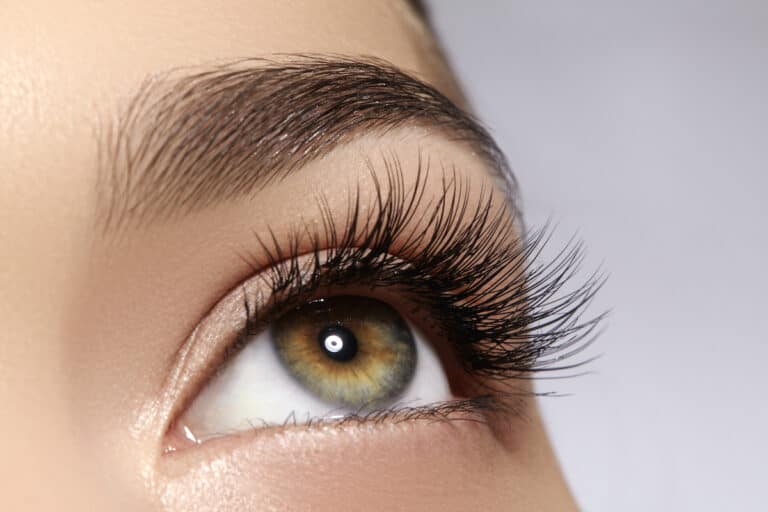
The article photos are illustrative, not a verified side-by-side treatment comparison. They cannot establish that either product caused the appearance shown.
Which Eyelash Serum Is Right For You?
Start with your goal: fuller-looking lashes, a medically assessed growth treatment, or simply less need for mascara.
Then ask which trade-offs you are comfortable accepting. Similar marketing does not mean similar results or equal risk.
The main considerations are the evidence, ingredient class, eye history, current eye medicines, daily routine, monitoring, and ongoing cost.
Nulastin
Nulastin may appeal if you want direct purchase without a prescription.
It does not fit a preference for avoiding prostaglandin analogues in the currently published formula.
The brand’s vegan and cruelty-free claims may matter to your purchasing preferences, but they do not answer medical safety questions.
Do not infer years of risk-free use from cosmetic status or favourable reviews.
If you choose it, follow the current label and stop for irritation rather than increasing use to force a result.
Latisse
Latisse may suit someone seeking an approved treatment who is eligible after a clinical assessment.
Allow time for the response. It is not an instant substitute for mascara or false lashes before an event.
Before starting, discuss pigmentation, irritation, and possible eyelid changes so you can make an informed choice.
Use it as prescribed, with the supplied applicators.
Set a review point with the prescriber to assess both benefit and tolerability.
Remember that maintaining the effect generally means continuing treatment.
How To Avoid Potential Irritation
A few practical steps can reduce avoidable application mistakes, although they cannot eliminate every risk.
Do not layer Nulastin and Latisse together to chase faster results. Ask a clinician before combining, alternating, or switching lash-growth products, particularly if you use other eye medicines.
Consult A Doctor
Get medical advice before use if you have eye disease, recent eye surgery, persistent dry eye, eyelid inflammation, or take glaucoma or other eye-pressure medication. Discuss pregnancy or breastfeeding as well.
Stop and seek prompt assessment for eye pain, marked swelling, significant discharge, or changes in vision. Do not treat those symptoms as a normal adjustment period.
Perform A Patch Test
A home skin test has important limits when a product is intended for the eyelids because eye-area irritation and medication-specific effects cannot be predicted from an arm test.
For a cosmetic, follow the manufacturer’s test directions if provided. Do not invent an arm-test dosing schedule for prescription Latisse; follow the prescriber’s instructions.
No reaction on the arm does not rule out eye irritation, pigmentation changes, or other effects near the eye. A patch test is not proof of eye safety.
Final Thoughts
The main distinction is evidence and oversight. Latisse is a prescription medicine with an approved eyelash-growth indication, defined dosing, and prescribing warnings.
Nulastin is a directly available cosmetic with brand-supported appearance claims.
Both involve an ongoing routine rather than an instant or permanent makeover.
Convenience may favour Nulastin for some users, but easier access does not establish lower risk or stronger evidence.
Its elastin-and-keratin story should be read alongside the prostaglandin analogue in its full formula.
Latisse’s defined active ingredient is bimatoprost 0.03%.
Its prescription consultation provides an opportunity to assess whether the treatment fits your eye history and expectations.
Pay attention to tolerability as well as growth; longer lashes are not worth ignoring persistent irritation, eye pain, vision changes, or new eyelid changes.
Budget for continued use and choose a review point rather than buying indefinitely on hope alone.
If neither product’s trade-offs appeal to you, choosing neither is reasonable.
Make the decision from the complete formula, evidence, instructions, risks, and required monitoring rather than a simplified “natural versus drug” comparison.
If lash loss is new, uneven, or accompanied by eyelid symptoms, identify the cause before choosing either option. A growth product should not delay assessment of an underlying eye or skin condition.
Related Articles
How To Make Your Eyelashes Grow Overnight
What Do You Need For Polygel Nails?