
Hard Gel Vs Soft Gel (Everything You Need To Know)
There are many ways to customize a manicure, from simple gel colour to structured overlays and extensions.
Traditional manicures usually involve several coats of regular polish followed by air-drying or a fan-style nail dryer.
Because regular polish continues to harden after application, it can still smudge or dent if you are rough with your hands too soon.
Gel systems offer another option, with light-cured coatings, overlays, and extensions that can provide longer wear and, depending on the product, added structure while they are on the nail.
Most people are familiar with gel polish, which is applied in thin coats and cured in a compatible UV or LED nail lamp according to the product directions.
Beyond gel polish, there are several gel systems designed for different levels of flexibility, structure, length, and removal.
Hard gel and soft gel are two broad categories, but the terms can cover several different products and services.
Understanding the difference helps you choose a system based on length, rigidity, flexibility, maintenance, and removal rather than trend alone.
What is the difference between hard and soft gel?
Hard gel is generally a more rigid, file-off gel used for structured overlays and sculpted extensions. Soft gel is a soak-off category that includes gel polish, some flexible builders, and full-cover extension systems. Exact strength, flexibility, cure requirements, and removal method still depend on the specific product.
Below, we’ll compare how hard and soft gels are used, how they are maintained and removed, and what to ask for before booking a service.
What Is Hard Gel?
Hard gel is a light-cured nail-enhancement material used for structured overlays and sculpted extensions.
Once cured, it is generally more rigid than soak-off soft gel, which makes it useful when a technician needs to build an apex, add structure, or create length.
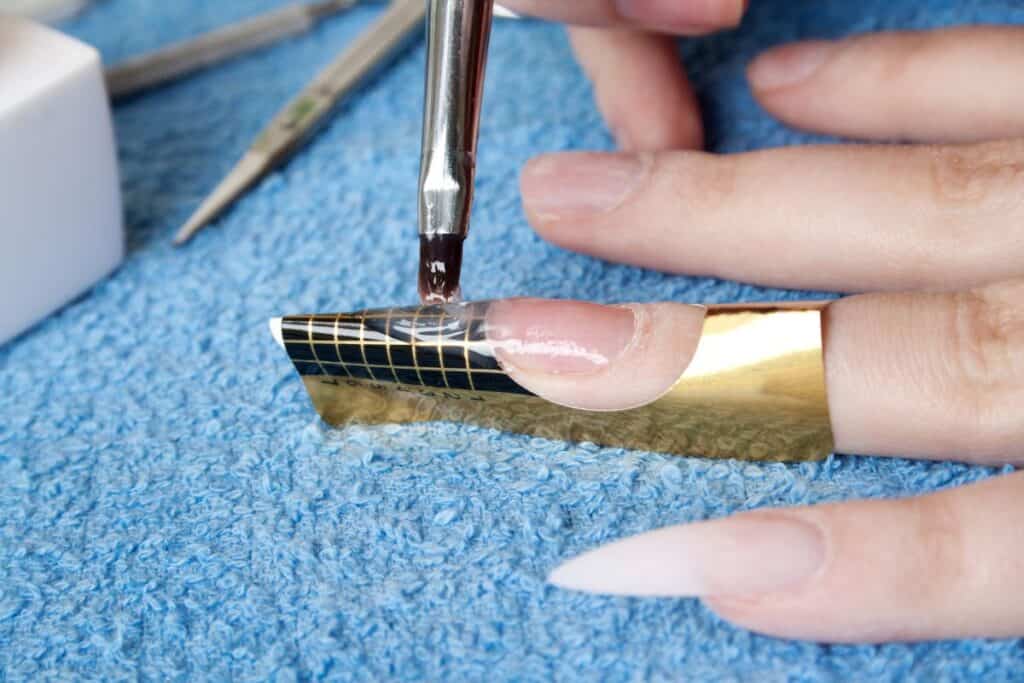
Hard gel can be applied over the natural nail as an overlay or sculpted beyond the free edge with forms or compatible extension methods approved for the system.
Hard gel is sometimes described as builder gel or sculpting gel, but builder gel is a broader term. Some builder gels are hard, file-off gels, while others are soak-off products.
Hard gel must be fully cured in the lamp specified or approved by the manufacturer. Cure time, lamp spectrum, and compatible application thickness vary by system, so wattage alone is not enough to judge compatibility.
Hard Gel Pros
Hard gel is useful when you want more structure or length than a thin gel-polish manicure can provide.
It can be especially practical for medium-to-long sculpted nails when the product is built with an appropriate apex, intact sidewalls, and balanced free edge.
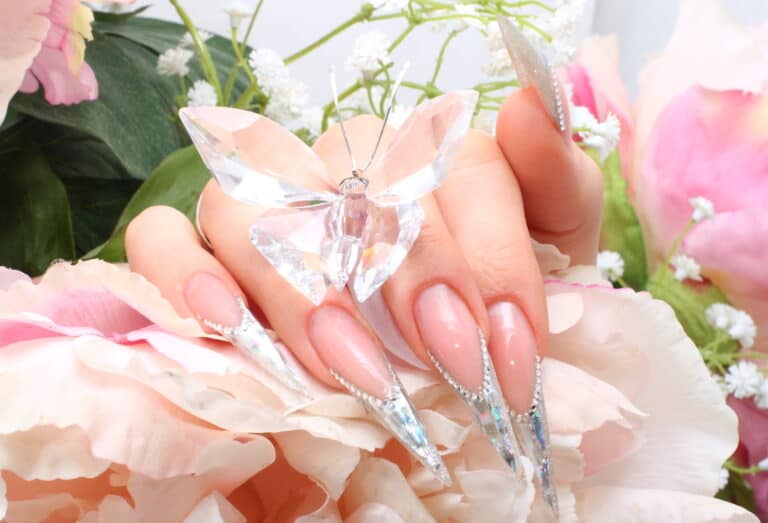
A technician can file hard gel into many shapes, including oval, almond, coffin, and stiletto, provided the length and structure suit the client’s nails and lifestyle.
Final filing refines the shape, thickness, sidewalls, and free edge after curing.
Compared with a thin coat of gel polish, hard gel can provide more structural support while it is being worn.
After hard gel is applied and correctly cured, it forms a rigid enhancement. Durability still depends on proper prep, balanced product thickness, nail length, daily use, and timely maintenance.
Hard gel can be very durable, but it is not automatically the strongest or most damage-proof gel service for every person.
A well-built hard-gel set can wear for several weeks, although growth, lifting, cracks, and balance determine when maintenance is needed.
Many clients return for maintenance at around two to four weeks, before excessive growth changes the balance of the enhancement or increases leverage and the chance of chipping, breaking, or lifting.
How long a set remains wearable varies with nail growth, length, technique, and lifestyle; waiting for a specific number of weeks is less important than checking the condition of the enhancement.
A fill or rebalance involves reducing old product where needed, removing lifted material, and rebuilding the apex and grown-out area with compatible hard gel.
Maintenance is often scheduled every two to four weeks, but your technician may recommend a different interval based on your growth and the product system.
Your nail technician can also tell you when a set should be fully removed and replaced rather than repeatedly filled.
Hard Gel Cons
Hard gel has useful structural benefits, but there are also maintenance, removal, and allergy considerations to understand.
Hard gel itself does not inevitably make natural nails weak or sensitive. Problems are more likely when the nail plate is over-filed, product is peeled off, lifting is ignored, uncured gel repeatedly contacts skin, or removal is too aggressive.
Some gels can create a brief heat spike while curing. This comes from the exothermic curing reaction and can feel more intense with thicker applications, thin or damaged nail plates, or certain formulas.
If curing becomes painful, remove the hand from the lamp and tell the technician rather than trying to tolerate severe heat. The product should then be handled according to the manufacturer’s guidance rather than repeatedly forcing a painful cure.
Traditional hard gel is a file-off product. A professional may use an e-file, hand file, or both, taking care not to file into the natural nail plate.
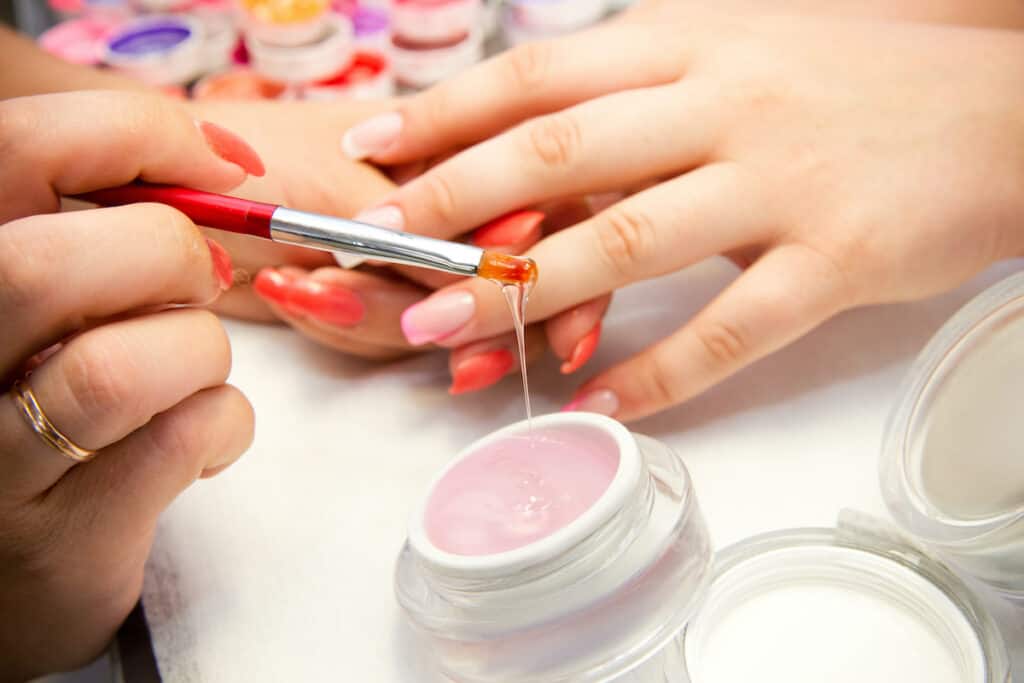
Hard gel may also be reduced during a fill so the technician can correct lifting, thickness, shape, and balance before adding new product.
The concern is not simply how often an e-file is used. Over-filing the natural nail, using too much pressure, using an unsuitable bit, or staying in one spot too long can cause thinning, heat, and soreness.
A hard-gel extension appointment can also take longer than a basic gel-polish service because the enhancement must be built, cured, refined, and finished.
A new set may take roughly one to several hours depending on length, design, technique, and salon workflow.
Fill appointments are often shorter than a new set, but timing still varies with the amount of growth, lifting, reshaping, and nail art required.
Who Should Use Hard Gel?
Hard gel is worth considering if you want structured overlays or sculpted length and are comfortable with regular rebalancing and file-off maintenance.
It can support a wide range of extension shapes, but the safest length is one that your natural nails and daily routine can reasonably handle.
It can also suit people who prefer scheduled fills instead of soaking off the entire enhancement at every appointment.
Hard Gel Procedure And Removal
Hard-gel application starts with deciding whether you need an overlay, repair, or extension and selecting a compatible product system.
For added length, the gel can be sculpted over a nail form or used with compatible extension methods specified by the brand.
Some services may also use pre-shaped tips, depending on the system, the salon, and the desired result.
Prep generally includes cleansing, shaping the free edge, and gently removing non-living tissue from the nail plate. Cutting living skin or aggressively thinning the natural nail is not required for gel adhesion.
The technician applies the gel in controlled amounts to create the apex, sidewalls, free edge, and desired extension without flooding the surrounding skin.
Each product is then cured in a compatible UV or LED lamp for the manufacturer’s specified time.
After curing, the technician can refine the surface and shape with a file before applying color or top coat if the system calls for it.
Gel color can be applied over the finished hard-gel structure when the products are compatible.
Each gel layer should be cured according to its own lamp, timing, and thickness instructions; thicker is not automatically stronger, better, or safer.
For removal, file-off hard gel is carefully reduced with a hand file, e-file, or both. The goal is to remove product without grinding into the natural nail.
If you are fully removing hard gel, do not peel or pry it from the nail plate.
Because true hard gel is not designed to dissolve in acetone, any remaining layer is usually carefully filed down or left as a thin protective layer to grow out, depending on the service, product, and condition of the natural nail.
Unlike soak-off gel, traditional hard gel is primarily removed by filing. Follow the specific brand’s removal instructions because not every builder product belongs to the hard-gel category.
What Is Soft Gel?
Soft gel is a broad term for gel products formulated to be soaked off with acetone or another manufacturer-approved remover. It can include gel polish, flexible overlay products, and full-cover soft-gel extension systems.
That means soft gel is not defined by one thickness. Some formulas are thin like gel polish, while others are thicker builders or pre-shaped extension tips.
Soft gel generally provides a more flexible enhancement than traditional hard gel, but wear and chip resistance depend on the formula, prep, nail condition, extension length, and application.
Soft-gel systems still need a compatible curing lamp. The same product should not be assumed to cure correctly in every UV or LED lamp, and a hard-feeling surface does not prove that deeper gel is fully cured.
If you’d like to see a tutorial, check out this helpful one from Gelish on YouTube.
Soft Gel Pros
If you want a soak-off service, soft gel can be a convenient option for color, overlays, or certain extension systems.
A soft-gel overlay can add temporary reinforcement while worn, but it does not permanently thicken or strengthen the natural nail plate underneath.
Soft gels are generally more flexible than traditional hard gel, which can feel more natural on shorter nails and some full-cover extension systems.
They also tend to offer longer wear than regular air-dry polish when the nail is properly prepped, the product is kept off the skin, and each layer is fully cured.
Many soft-gel manicures are worn for around two to three weeks, although lifting, cracking, growth, and product instructions should determine when they are serviced or removed.
Appointment time varies widely. A simple gel-polish service can be relatively quick, while a structured overlay or full-cover soft-gel extension set can take considerably longer.
Soft Gel Cons
The main risks are not that soft gel automatically makes nails sensitive. Problems can come from over-prep, peeling product off, aggressive removal, repeated skin exposure to uncured gel, flooding the cuticle, or improper curing.
Because soft gels are commonly removed with acetone, the surrounding skin and nails may feel dry afterward. The greater risk of thinning comes from scraping, peeling, prying, or filing into the natural nail.
A well-applied soft-gel service can often wear for a couple of weeks or longer, but there is no guaranteed chip-free period for every client.
If a gel coating starts to lift, crack, or separate, it should be assessed rather than picked, pressed down, or glued back in place, because trapped moisture and continued leverage can create problems.
Soft gel is not limited to natural-nail color. Full-cover soft-gel tip systems can add substantial length, and some soak-off builders can create short extensions when the manufacturer allows it.
For very long sculpted extensions, a rigid hard-gel system may offer more structure, while soft-gel tips can be a practical alternative when a soak-off, pre-shaped extension is preferred.
Who Should Use Soft Gel?
Soft gel is a useful choice for anyone who prioritizes soak-off removal, flexibility, and lower-commitment removal rather than a rigid file-off enhancement.
It can feel more flexible than hard gel, though the exact feel depends on whether you choose gel polish, a soft builder, or a full-cover tip system.
If you are happy with your natural length, gel polish or a soft-gel overlay may be enough to add color and temporary reinforcement.
If you want extra length, ask specifically about soft-gel extension tips or a soak-off builder that is approved for extensions rather than assuming every soft gel can do the same job.
Soft Gel Procedure and Removal
The application process depends on which soft-gel system you are using, so the brand’s prep, primer or base, lamp, cure time, maximum thickness, and removal instructions should take priority.
For gel polish or a soft overlay, the product is applied over the natural nail. Full-cover soft-gel systems use a pre-shaped gel tip and compatible gel adhesive to create length.
Prep usually includes cleansing and light surface preparation as directed by the system. The goal is reliable adhesion without aggressively etching or thinning the nail plate.
The nail should be clean and dry before gel application. Avoid getting gel on the surrounding skin, and do not cut healthy living cuticle simply to make the manicure last longer.
For a polish or overlay service, gel is applied in controlled layers. For full-cover tips, the extension is fitted and attached using the system’s compatible gel and curing method.
Each layer or tip must be fully cured under the UV/LED light specified for that system. Correct curing is important because under-cured gel can increase the risk of lifting and exposure to unreacted acrylate ingredients, which may contribute to sensitization.
The key difference from traditional hard gel is that properly formulated soft gel is designed to soak off after the top surface is broken or reduced as directed.
Removal usually involves filing or buffing through the top coat as directed, then using acetone wraps or another manufacturer-approved soak-off method until the product softens and releases.
Soak time varies by product and thickness. Do not force off gel that is still firmly attached; re-wrap it instead of aggressively scraping or peeling the natural nail.
Some soft-gel services are completely removed before reapplication, while certain soak-off builder systems can be maintained according to their manufacturer’s instructions. There is no single removal rule for every soft gel.
Is Hard Gel or Soft Gel Right for You?
Hard and soft gel can sometimes be combined in one service, but compatibility depends on the specific brands, cure requirements, and system instructions.
If you want a sculpted, rigid extension that can be filed and rebalanced over time, hard gel may suit that goal.
If you prefer soak-off removal, more flexibility, or a full-cover pre-shaped extension, a soft-gel system may make more sense.
A soft-gel colour can often be applied over a hard-gel enhancement when the products are compatible and the surface is prepared according to the system.
In that setup, hard gel provides the structure while a compatible soft-gel polish provides the color or nail art.
Conclusion
The right gel service depends on whether you prioritize length, rigidity, flexibility, soak-off removal, fill maintenance, a natural-nail overlay, or a pre-shaped extension.
Hard and soft gel can both produce polished, long-wearing results, but neither is automatically healthier, gentler, or safer simply because of its category.
For a first gel service, choose the system that matches your actual goal and ask how it is cured, maintained, and removed. Proper application, full curing, and careful removal matter more than choosing the least complex-looking option.
For sculpted length and a rigid structure, hard gel is one option. For soak-off color, flexible overlays, or full-cover soft-gel extensions, choose a compatible soft-gel system.
Whichever type you choose, avoid peeling product off, picking at lifting, or curing gel that has flooded the skin. Those habits can damage the nail plate and increase unnecessary exposure to reactive gel ingredients.
Nails can still be a fun way to express your personal style, whether you prefer a short natural-looking overlay or a dramatic extension.
Knowing the difference between file-off hard gel and soak-off soft gel makes it easier to ask for a service that fits your desired structure, maintenance routine, removal preference, and look.
Related Articles
Can You Paint Over PolyGel Nails?
Gel Polish Remover Machines – Do They Work?