
Best Nail Lamps for Gel Nails: Compatibility and Current Options
This post contains affiliate links. If you buy through a link, we may earn a commission. As an Amazon Associate, I earn from qualifying purchases.
The best nail lamp for gel nails is the one your gel manufacturer recommends for the products you use. Start with that compatibility check, then compare the timers, size and power supply. A high wattage or a long list of supported gels is not enough to choose a lamp.
Three of the original lamp links still showed available offers when checked on October 8, 2026: SUNUV SUN2C, JEWHITENY and Kepma. Four other lamp listings were unavailable, and the JODSONE link redirected to a different model. The comparison below makes those differences visible instead of ranking eight lamps as current buying choices.
This comparison uses listed features and documentation. We have not tested the lamps’ curing performance or verified them against every gel formula. Check your base, color, top coat and any builder or extension product separately before ordering.
Do I need a UV or LED lamp to cure gel nails?
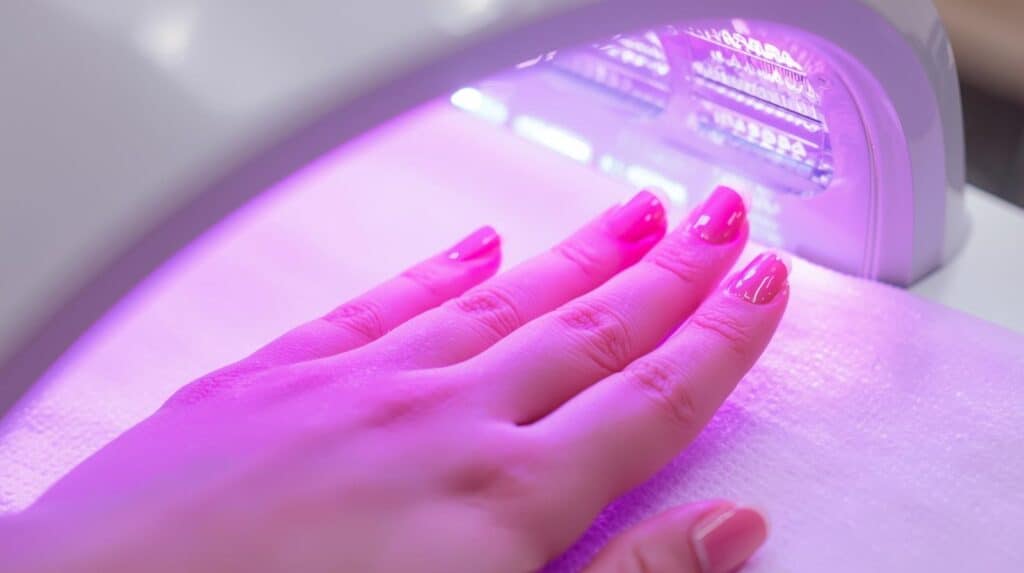
Light-cured gel needs the lamp and full curing schedule specified for it. Ordinary air-drying nail polish is a different product. A bottle’s “gel effect” description does not necessarily mean it needs a curing lamp; read its directions.
The British Association of Dermatologists advises users of home artificial-nail products to follow the instructions, use the recommended lamp and avoid skin contact with uncured product. It warns that insufficient curing can increase the risk of developing an allergy.
What wattage is best for gel nail lamps?
There is no useful universal minimum wattage to shop by. A power label does not establish the light output reaching each nail or compatibility with your gel. Do not replace the required lamp with a higher-rated one or shorten a curing cycle just because the seller promises speed.
The CTPA’s artificial-nail guidance explains that different gel brands may require specific lamps, and that a nail’s appearance cannot confirm a complete cure. Its advice is to use the appropriate lamp for the required time and follow the product manufacturer’s instructions.
How to choose a gel nail lamp
Write down the exact gel names before you shop. Ask the gel manufacturer which lamp supports them, how to position your hand and which cycle each layer needs. If that answer is missing, resolve it before comparing extras or buying a larger kit.
UV or LED?
LED describes a light source. It does not establish that a nail lamp is UV-free. SUNUV’s own SUN2C specifications list 365 nm and 405 nm alongside conflicting “non-ultraviolet” marketing language. We do not adopt that skin-safety claim or its promise of compatibility with every gel.
Use the lamp your gel system specifies. A fluorescent UV lamp and an LED lamp are not automatically interchangeable, and a household flashlight is not a substitute for either.
Bulbs, cleaning and support
If a lamp uses replaceable tubes, check that the correct replacements are available and follow its maintenance schedule. For an integrated-LED model, check servicing and warranty support. An advertised LED lifespan is not a guarantee that the power supply, controls or whole lamp will last as long.
Get the operating and cleaning instructions before buying. Confirm who supplies the warranty and whether the seller’s return terms apply to your order. Unplug before cleaning as directed; do not put water or cleaning spray into electrical components.
Size, power and portability
Look at the working space as well as the outside dimensions. You need to position your nails as instructed, including the thumbs. Long extensions and pedicures may need a different arrangement from short fingernails.
USB-powered, rechargeable and cordless mean different things. Check the input requirements and what is supplied in the box. A lamp connected to a power bank is not necessarily rechargeable itself.
Compare the original nail-lamp listings
These rows describe the original links in this guide. An available offer is not a gel-compatibility guarantee. Once your gel brand confirms the model, compare the selected seller and package before ordering.
On a small screen, scroll sideways to read all three columns.
| Model / original link | What the current listing shows | Buying-link status |
|---|---|---|
| Gelish Harmony 5-45 | Original ASIN now titled a different MINI light | Unavailable; original buying pitch retired |
| SUNUV SUN2C | Hand rest, removable base and automatic sensor; documentation conflicts need checking | Check the current Amazon listing |
| JEWHITENY | Listed 54W, sensor and LCD display; LED-count and timer descriptions conflict | Check the current Amazon listing |
| Winjoy | Original lamp listing remains identifiable | Unavailable at the check |
| JODSONE | Original link redirects to a rechargeable pink three-timer lamp under a new ASIN | Changed model; replacement purchase link not selected |
| Janolia | Original plated-green 86W listing remains identifiable | Unavailable at the check |
| Kepma mini | Listed 6W USB-powered lamp; 60/180-second timers; not rechargeable | Check the current Amazon listing |
| LKE | Original ASIN now titled a 220W pink four-timer lamp | Unavailable; old 48W description does not identify it |
Gelish Harmony 5-45: the old link no longer identifies it
The original Amazon ASIN now has the title “Gelish MINI Portable & Rechargeable USB Touch LED Light for Soft Gel Tips,” and it was unavailable at this check. That is not evidence that you can order the Harmony 5-45 described in the older comparison. We have removed that buying link and the unavailable Garden Teal Party polish link.
Gelish’s own lamp comparison distinguishes full-hand lamps from a focused MINI light used for flash curing. Do not treat a compact light, flash-cure step or another model’s timer as a complete curing schedule for your gel. Check the exact current system with Gelish.
SUNUV SUN2C: hand rest and removable base
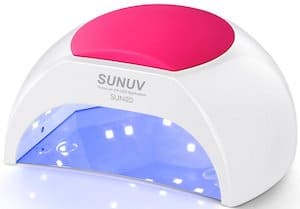
The original rose SUN2C listing showed an available offer. Its automatic hand sensor, removable mirrored base and hand rest are useful features to compare once your gel brand confirms the model.
The manufacturer’s page is inconsistent about the low-heat timer, giving 90 seconds in one section and 99 seconds in another. It also gives conflicting warranty and return descriptions. Confirm the manual and the terms for your actual seller; do not choose a curing cycle from whichever webpage figure looks convenient.
Check the current Amazon listing.
JEWHITENY: display and conflicting timer details
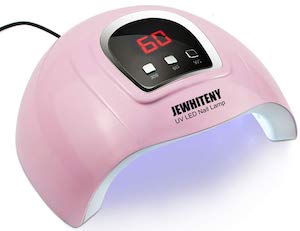
The original listing showed an available offer and names a 54W lamp with an automatic sensor and LCD display. Its feature bullets give 18 light beads and 30-, 60- and 90-second timers, but the product description also gives 24 beads and a different four-timer set. Confirm the manual for the exact version before relying on those figures. Neither the power label nor a shorter timer proves cure quality.
The listing’s broad gel-compatibility and sunlight comparisons do not establish suitability for your products. Get a compatibility answer from the gel manufacturer before buying, then follow its supported curing schedule.
Check the current Amazon listing.
Winjoy: original offer unavailable
The original Winjoy listing was unavailable. Its display, sensor and timer descriptions remain historical comparison details, rather than a current buying recommendation. We have removed its purchase links instead of substituting a different high-wattage lamp without checking it.
JODSONE: redirected to a different ASIN
The original JODSONE link redirected to a pink rechargeable lamp under ASIN B0FNC6KYGY. That page describes three timers, an LCD display, 18 light beads and a built-in 2,600 mAh battery. It is not the earlier two-hand 120W model in the old table.
We have not selected a replacement purchase link. A new model needs its own manual, power supply, gel-compatibility and seller checks. Brand name alone cannot carry over the specifications of the old lamp.
Janolia: original offer unavailable
The original plated-green Janolia 86W listing was unavailable. We have removed its buying links. A claimed bulb lifespan, broad gel list or temperature-protection feature does not establish that another Janolia variant will fit your gel system.
Kepma mini: compact USB-powered design
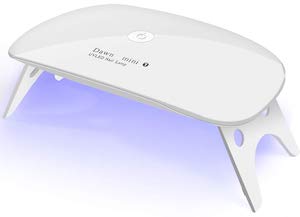
The original Kepma listing showed an available offer. It specifies a 6W lamp, 60- and 180-second timers and dimensions of about 5.12 inches wide by 3.54 inches deep by 0.79 inches high. It is USB-powered and is explicitly not rechargeable.
The listed power requirement is a standard 5V/1A USB supply with the original cable; the seller advises against fast-charging adapters and cables. Check what the package includes. Its small size and wavelength claims still need to match the gel manufacturer’s instructions and nail placement.
Check the current Amazon listing.
LKE: old specifications no longer match
The original LKE ASIN now names a pink 220W, four-timer lamp and was unavailable at this check. The earlier table’s 48W, three-timer description should not be used to identify that offer. Its buying links have been removed; we have not guessed a replacement model.
Avoid common gel-curing mistakes
Follow the gel’s directions for coat thickness, hand placement and the full cycle for every layer. Keep uncured product away from skin, and deal with any contact as the product instructions direct before curing. The FDA’s nail-product guidance emphasizes reading labels and warnings and avoiding skin contact with ingredients that can cause sensitization.
Do not improvise a thicker coat, mix unrelated systems or use touch alone to judge the cure. A timer tells you how long the lamp ran; it does not test the gel. If the product remains soft, wrinkles or moves, stop and ask the gel supplier how to correct the application rather than covering it with another coat.
If curing feels painfully hot, remove your hand instead of enduring it. Ask the supplier or a trained nail professional how to correct the application and complete the supported cure. Stop using the products and seek medical advice if a reaction or persistent nail problem develops.
Related questions
Is a UV or LED lamp better?
Choose the exact lamp your gel manufacturer specifies. The light-source label, color of the light and advertised power are not a general quality or safety ranking.
The American Academy of Dermatology recommends broad-spectrum, water-resistant SPF 30 or higher on the hands before gel manicures, or dark opaque gloves with the fingertips cut off. It also advises considering ordinary polish if gel manicures cause recurring nail problems and seeing a dermatologist for persistent concerns.
Use the prescribed curing time without shortening it or adding unnecessary cycles. The FDA’s UV guidance notes that some medicines can increase light sensitivity. If a condition or medication affects yours, ask your clinician before using a curing lamp. Ordinary air-drying polish is an option if you want to avoid lamp use.
Can I use a regular LED flashlight to cure gel nails?
A household flashlight is not the lamp specified for your gel. Its appearance does not validate the required output, coverage or curing schedule. Use the recommended nail lamp instead of experimenting with other lights. Our guide to ordinary polish and LED lamps explains the different products.
Related articles
For related nail questions, read why polygel nails keep popping off. You can also find makeup ideas for a silver dress and makeup colors for olive skin tones.