
Polygel Nails Keep Popping Off? – Here’s What To Do
Polygel is a relatively modern nail enhancement system that combines the sculptability of acrylic-style products with a gel-like curing process.
Application technique can vary by brand and system, so it is important to follow the instructions for the specific polygel, base coat, primer, slip solution, and lamp you are using.
However, many people choose to buy a starter polygel set and try it themselves.
But if you’re doing things on your own and don’t have professional training, mistakes can happen.
And sometimes those polygel nails can even pop off. What a disaster!
If your polygel nails keep popping off, what can you do?
If your polygel nails keep popping off, the most common causes are poor surface prep, product touching the skin or cuticle, an incorrect dual-form fit, too much slip solution, trapped air, or incomplete curing. Lightly remove surface shine instead of aggressively thinning the natural nail, and follow the curing time and lamp requirements for your specific system.
In today’s article, we’ll talk about polygel nails and share a few maintenance tips to help keep them from popping off!
Why Do My PolyGel Nails Keep Popping Off?
Properly applied polygel should stay bonded until it is intentionally removed or grows out, rather than popping off as a complete piece.
However, if you experience this issue, it may be because you or your technician missed a crucial step in nail prep!
If your polygel is lifting from the cuticle area, common causes include oil or moisture on the nail plate, product touching the skin, flooding the cuticle, insufficient prep, or a base layer that is incompatible with the system.
Make sure your nails are free of water and oil.
If lifting starts at the free edge, check the nail’s flexibility, product thickness, apex and structure, whether the edge was fully capped, and whether the enhancement is being used as a tool during everyday tasks.
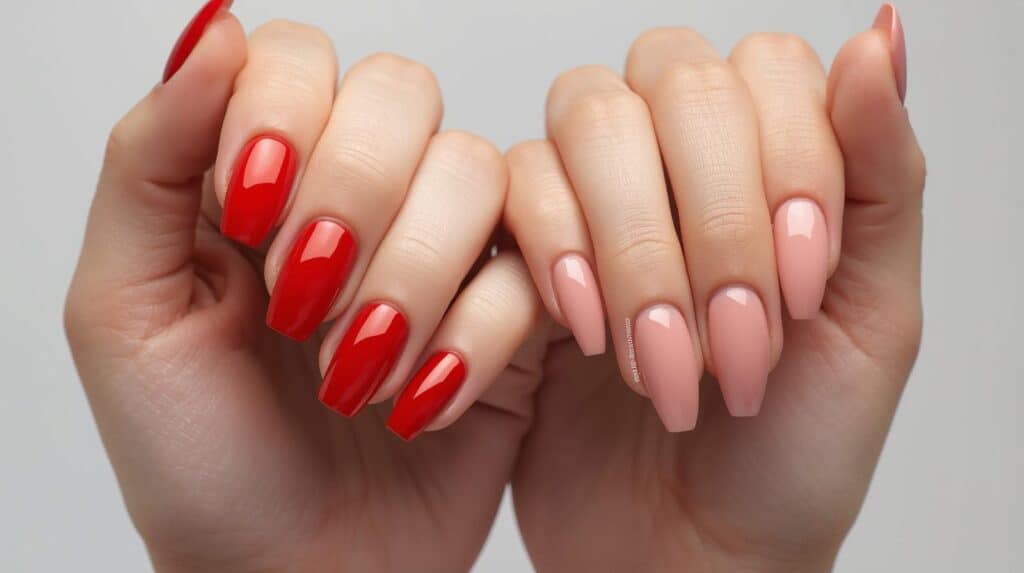
If a professional set repeatedly lifts or pops off, show the technician where the lifting begins. That pattern can help identify whether the problem is prep, structure, product compatibility, curing, or nail condition.
How Do I Stop My PolyGel From Falling Off?
You can stop your poly gel from falling off by prepping your nails.
When people do their nails at home, they often forget about nail prep, but it’s super important.
Make sure your nails are clean, dry, and free of surface oil. Then gently remove the natural shine with the appropriate grit recommended for your system. The goal is a uniformly matte surface, not a deeply scratched or thinned nail plate.
This will help the gel adhere to the nail bed better and last longer.
If your polygel nails keep popping off, check whether your system calls for a dehydrator, primer, base gel, or a combination of these. Do not add extra products at random because incompatible layers can reduce adhesion.
If you’re doing your polygel nails at home, cleanse and prepare the nail plate according to the brand directions before applying any bonding products.
You want the nail plate to be evenly prepped with the surface shine removed, but avoid aggressive filing. Over-buffing can thin and weaken the natural nail without improving adhesion.
Select a dual form that fits from sidewall to sidewall without pinching or leaving gaps. If you are between sizes, a slightly larger form can be refined to fit more accurately.
Refine the form carefully so it sits flush at the sidewalls and cuticle area without forcing it onto the nail.
When shaping the gel on the dual forms, don’t use too much slip solution.
Too much slip solution can interfere with control and, depending on the system, may contribute to adhesion problems if excess liquid remains. Also make sure there are no large air pockets between the product and the natural nail.
Apply enough product to create proper structure without making the enhancement unnecessarily thick, then cure for the exact time recommended by the polygel manufacturer.
Some systems may require you to cure from more than one angle, especially with dual forms or thicker enhancements. However, do not simply cure longer than the instructions. Use the compatible lamp and follow the manufacturer’s stated cure time so the product polymerizes correctly.
Where Is The Polygel Lifting?
The location of the lift can help you troubleshoot the cause. If the entire enhancement pops off cleanly, adhesion or curing is often the first thing to investigate.
- Cuticle lifting: Check for product touching the skin, flooded cuticles, remaining surface oil, incomplete prep, or overly thick product near the cuticle.
- Sidewall lifting: Check the dual-form fit, sidewall prep, product coverage, and whether the enhancement is too narrow for the natural nail.
- Free-edge lifting: Check structure, capping, nail flexibility, length, and whether repeated impact or water exposure is stressing the edge.
- Whole nail pops off: Revisit cleansing, dehydrator or primer use, base compatibility, slip-solution residue, air pockets, and lamp compatibility.
Do not glue a lifted enhancement back down over trapped moisture. Remove or repair the lifted product properly so water and debris are not sealed underneath.
How Should PolyGels Be Applied?
The basic steps are straightforward, but consistent results depend on careful prep, product control, structure, and complete curing. Here’s a summary of what to expect during a salon appointment or an at-home application.
1. Prep the nail.
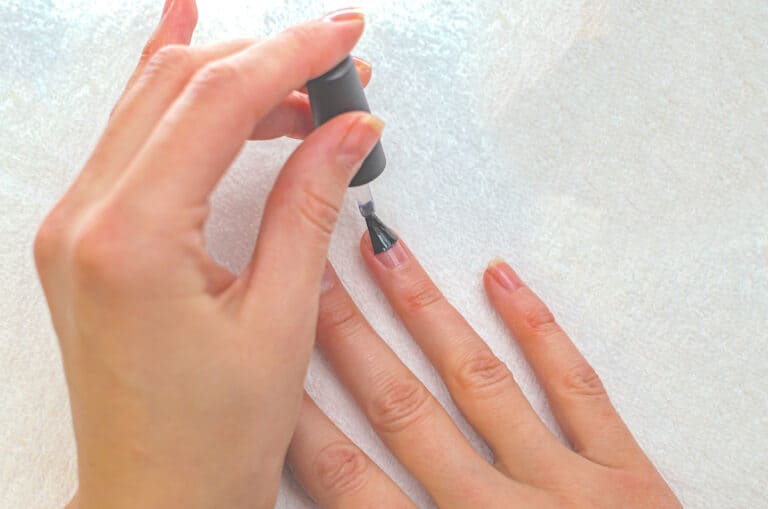
Nail prep is super important. Your nail technician will prepare your nails by removing all polish, dirt, and oil.
Then they will gently remove the surface shine without aggressively filing into the natural nail.
If you’re doing this at home, you’ll want to approximate this process with your own materials.
2. Apply the Polygel.
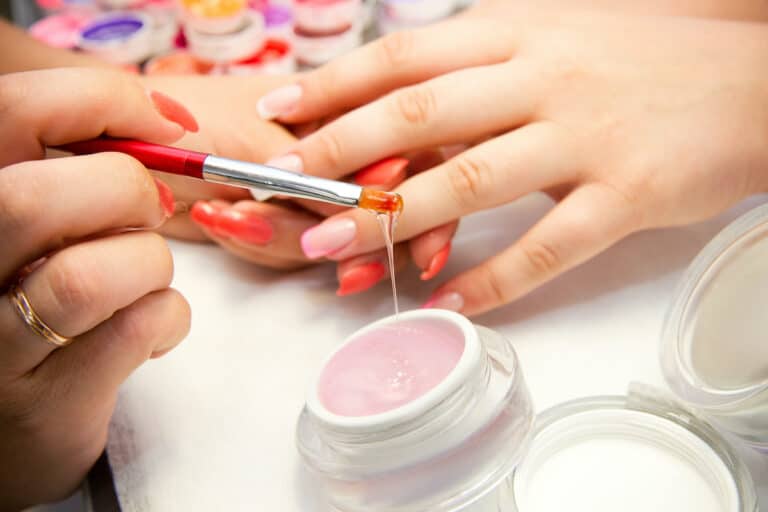
The second step involves applying the poly gel formula to your natural nails using a precise, small brush.
The poly gel will be used in the middle of your nail, starting with a small ball.
3. Smooth the product.
Using a brush moistened with a solution formulated explicitly for poly gel.
They will smooth the formula out so it covers your whole nail and shape it as desired (for coffin- or almond-shaped nails).
4. Cure under UV or LED lamp.
The next step is to cure the nail. Cure time varies by brand, product thickness, lamp output, and whether the system uses UV, LED, or a dual-cure lamp, so follow the manufacturer’s instructions rather than assuming every polygel cures in 30 seconds.
It depends on the shape you’re trying to accomplish, whether your nail technician will repeat the previous steps to add another detail to your nail, like a white point.
5. File and shape.
Polygel is different from other techniques.
Polygel is generally easy to refine with a hand file, although some technicians may also use an electric file carefully for shaping or removal.
A regular hand file will work just fine.
It will smooth out any uneven areas or bumps and help form the shape you prefer.
If you’re not sure what shape to choose, research and find your favourite!
6. Applying the finish.
Whether you like a matte or shiny finish, your nail technician may apply a compatible top coat to protect the color and create your preferred finish.
7. Cure the nail again.
Once again, your nail will go under a UV or LED lamp to cure.
Whether a sticky inhibition layer remains after curing depends on the specific polygel and top coat. Some products are no-wipe, while others need to be cleansed after curing.
8. Apply cuticle oil.
After the enhancement is finished, you can moisturise your cuticles and surrounding skin with a cuticle oil or lotion. One option is this apricot-scented cuticle oil.
This top-notch oil absorbs quickly and leaves your cuticles beautiful and soft.
You can also check out this excellent video tutorial from The Beauty Vault if you need another play-by-play! Plus, as a fun bonus, you get some great styling tips.
Polygel Safety Tips
Keep uncured polygel, base gel, and top coat off the skin as much as possible. Repeated skin exposure to uncured acrylate-based nail products can increase the risk of irritation or allergic contact dermatitis.
Use the lamp recommended for the system and cure for the stated time. Product that looks hard on the surface can still be incompletely cured underneath if the layer is too thick or the lamp is not compatible.
If you develop persistent itching, swelling, redness, blistering, or a rash around the nails or fingertips, remove the product safely and seek medical advice rather than repeatedly reapplying it.
How Long Do PolyGels Last?
Polygel has practically taken over the nail care industry, it seems.
A well-applied polygel manicure can often last around two to three weeks, although wear time varies with nail growth, prep, structure, lifestyle, and the products used.
Polygel systems are often described as having less noticeable odor than traditional acrylic liquid-and-powder systems, although the exact scent varies by product.
A finished polygel manicure should not be chosen for fragrance. Product odor is mainly a formula characteristic rather than a manicure benefit.
Is PolyGel Bad for Your Nails?
Polygel itself is not automatically damaging, but poor prep, over-filing, improper curing, picking, peeling, and aggressive removal can damage the natural nail.
When applied and removed carefully, polygel can be worn without unnecessary damage to the natural nail.
It may also have a less intense odor than some acrylic systems, although this varies by brand and should not be confused with being safer or gentler.
The biggest nail-health risks usually come from over-filing, product allergies, incomplete curing, lifting that traps moisture, and forceful removal, so technique matters.
The removal process can be straightforward when done patiently, but filing too deeply or peeling the product off can thin and damage the natural nail.
Your nail technician will file the product off your nails to remove the bulk of it.
Whether the remaining product can be soaked off with acetone depends on the specific polygel system. Some are primarily file-off products, so follow the brand’s removal instructions instead of assuming every formula will dissolve.
The Pros and Cons of PolyGel Nails
Polygel is a new trend in the beauty industry. And for a good reason.
It can be durable and versatile, and many people find the workable putty-like texture easier to control than runnier builder gels.
Polygel is often marketed as combining qualities associated with both gel and acrylic enhancement systems, but it still has its own learning curve, allergy risks, curing requirements, and removal considerations.
In fact, polygel is also known as ‘the love child of gel and acrylic’.
It’s applied over your natural nails and cured under a UV or LED light.
The removal process can be simple with the right technique, but any enhancement system can damage the natural nail if it is over-filed, picked, peeled, or removed incorrectly.
It is not completely risk-free. Skin contact with uncured gel products can contribute to irritation or acrylate allergy, and under-cured material should not be left on the nail.
The poly gel is buffed off. However, the leftovers are often soaked off, if necessary.
This formula comes in a wide array of colours, but you can also apply the poly gel over the surface if you prefer something different.
With good prep, structure, curing, and aftercare, many polygel sets last roughly two to three weeks before growth or lifting makes maintenance necessary.
Polygel can be more expensive than some acrylic or gel services, depending on the salon, location, and complexity of the set.
Its odor may be less intense than traditional acrylic monomer, which some people prefer, although fragrance sensitivity can still vary by product.
Pros:
- Many systems have less noticeable odor than traditional acrylic liquid-and-powder products.
- Polygel cures on demand under a compatible UV or LED lamp, following the manufacturer’s stated cure time.
- Many polygel systems can be reduced and removed by careful filing, although removal instructions vary by brand.
- When structured correctly, they can feel relatively lightweight and comfortable.
- Properly applied polygel can provide strong, long-lasting enhancements.
Cons:
- Some users may feel a heat spike during curing, particularly with thicker product layers or certain lamps and formulas.
- It takes some time to learn and perfect polygel nail application.
Are PolyGel Nails Worth It?
Whether a polygel manicure is worth the price depends on the look you want, your budget, how well the system works with your nails, and whether you prefer its application and wear compared with acrylic or builder gel.
Many systems have a less intense odor than traditional acrylic, and a well-applied set may last around two to three weeks.
If you tend to pick or bite your nails, an enhancement may create a physical barrier, but it will not address the underlying habit and should not be used over damaged or infected skin.
Polygel nails cure under a compatible UV or LED lamp, but the required time is brand- and lamp-specific. Follow the manufacturer’s directions instead of assuming a universal 30-second cure.
They’re super light and comfortable to wear.
With careful application and removal, you can minimize unnecessary damage to the natural nail.
Removal usually involves careful filing and, for compatible formulas, possibly soaking. Stop before filing into the natural nail and follow the specific brand’s removal method.
Final Words
If your polygel nails keep popping off, look first at prep, product placement, dual-form fit, structure, curing, and product compatibility.
Nail prep is key to long-lasting, durable poly gel nails.
Make sure your nails are clean and dry, gently remove the surface shine, keep product off the skin and cuticle, and use only the dehydrator, primer, base, and curing steps recommended for your system.
This will help the poly gel adhere to the nail better.
Polygel Lifting FAQs
Why Does My Polygel Pop Off In One Piece?
When the entire enhancement releases cleanly, the bond between the product system and the natural nail likely failed. Check prep, base or primer compatibility, slip-solution residue, air pockets, product touching the skin, and whether the lamp is curing the system correctly.
Can Too Much Slip Solution Make Polygel Lift?
Using more slip solution than necessary can make the product harder to control and may leave excess liquid where you do not want it. Use only enough to keep the brush from sticking and follow the directions for the specific system.
Should You Cure Polygel Longer If It Keeps Popping Off?
Not automatically. If curing is the problem, the better fix is to confirm the correct lamp, product thickness, and manufacturer-recommended cure time. Simply adding extra time does not solve every compatibility or adhesion problem.
Can You Glue A Lifted Polygel Nail Back Down?
It is better to remove or properly repair the lifted area. Gluing down a pocket that contains moisture or debris can trap it against the natural nail and hide a worsening lift.
Related Articles
Can Normal Nail Polish Dry Under LED Light?
Can You Use Purple Shampoo On Green Hair?
What Will Happen If You Put Red Dye Over Green Hair?