
How To Get A V Shape Face
Your face shape reflects a combination of bone structure, muscle, fat distribution, and skin. Genetics plays a large part in those proportions.
If you enjoy experimenting with your look, makeup and hairstyle changes can make the lower face appear more tapered without changing its anatomy.
Beauty trends vary across cultures and over time. No single face shape is a measure of attractiveness or health.
A V-shaped face usually describes a face that looks wider at the cheekbones and narrows towards the chin.
It is one aesthetic preference, rather than a sign that someone is younger or healthier.
Round faces, broad jaws, and less pointed chins are all normal variations in facial structure.
You do not need to change yours, but you can explore a different visual effect if that is what you like.
The useful question is which methods change appearance temporarily and which can actually alter structure.
Contouring creates shadows, and a haircut changes the outline around your face. Massage may make temporary puffiness less noticeable for some people, but it cannot narrow jawbones.
Facial exercises, creams, and chin straps cannot reliably turn every face into a V shape or selectively remove facial fat.
So, how do you get a V-shape face?
For a temporary V-shaped effect, start with subtle contouring and face-framing hair. Gentle massage may help some puffiness, but it does not permanently slim the jaw. Structural changes require an individual medical assessment, and cosmetic procedures have risks and limits.
Below, we explain the realistic uses of each option, from everyday styling to the questions to ask before considering a treatment.
Facial Massage
Facial massage can be a relaxing part of a routine, but it is not a proven way to permanently reshape the face.
Some people notice a temporary change in puffiness. Others see little difference, and lighting or pressure marks can make before-and-after photos misleading.
Repeating massage does not establish that any slimming effect becomes permanent. It does not remove fat or change bone structure.
Gentle lymphatic massage is intended to encourage fluid movement. Medical lymphatic drainage for diagnosed swelling is different from a cosmetic routine.
Fluid retention can contribute to puffiness, but it is not the explanation for every full cheek, broad jaw, or area of loose skin.
Any change linked to fluid movement should be understood as temporary, not a face lift.
You do not need cosmetic facial massage to keep a normally functioning immune or lymphatic system working.
Do not rely on facial massage to prevent migraines or temporomandibular joint problems. Recurring headaches or jaw pain deserve appropriate assessment.
If you enjoy it, keep the pressure light and stop if your skin becomes sore, irritated, or bruised.
The tutorial below demonstrates a cosmetic massage routine. Its title and lifting claims should not be treated as evidence of permanent results.
Ask your treating clinician before massaging an area with recent injections, surgery, unexplained swelling, or an active skin problem.
For a simple home routine, comfort and gentle handling matter more than trying to force fluid along a particular route.
Gua Sha
Gua sha has roots in traditional Chinese medicine. Modern facial routines generally use much lighter pressure than traditional body scraping.
A gua sha massager may be made from stone or metal. Choose a smooth, undamaged tool that you can clean easily; the material does not prove a reshaping benefit.
Traditional explanations refer to the movement of qi. That cultural context is distinct from evidence for modern cosmetic claims.
Cleveland Clinic notes that research does not establish facial depuffing claims, although gentle massage may help fluid movement and relaxation.
Gua sha should not be expected to permanently slim your cheeks, reduce a double chin, or create a sharper jawbone.
A comfortable massage may feel soothing. Pain or bruising is not a sign that a facial treatment is working better.
If you try it, use clean hands and a clean tool on intact skin. Apply a small amount of a product that gives enough slip to avoid dragging.
Use a moisturiser or oil you already tolerate. Stop if it causes stinging, itching, or redness.
Keep the tool nearly flat and use very light pressure. Avoid pressing firmly on the front or sides of your neck.
A short, gentle glide over the jaw area is enough for a cosmetic massage; there is no established number of strokes that produces a V shape.
Avoid scraping over inflamed spots, broken skin, sunburn, or areas that bruise easily.
Keep the tool away from your eyeballs and avoid pressure on the delicate eyelids.
The video below shows the tool in use. Follow gentle technique rather than copying any pressure or routine that feels uncomfortable.
Clean the tool according to its care instructions after use, and do not share it without appropriate cleaning.
If you take blood-thinning medication or have a bleeding disorder, check with your clinician before trying scraping or massage techniques.
Treat gua sha as optional self-care. Daily use is not necessary, and more frequent massage does not guarantee a narrower face.
Face Yoga
Face yoga is a broad term for repeated facial movements, expressions, and sometimes massage.
Routines aim to exercise facial muscles, but claims of a non-surgical face lift go beyond what the evidence establishes.
There is not strong evidence that face yoga reliably narrows the lower face into a V shape.
You do not need to combine it with gua sha or buy equipment to maintain normal facial muscle function.
The video below is an example of a face-yoga routine. The “lower face lift” description in its title should be viewed as a claim, not a guaranteed outcome.
A small 2018 pilot study reported fuller cheeks after a facial-exercise programme. Only 16 participants completed it, and there was no control group.
That study does not show that facial exercise reduces fat, narrows a jaw, or produces permanent results.
Fuller cheek muscles would also be a different outcome from changing the width or shape of the cheekbones themselves.
Avoid forceful jaw clenching or resistance exercises if they provoke clicking, pain, or headaches. Ask a clinician about persistent symptoms.
Facial movement cannot selectively burn away fat from the cheeks or chin.
If you enjoy gentle movements, keep expectations modest. They are not a substitute for assessment of swelling or a medical treatment for loose skin.
Devices
Home facial devices use different technologies, so it is worth identifying exactly what a product does before buying it.
A vibrating massager, a microcurrent device, and a radiofrequency device are not interchangeable. Radiofrequency devices heat tissue; they are not simply automated gua sha tools.
The products below are examples from this article, not a guarantee of V-shaped results. The TriPollar STOP X ROSE manufacturer page identifies it as a radiofrequency device. Check the exact technology and instructions for any model:
Results and risks depend on the specific device. Follow its permitted treatment areas, contact medium, timing, and contraindications; excess heat or incorrect use can injure skin.
Before spending money, look for evidence on that exact model and consider ongoing costs. Ask a clinician first if you have an implanted electronic device, a relevant medical condition, or recent facial treatment. There is no basis for assuming every device gives the same results as massage.
Makeup
Makeup offers an immediate, reversible way to create a more tapered-looking outline. The effect lasts until you remove it.
Contouring uses light and shadow to influence how facial features appear, especially from the front.
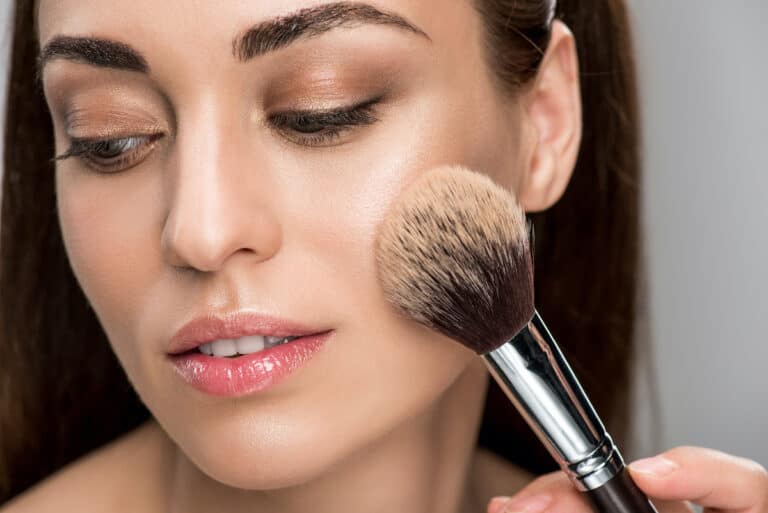
A matte contour product, a little concealer, blush, and an optional highlighter are enough to experiment. You do not need to contour every feature.

A contouring kit can be convenient, but check that its shades suit your depth and undertone. You can also use suitable products you already own.
Start with a contour shade slightly deeper than your skin that resembles a natural shadow. Build thin layers instead of drawing a dark stripe.
For a more tapered lower-face effect, lightly shade the outer corners of the jaw where you want less emphasis.
Blend the edges into the surrounding skin and slightly beneath the jaw so the colour does not stop abruptly at the neck.
Keep the cheekbone area softly defined. A small amount of concealer or highlighter on the upper cheek can bring attention there without creating a stark pale patch.
Place blush a little higher on the cheeks and blend towards the temples if you like a lifted-looking finish. Adjust the placement to your own features.
A small touch of light at the centre of the chin may emphasise it, but skip this if it makes the chin look more prominent than you want.
Check the result in daylight and from the side. A shadow that works in a photograph can look obvious in person if it is too dark.
Nose contour is optional and does not need to be part of a V-shaped makeup look.
If you want to try it, use a small brush and a much lighter hand than you would on the jaw.
Blend a little shadow along the sides and a narrow highlight on the bridge, checking that neither forms a visible stripe.
The tutorial below demonstrates a V-line makeup approach. Adapt the placement to your face instead of copying every line exactly.
Start with one change at a time. Often, softer jaw shading and adjusted blush placement are enough to create the effect you want.
Hairstyle
Hair changes the frame around your face, so layers, parting, and volume can alter the apparent balance between cheeks and jaw.
If you want emphasis near the cheekbones, consider curtain bangs or longer front pieces that curve away from the face.
Curtain bangs do not have one fixed length. A stylist can place the shortest pieces according to your hair texture and where you want the frame to sit.
Styling them outward near the cheeks can create width at that level without changing your underlying facial structure.
Try pinning or styling the front sections first if you want to preview the effect before cutting.
For a softer outline around the jaw, longer face-framing layers are another option.
Discuss where the layers will fall when dry. Ends that flare out exactly at the jaw can emphasise width, while longer pieces create a different frame.
When wearing your hair up, leave a few loose front pieces if you like the effect. They should feel comfortable rather than pull at the hairline.
Skincare
Skincare can improve hydration and surface texture, but it cannot narrow your jawbone or selectively remove facial fat.
Masks and creams are best judged by how they make your skin feel and look, rather than promises of a new face shape.
V-Line Masks
V-line lifting masks usually fit around the chin and jaw, sometimes with loops behind the ears.
Ingredients vary. A hydrating formula may temporarily make the skin feel smoother, but collagen or caffeine on the label does not establish a jaw-slimming effect.
There is no dependable basis for promising a particular number of hours of visible lifting from every mask.
A mask cannot remove a double chin, reposition bone, or permanently tighten loose skin.
Make sure the fit is comfortable. Tightness, ear pain, numbness, or skin irritation are reasons to remove it.
Follow the specific wear time and do not sleep in a mask unless it is explicitly intended for that use. Longer wear is not proof of better results.
Tightening Creams
Moisturiser can reduce the appearance of dryness and fine lines. It cannot prevent all age-related changes around the chin and jaw.
The American Academy of Dermatology explains that creams cannot lift sagging skin; an immediate plumping effect from moisturisation is temporary.

A gentle cleanser, suitable moisturiser, and sun protection are a practical starting point for skin care.
Some ingredients, such as retinoids, can improve the appearance of photoaged skin over time, but they are not jaw-reshaping treatments.
Do not assume retinol, caffeine, collagen, glycolic acid, and vitamin C all have the same effect or belong together in one routine.
Introduce active products gradually and stop if they irritate your skin. Ask a clinician about suitability during pregnancy or when managing a skin condition.
Lifestyle
Lifestyle affects general health and sometimes temporary puffiness, but it does not guarantee a particular facial outline.
Consider whether you are seeing your normal facial proportions or a recent change. New or persistent swelling needs a different approach from styling a naturally full face.
Weight Loss
Weight loss is not a necessary step towards enjoying your appearance. A round face or broad jaw does not establish that someone needs to lose weight.
Changes in body weight may affect facial fullness, but the location and amount of change are unpredictable.
You cannot choose where the body loses fat through facial exercise, massage, or a particular food.
If weight management is appropriate for your health, discuss a sustainable plan with a qualified healthcare professional rather than dieting solely to change your jawline.
Regular, adequate meals and enjoyable movement support wellbeing. Avoid crash diets, dehydration, or skipping meals to make your face look temporarily smaller.
Reduced Sodium Intake
A salty meal may contribute to temporary puffiness in some people, but salt is not necessarily the reason for a naturally soft jawline.
Mayo Clinic lists fluid retention after salty meals among contributors to under-eye bags. That does not mean every change in facial shape is fluid retention.
Aim for normal hydration and a balanced diet. Do not force large amounts of water to “flush out” salt or start an extreme low-sodium diet for cosmetic reasons.
Persistent, painful, or one-sided swelling should be assessed. Sudden swelling of the lips or tongue, especially with breathing difficulty, requires emergency help.
Alcohol
Alcohol may affect sleep, hydration, and how puffy you look the next day, but it does not affect everyone’s face in the same way.
If you notice a pattern after drinking, reducing alcohol may help you assess the connection. It should not be presented as a guaranteed face-slimming treatment.
If you drink heavily or are dependent on alcohol, seek medical guidance before stopping suddenly because withdrawal can be dangerous.
Regular sleep and attention to unexplained swelling are more useful than judging your health by whether your chin forms a point.
Final Thoughts
Makeup and hair offer the most direct temporary ways to create a V-shaped visual effect. Massage, masks, and creams have more limited roles and should not be expected to permanently reshape the face.
For structural changes, consult a qualified dermatologist or plastic surgeon about your goals and anatomy. Fillers add volume rather than remove fat and are often temporary. The FDA warns of rare but serious filler complications, including tissue injury and vision loss from injection into a blood vessel.
Surgery can alter structure but involves recovery and risks such as infection, nerve injury, or an unwanted result. It is not a routine next step when skincare does not change your shape. Choose an approach based on realistic expectations and your own preferences.
Related Articles
Can I Wash My Face Three Times A Day?