
How Many Sprays Of Perfume (How Much Is Too Much?)
Figuring out how much perfume to wear sounds simple until you realize that every fragrance projects, lasts, and sprays a little differently.
Body mists are often an easy introduction to fragrance because they tend to be lighter, softer-projecting, and easier to reapply than more concentrated perfumes.
They are usually easy to apply, and their lighter scent often fades sooner, making occasional reapplication practical.
More concentrated fragrances can be a different story. A few sprays may create a noticeable scent trail, while the same spray count from a light mist may remain relatively subtle.
Perfumes can be potent, and heavy application may feel overwhelming or bother people who are sensitive to fragrance. Fragrance can also irritate some skin, so reduce or avoid direct skin application if you notice stinging, redness, or a rash.
So how many sprays of perfume do you need?
There is no single perfect number of sprays. For many perfumes, starting with 1 to 3 sprays is sensible, then adjusting for the fragrance concentration, projection, atomizer output, setting, weather, and your own preference.
The right amount also changes with fragrance concentration, projection, weather, where you are going, and whether you are layering scented body products.
A close-fitting office, classroom, car, or restaurant usually calls for a lighter hand than an outdoor event, while a strong fragrance may need fewer sprays than a soft skin scent.
The goal is for your fragrance to be noticeable at a comfortable distance without dominating a shared room, car, office, or restaurant.
Using a controlled amount also helps you judge the fragrance more accurately and makes an expensive bottle last longer.
How Many Sprays Of Perfume Do You Need?
While it can be tempting to keep spraying your favorite perfume, it is easy to apply more than you realize, especially once your nose becomes accustomed to the scent.
There is no universal spray count because different atomizers release different amounts and fragrances vary widely in projection, concentration, and longevity.
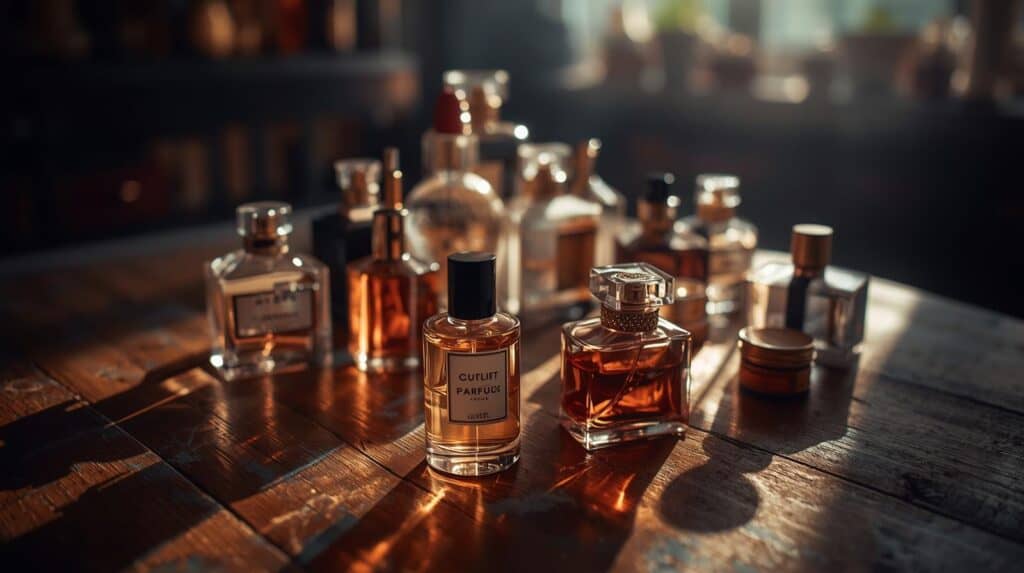
As a starting point, consider the concentration, atomizer output, scent strength, application area, weather, and setting before deciding how many sprays to use.
A practical rule is to start lightly. You can always add another spray later, but removing excess fragrance is much harder once you have applied it.
How To Spray Perfume
The best way to apply perfume is to use a controlled amount in a few deliberate places rather than spraying broadly and guessing.
The concentration of your fragrance is a useful starting point, but the atomizer, projection, setting, and your sensitivity to scent also determine how much perfume to apply.
A few simple application habits can help you control projection and avoid wasting product, regardless of the fragrance style.
It also helps to consider your other body products, such as lotion or body wash, because their scents can mix with your perfume.
Placement matters too because one or two direct sprays are easier to control than a large cloud of fragrance.
Less Is More
When trying a fragrance for the first time, start sparingly. This is especially helpful if you have sensitive skin, are unfamiliar with its projection, or plan to wear it in a shared indoor space.
For a concentrated perfume, begin with one or two sprays. Lighter fragrances may comfortably take more, but increase gradually rather than applying several extra sprays at once.
This approach makes it easier to judge the fragrance after it has settled and reduces the chance of overpowering your surroundings before you know how strongly it projects.
Give the scent a little time before adding more. The opening can be stronger than the dry-down, and your nose can become less aware of a fragrance after continuous exposure.
Avoid Misting
Spraying perfume into the air and walking through it may look elegant, but it is difficult to control how much fragrance actually reaches you.
Much of an airborne mist can land on the floor, clothing, or nearby surfaces instead of evenly on you, which can waste product.
For a more controlled application, spray the fragrance directly onto your skin or, if the formula is suitable, onto clothing from a safe distance.
A direct spray also makes it easier to know exactly how much fragrance you used instead of guessing how much of an airborne mist reached you.
Use Directly On The Skin
If your skin tolerates fragrance, direct skin application gives you better control over placement and lets you experience the scent as it warms.
Applying fragrance to skin allows you to experience how it develops with your body warmth and gives you better control over placement.
Pulse points such as the wrists and sides of the neck are popular application areas because they are easy to reach and naturally warm, but you do not need to cover every pulse point.
Warm skin can help the scent become noticeable as it evaporates. You do not need to spray every pulse point, though. Choosing one or two areas is often enough.
If perfume irritates your skin, stop using it on that area. Spraying clothing can be an alternative for some fragrances, but test an inconspicuous spot first because perfume can stain or mark certain fabrics.
Be Mindful Of Body Care
Your body lotions, creams, and washes can change the overall scent profile when layered with perfume.
Fragrance can also smell somewhat different from person to person as it warms and develops on the skin.
Strongly scented body care can compete with, amplify, or change how your perfume smells.
If you layer several scented products, you may need fewer perfume sprays because the total fragrance load is already higher.
An unscented moisturizer can give fragrance a comfortable base, while a strongly scented lotion may compete with the perfume or make the overall result feel heavier.
Types Of Fragrance
What type of perfume are you applying?
Fragrances vary in concentration, and a higher concentration is one reason you may need fewer sprays. Projection and longevity still vary by formula, so concentration alone does not predict strength perfectly.
Common fragrance concentration labels include Eau de Cologne, Eau de Toilette, Eau de Parfum, and Extrait de Parfum. The exact percentage can vary by brand and formula.
Eau De Cologne
An Eau De Cologne is typically among the lighter fragrance concentration categories.
Many colognes are built around fresh, citrusy, or aromatic notes, although the scent profile ultimately depends on the individual formula.
Their lighter feel can make them appealing in warm weather, but Eau De Cologne can be worn at any time of year.
Eau de Cologne is often described as using a relatively low concentration of aromatic materials, although exact formulas vary by manufacturer. Its lighter character may make additional sprays or later reapplication more comfortable than with a very concentrated scent.
Start with a few light sprays, then judge the actual projection on your skin before adding more.
Eau De Toilette
Eau de Toilette has a higher concentration than Eau de Cologne, but it’s less intense than Eau de Parfum.
It often feels lighter than an Eau de Parfum, making it useful for those who prefer a more subtle application.
Eau de Toilette is generally less concentrated than Eau de Parfum, though brands do not all use fragrance labels in exactly the same way. Its usually lighter character makes it a common choice for everyday wear.
Eau De Parfum
Eau de Parfum is one of the most common concentration labels used for modern spray fragrances.
This has a higher concentration than Eau De Cologne and Eau De Toilette.
It is generally more concentrated than an Eau de Toilette, although some Eau de Parfums are soft and close-wearing while others project strongly.
Eau de Parfum is typically more concentrated than Eau de Toilette, but the exact formula varies by brand. Starting with fewer sprays gives you room to adjust.
For an unfamiliar Eau de Parfum, try 1 to 3 sprays, then see how it develops before deciding whether you need more next time.
Extrait De Parfum
Finally, Extrait De Parfum, also called parfum or perfume extract in some lines, is usually among the most concentrated fragrance formats.
Because formulas vary, an extrait can range from intimate and close to the skin to very rich and noticeable. The label alone does not tell you exactly how far it will project.
With a new extrait, one spray is a sensible starting point. Add a second only if the fragrance wears softly and the setting allows for it.
This category is generally associated with a higher fragrance concentration, although there is no single percentage that every brand follows.
Do You Need To Reapply Perfume?
You can reapply perfume later in the day, but only if the fragrance has genuinely faded and the setting makes another spray appropriate.
It depends on the fragrance, concentration, projection, weather, and how long it lasts on your skin.
For example, a light Eau De Cologne may be reapplied later in the day if the scent has genuinely faded.
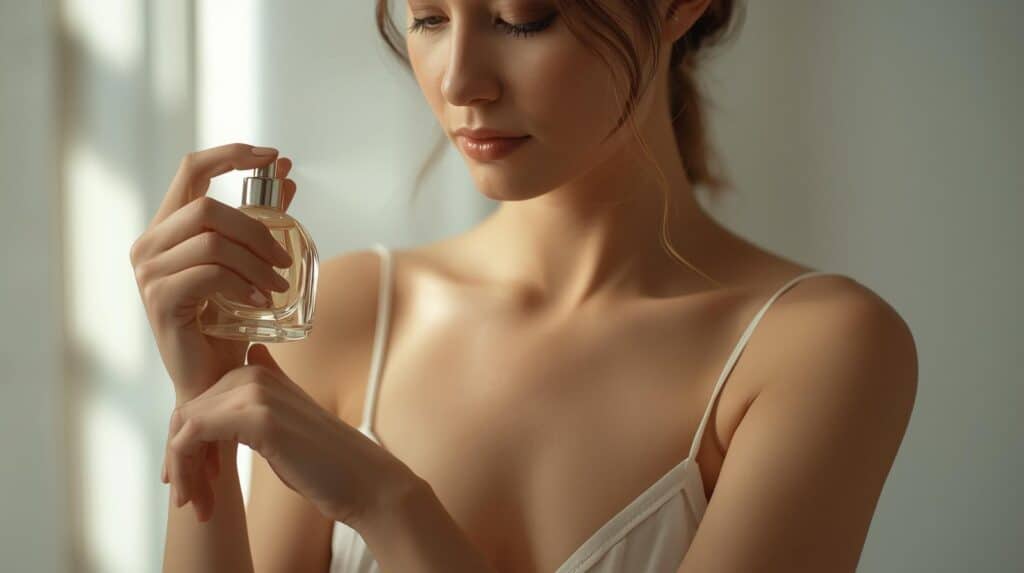
When reapplying, start with one spray and add another only if needed.
This gives you a light refresh without unexpectedly doubling the projection in a shared space.
Before reapplying a strong fragrance, remember that your nose may have become less aware of it. If possible, check the scent on your clothing or ask someone you trust whether it is still noticeable at a normal distance.
Do Notes Affect How Much Perfume You Apply?
The character of a fragrance can influence how strong it feels, but notes alone do not determine a fixed spray count.
Fragrance notes are the individual scent impressions used to describe a perfume, such as bergamot, rose, vanilla, woods, or musk. Some compositions feel airy and transparent, while others feel dense or powerful.
A fragrance built around rich woods, amber, resins, sweet accords, or musks may feel stronger than a sheer citrus or fresh floral, but the finished formula matters more than any single note.
The result can also change depending on the products you layer underneath it and how the fragrance develops on your skin.
Fragrance Notes
Fragrance notes are the scent impressions used to describe how a perfume opens, develops, and dries down.
Descriptions such as sandalwood, orange, rose, vanilla, or musk help communicate the character of a fragrance, but they do not tell you the exact strength of the finished formula.
Perfume descriptions often organize these impressions into three stages: top notes, heart notes, and base notes.
These categories describe how a fragrance is designed to unfold over time, from the first impression to the longer-lasting dry-down.
They can help you understand how a perfume may develop, but the number of sprays you need is better judged by the finished fragrance’s strength and projection.
Top Notes
Top notes are the first scent impressions you notice after spraying. Citrus, aromatic, fruity, and fresh materials are common in this opening stage.
They generally become less prominent sooner than the heart and base of the fragrance.
As the opening settles, the heart and base notes become easier to notice and shape the fragrance’s dry-down.
Middle/Heart Notes
Next are the middle notes, also called the heart notes.
The heart forms the central character of the fragrance after the opening begins to fade.
Heart notes are often floral, fruity, spicy, or aromatic, depending on the composition.
Middle notes generally remain noticeable longer than the first top-note impression and help connect the opening to the deeper base.
Base Notes
Finally, base notes are associated with the later dry-down and often include materials that remain noticeable after the brighter opening has faded.
Common base-note descriptions include vanilla, musk, woods, amber, and sandalwood.
These deeper notes often give the fragrance its warm, woody, sweet, or musky foundation.
How Do Notes Affect Staying Power?
The note structure can influence how a perfume develops, but staying power depends on the entire formula rather than one note category.
A light Eau De Cologne or Eau De Toilette may fade sooner than a richer fragrance, but longevity depends on the whole formula, not simply whether the perfume contains floral or fruity notes.
An Eau De Parfum or Extrait De Parfum with a persistent woody, amber, sweet, or musky dry-down may remain noticeable for longer, so it can be smart to begin with fewer sprays.
How To Make Perfume Last
What are some ways to get the most out of your perfume?
You may find that a light Eau De Cologne or Eau De Toilette needs refreshing sooner than a long-lasting Eau De Parfum.
A few application habits can also help you get more from each wear without automatically increasing the spray count.
Applying perfume in a few intentional spots and carefully layering your body products can help you get more from each application without spraying a cloud.
Spray On Pulse Points
Pulse points are convenient places to apply perfume, although one or two areas are usually enough for a first wear.
Warm areas of skin can help the fragrance evaporate and become noticeable, so a controlled spray on one or two areas may be enough.
Common areas include the wrists, sides of the neck, collarbone, and inner elbows. Avoid spraying close to the eyes or onto irritated or freshly shaved skin.
One or two sprays are a useful starting point for an unfamiliar concentrated fragrance. You can adjust on future wears once you know its projection and longevity.
Avoid Rubbing
You do not need to rub perfume into the skin after spraying it.
Rubbing your wrists together is a familiar habit, but it is not necessary to make perfume last longer.
Instead, spray the fragrance where you want it and allow the liquid to dry naturally on the skin.
This avoids unnecessary friction and lets you experience the fragrance as it settles. There is no need to massage perfume into the skin.
Carefully Layer
For consistent results, apply perfume to clean skin. If your skin feels dry, an unscented moisturizer can provide a comfortable base before fragrance.
However, please be aware of your body products, as scented ones can alter your perfume experience.
So, you can shower and moisturize your body with an unscented lotion or a cream that matches the scent of your perfume.
This can help the scent sit well alongside your body care without forcing you to compensate with additional sprays.
Alternatives To Spray Perfumes
You can still wear perfume without a traditional spray bottle. Rollerballs and solids make it easier to control placement if you tend to overspray or prefer a quieter scent profile.
If spray counts feel inconsistent, a non-spray format lets you judge fragrance by the amount you apply directly to the skin.
Some alternatives to traditional perfume bottles are rollerballs and solid perfume.
Both give you more control over placement and can be convenient when you want a quieter, close-to-the-skin application.
Rollerball
Rollerballs are packaged in a thin glass tube with a ball at the end that glides easily onto the skin.
This lets you apply a small amount exactly where you want it without using a spray bottle. Rollerballs are also compact and convenient for travel.
Start with a small swipe on one or two pulse points, then add more only if the scent wears very close to the skin.
Rollerballs offer more control over how much perfume you apply and exactly where it goes.
Solid Perfume
Solid perfume is another controlled alternative to a spray. These formulas usually have a balm-like texture and are often packaged in a compact or small tin.
This can be a useful alternative for anyone who prefers a more controlled application or does not want to use an atomizer.
You can gently pat the solid perfume onto your pulse points and reapply as needed throughout the day.
How Many Sprays Of Perfume Do You Need On Average?
So, how many sprays of perfume do you actually need? There is no universal number, but the concentration, projection, atomizer, setting, and your sensitivity to fragrance give you a practical starting point.
For a light Eau de Cologne, a few sprays may feel comfortable, while an Eau de Toilette may need slightly fewer. Start at the low end if the fragrance projects strongly, the atomizer is generous, or you will be indoors.
A lighter fragrance can also be refreshed later in the day if it has genuinely faded, but avoid automatic reapplication just because you can no longer smell it on yourself.
For Eau de Parfum, 1 to 3 sprays is a useful starting range. With an Extrait de Parfum or another very concentrated scent, begin with 1 spray and increase only if the fragrance wears softly and the setting allows it.
Very rich, sweet, woody, amber, or musky compositions may feel powerful even at low spray counts, so the actual fragrance matters more than the label alone.
Consult A Fragrance Specialist
A fragrance specialist can help you compare perfumes, concentrations, and projection before you buy, especially if several versions of the same scent are available.

If the notes, concentrations, and flankers feel overwhelming, a specialist can help narrow the options based on where and how you plan to wear the fragrance.
If the brand provides application guidance, use it as another reference point. Many perfume bottles do not specify a spray count, so personal testing is still useful.
When testing a new scent, wear a small amount first and see how it performs over several hours before increasing your usual spray count.
Takeaway
You do not need an exact formula to decide how much perfume to apply.
The easiest strategy is to start low, let the fragrance settle, and adjust on future wears.
For many perfumes, 1 to 3 sprays is a sensible first wear. Lighter colognes may take more, while powerful Eau de Parfums and extraits may need less. Consider your setting, give the scent time to develop, and add more only when you know you need it.
The best spray count is the one that lets you enjoy your fragrance comfortably without overwhelming the people around you or irritating your skin.
Related Articles
How To Use Solid Perfume – Complete Guide
How Long Does Perfume Last On Skin And Clothes?