
Does Honey Darken Skin?
Honey on the face is often promoted as a simple way to moisturize, brighten, or calm the skin, but its realistic benefits are more modest than many DIY claims suggest.
A kitchen ingredient is not automatically safer or more effective than a skincare product formulated and preserved for facial use.
That distinction matters with honey because food-grade honey, cosmetic formulas containing honey, and medical-grade honey products are not interchangeable.
What honey may do for skin depends on the type of honey, how it is prepared, and the concern you are trying to address.
For everyday cosmetic use, honey may leave intact skin feeling softer, more hydrated, and more comfortable. It should not be treated as a proven cure for acne, scars, eczema, psoriasis, or pigmentation.
A common concern is whether honey darkens the skin or changes skin tone over time.
For most people, the answer is no, but irritation can complicate the picture.
Honey is not known to directly stain or permanently darken healthy skin, and it is also not a proven skin-lightening treatment.
If honey irritates your skin, the inflammation can sometimes leave post-inflammatory dark marks, especially if your skin is prone to hyperpigmentation.
Patch testing and realistic expectations matter because a natural ingredient can still trigger irritation or allergy.
Below, we break down what honey can reasonably do for the face, what it cannot be relied on to treat, and how to try it more safely.
So, does honey darken skin?
Honey does not normally darken healthy skin, and household honey is not a proven way to lighten skin or fade acne marks. Its most realistic cosmetic benefits are moisture and a soothing feel. Stop using it if you develop burning, itching, swelling, or a rash.
Here is what to know about honey on the face, including dark spots, acne claims, wound care, allergies, patch testing, and safer ways to use it.
Can You Use Honey on Your Face?
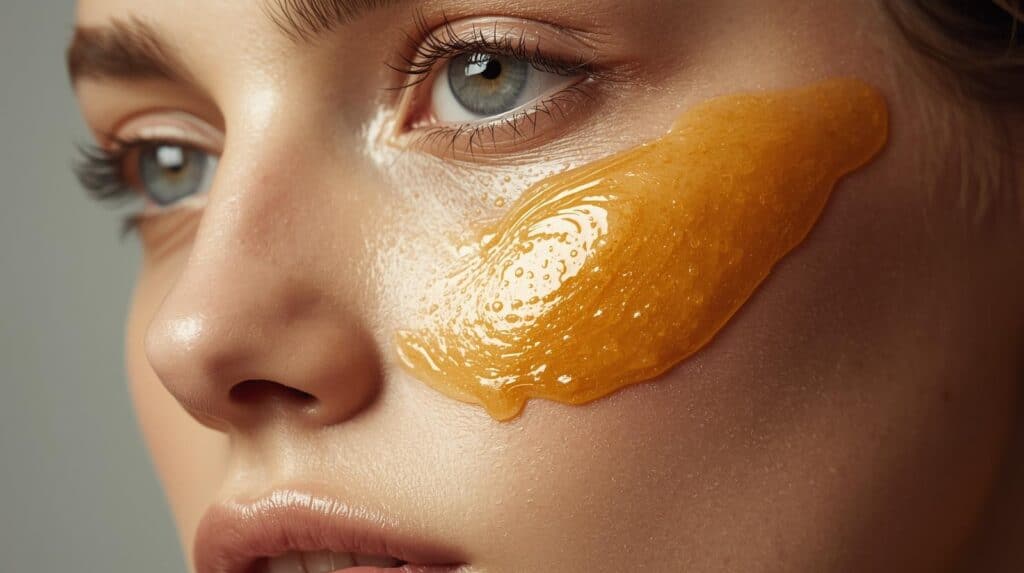
Honey can be used on intact facial skin as a rinse-off cosmetic ingredient if your skin tolerates it, but not every jar of honey is equivalent to a formulated skincare or medical product.
Its thick texture can feel comforting on dry skin, while naturally occurring sugars contribute to its humectant properties, meaning they can help attract and hold water at the skin surface.
Honey contains sugars, water, organic acids, enzymes, and other compounds, and its exact composition varies with the floral source and processing method.
Some honeys show antimicrobial and anti-inflammatory activity in laboratory research, but that does not mean ordinary food-grade honey has been proven to treat acne, dermatitis, or other facial skin conditions.
If you want to try honey as a rinse-off cosmetic mask, start with a clean product, clean hands, and intact skin rather than irritated, broken, or freshly exfoliated areas.
Raw and unprocessed is not automatically safer. Medical-grade honey used in wound care is specially prepared for that purpose and should not be confused with pantry honey.
Products such as Manuka honey are popular for at-home beauty routines, but food-grade Manuka honey is still different from medical-grade honey dressings intended for wound care.
Honey is not suitable for everyone. Sensitive, allergy-prone, or already inflamed skin may sting, itch, or react.
Dry or dehydrated skin may appreciate its humectant feel, but household honey has limited evidence for treating acne or fading scars.
Because honey contains bee- and plant-derived compounds, allergic reactions and irritation are possible even if the product is marketed as natural.
A patch test cannot guarantee that a reaction will never occur, but it can help you catch obvious irritation before putting honey over a larger area of your face.
If you have a known allergy to honey, pollen, propolis, or other bee products, ask a clinician before using honey topically. Stop immediately if you develop hives, swelling, wheezing, or significant irritation.
Does Honey Darken Skin?
Honey is often promoted as a brightening ingredient, but there is not good evidence that household honey reliably lightens skin or reduces melanin.
It does not normally deposit pigment or make healthy skin darker. However, irritation itself can trigger post-inflammatory hyperpigmentation in some people, leaving a mark after the redness or rash settles.
Some honeys can generate small amounts of hydrogen peroxide under certain conditions, but the amount is variable. That does not make honey a controlled or predictable bleaching treatment.
If your concern is post-acne dark marks, consistent sun protection and skincare ingredients with better evidence for pigmentation, such as azelaic acid, retinoids, vitamin C, or niacinamide, may be more predictable options depending on your skin and routine.
Honey may make the skin surface feel softer and look temporarily more hydrated, but it has not been established as a treatment that reliably fades scars.
If you have acne-prone skin, keep expectations modest. Clinical evidence for honey as an acne treatment is limited, and results from standardized honey preparations should not be assumed to apply to household honey.
Dark marks can also fade gradually over time, so improvement while using a DIY mask does not necessarily mean honey caused the change.
Honey is sometimes described as a natural exfoliator, but plain honey is not equivalent to a formulated alpha-hydroxy acid, beta-hydroxy acid, or enzyme exfoliant.
Its sticky, humectant texture may leave dry skin feeling smoother after rinsing. That temporary surface hydration can make skin look more luminous without changing its natural pigment.
For targeted exfoliation or pigmentation care, products formulated at known concentrations are more predictable than relying on the variable acidity or enzymes of kitchen ingredients.
Benefits Of Using Honey On Your Skin
Honey has some reasonable cosmetic benefits, but they are mostly about hydration and skin feel rather than treating a medical skin condition.
Its clearest role in a DIY routine is as a humectant and soothing rinse-off ingredient. Claims about acne, pigmentation, and inflammatory skin disease have much weaker or less consistent clinical support.
For oily skin types, honey can still feel comfortable as a rinse-off mask, but it should not be expected to deep-clean pores or regulate sebum production.
Honey also contains antioxidant compounds, although the amount and type vary considerably with floral source and processing.
Some types also show antimicrobial and anti-inflammatory activity in laboratory research.
Those properties are interesting, but activity measured in a laboratory does not automatically translate into a reliable treatment for acne, eczema, or dermatitis on real skin.
Do not use household honey as a substitute for treatment of eczema, psoriasis, rosacea, or infected skin. These concerns can have different causes and may need different treatment.
Medical-grade honey is used in certain wound dressings, where the product is prepared and controlled specifically for wound management.
That evidence should not be generalized to spreading kitchen honey over open wounds or burns. Use appropriate first aid for injuries and seek medical advice when the wound is significant, worsening, or looks infected.
For intact facial skin, think of honey as an optional cosmetic step for comfort and hydration, not as a way to medically treat damaged tissue.
As a humectant, honey can attract water to the skin surface and may leave the face feeling softer after a short rinse-off mask.
Humectants attract water, while a well-formulated moisturizer can also include emollients and occlusives that help reduce moisture loss and support a comfortable skin barrier.
Dry skin may enjoy honey as an occasional mask, but it should not replace a suitable fragrance-free moisturizer when your skin barrier is dry, tight, or compromised.
If your skin tolerates it, the most noticeable result may simply be a softer, more comfortable feel after rinsing.
Any immediate glow is more likely to come from surface hydration and light reflection than from a meaningful change in skin tone.
Breakout-prone skin may tolerate honey, but tolerance is individual and honey should not be presented as a proven acne treatment.
If acne is persistent, painful, scarring, or getting worse, evidence-based acne care or advice from a dermatologist is more appropriate than relying on a DIY mask.
How To Use Honey On Your Skin
If you still want to try honey cosmetically, keep the routine simple, rinse-off, and low-risk so it is easier to tell how your skin responds.
A short face mask is the most practical DIY option. Avoid treating honey as a substitute for a formulated exfoliant, acne medication, or wound dressing.
Using honey on its own also makes reactions easier to troubleshoot. Adding several kitchen ingredients at once gives your skin more potential irritants to deal with.
If the texture feels too sticky, applying it to slightly damp skin can make a thin layer easier to spread.
Keep honey away from the eyes, lips, nostrils, and any broken, sunburned, or freshly irritated skin.
Use clean hands and rinse thoroughly so sticky residue is not left sitting on the skin for hours.
Face Mask
To try honey as a face mask, patch-test first, then apply a thin layer to clean, slightly damp, intact skin, keeping it away from the eye area.
Leave it on for about 5 to 10 minutes the first time. Leaving it on much longer is not necessary and may simply make it harder to rinse away.
Rinse thoroughly with lukewarm water, gently pat the skin dry, and follow with your usual moisturizer if needed.
If your skin stays comfortable, occasional use may be enough. Stop if you notice burning, persistent redness, swelling, itching, hives, or new irritation.
If you are considering more elaborate DIY recipes, remember that every added ingredient can make irritation or allergy harder to trace.
The video below shows popular DIY honey face mask recipes. Treat them as cosmetic ideas rather than medically proven treatments, and skip any ingredient that has irritated your skin before.
Can Honey Exfoliate Skin?
Plain honey is not a standardized exfoliating acid, so do not expect it to work like glycolic acid, lactic acid, salicylic acid, or a formulated enzyme exfoliant.
If you use honey after cleansing, spread it gently instead of scrubbing. Friction can worsen redness and irritation, especially on acne-prone or sensitive skin.
For visible flaking, dullness, or clogged pores, a formulated exfoliant used at a suitable frequency is more predictable than a DIY honey scrub.
Can Honey Work As A Spot Treatment?
You may see honey recommended as a spot treatment, but evidence that household honey reliably clears pimples is weak.
Antimicrobial activity measured in a laboratory does not make honey equivalent to established acne ingredients such as benzoyl peroxide, salicylic acid, or prescription treatments.
If you still choose to dab a small amount on intact skin, keep the contact time brief and do not apply it to a popped, bleeding, weeping, or infected-looking blemish.
Rinse it away after a few minutes and continue with a gentle skincare routine. Stop if the area becomes redder, itchier, or more irritated.
Honey And Wound Care
Medical-grade honey dressings are used for certain wounds and burns, but they are specially prepared products, not honey taken from a kitchen jar.
Do not apply food-grade honey to an open wound, significant burn, surgical site, or infected area unless a healthcare professional specifically tells you to use it.
For cosmetic use on intact skin, a thin rinse-off layer is enough. Using more product does not mean you will get more benefit.
There is no evidence-based schedule for DIY honey masks. Start infrequently and adjust based on how your skin responds rather than forcing daily use.
A simple routine is also easier to troubleshoot than rotating through several DIY treatments at once.
If your main concern is persistent breakouts, a recurring rash, or another ongoing skin problem, choose care designed for that concern rather than adding more home remedies.
Before trying honey on a larger area, test a small amount on intact skin first.
Wait and watch for redness, itching, burning, hives, or swelling before using it more widely.
Even after a successful patch test, irritation or breakouts can still occur later, so stop if your skin starts to worsen.
Can You Use Honey With Other Ingredients?
Honey can be combined with other skincare ingredients, but DIY mixing is not automatically better. Every extra ingredient adds another possible source of irritation or allergy.
For an intact-skin cosmetic mask, choose a clean product and do not assume that raw or unfiltered automatically means safer, gentler, or more effective.
Manuka and kanuka honey have been studied for several dermatologic uses, but results from standardized or medical-grade preparations should not be generalized to every food-grade jar.
If you have rosacea, psoriasis, eczema, or another diagnosed skin condition, introduce new topical products cautiously and keep following the treatment plan recommended for that condition.
If you still want to combine honey with another ingredient in a DIY routine, keep the mixture simple and avoid stacking several potential irritants.
Patch-test the finished mixture because ingredients can behave differently once they are combined.
For dry skin, pairing a brief honey mask with your regular moisturizer is usually more predictable than building a complicated kitchen recipe with multiple ingredients.
Be particularly cautious with fruit enzymes and acidic ingredients. They can sting or irritate compromised skin even when they are described as gentle or natural.
Do not add lemon juice to a facial honey mask. Citrus juice can irritate the skin, and some citrus compounds can cause a phototoxic reaction after ultraviolet exposure.
That reaction, called phytophotodermatitis, can cause redness, blistering, and lingering dark pigmentation, which is the opposite of the result most people want from a brightening routine.
For that reason, lemon juice is not a recommended DIY treatment for acne marks or scars.
If you have already applied citrus to your skin, wash it off thoroughly and limit ultraviolet exposure. Seek medical advice for significant pain, swelling, blistering, or a severe reaction.
For DIY use, a simple honey-only rinse-off mask is easier to troubleshoot than mixing several active kitchen ingredients together.
Frequently Asked Questions
Can Honey Lighten Dark Spots?
There is not strong clinical evidence that household honey can reliably lighten dark spots. Post-acne marks often fade gradually, and consistent sun protection plus evidence-based pigmentation care is more predictable.
Can Honey Make Skin Darker?
Honey does not normally stain healthy skin darker. However, if it causes irritation or an allergic reaction, the inflammation can sometimes leave post-inflammatory hyperpigmentation after the reaction settles.
Is Manuka Honey Better For The Face?
Manuka honey has been studied for antimicrobial and wound-related properties, but food-grade Manuka honey is not automatically a proven treatment for acne or pigmentation. Medical-grade honey used in wound care is a different category of product.
Conclusion
Honey can be a pleasant rinse-off moisturizing ingredient for some people, but its skincare benefits are often overstated.
For intact skin, the practical questions are simple: does your skin tolerate it, is the product clean, and can you rinse it away without irritation?
Raw, unprocessed honey is not required for a cosmetic benefit, and it should not be confused with standardized medical-grade honey intended for wound care.
Formulated skincare products containing honey may be easier to use because their texture, preservation system, and supporting ingredients are designed for cosmetic application.
Honey may suit many skin types, but sensitive, reactive, or allergy-prone skin should approach it cautiously.
Do not rely on honey to treat acne. Its antimicrobial properties are interesting, but clinical evidence for household honey as an acne treatment is limited.
It may feel soothing on intact skin, but diagnosed inflammatory skin conditions deserve care with stronger evidence behind it.
Likewise, small amounts of hydrogen peroxide that may occur in some honey do not make it a reliable bleaching treatment for dark spots or scars.
When honey is used for wounds and burns in healthcare, the relevant products are medical-grade dressings intended for wound management, not ordinary food-grade honey from the kitchen.
If you have a known allergy to honey or other bee products, or your skin is actively inflamed, skip DIY honey skincare unless a clinician says it is appropriate for you.
If you develop burning, hives, swelling, wheezing, or a significant rash after using honey, stop using it and seek appropriate medical care.
If you do try honey, keep expectations modest: hydration and a soothing feel are more realistic goals than skin lightening, scar fading, or acne treatment.
Related Articles
Types Of Facials And How To Choose – Complete Guide
Steaming Face With Lemon – Why You Should Try It