
Why You Should Use Glycolic Acid On Your Legs
You may already be familiar with the benefits of glycolic acid for your face.
Glycolic acid is an alpha-hydroxy acid (AHA) used in exfoliating skincare, including body lotions, toners, and washes.
For legs that feel rough even after moisturizing, a chemical exfoliant can be worth considering. The first step is figuring out what is causing the texture.
Glycolic acid works mainly by loosening the bonds between dead surface skin cells, which helps them shed more evenly and can smooth rough texture over time.
With consistent use, it may help improve dullness, uneven texture, some clogged pores, and the look of superficial discoloration. Results depend on the formula, concentration, frequency, and your skin’s tolerance.
That makes it an option for body care, especially when rough bumps are your main concern.
It is less useful if the dots you see are simply dark hair showing beneath the skin. Exfoliation does not remove hair or make follicles disappear.
Before covering both legs with an acid, check the product directions and try it on a small area first.
So why should you use glycolic acid on your legs?
Glycolic acid may help improve some causes of “strawberry legs,” especially rough follicular buildup and keratosis pilaris. It can also smooth texture, but it does not prevent every case of razor irritation or treat every cause of dark dots on the legs.
Here is how to decide whether glycolic acid fits your leg-care routine, choose a format, and use it without over-exfoliating.
Can Glycolic Acid Help Strawberry Legs?
One common reason people try glycolic acid on the legs is the appearance often called “strawberry legs.”
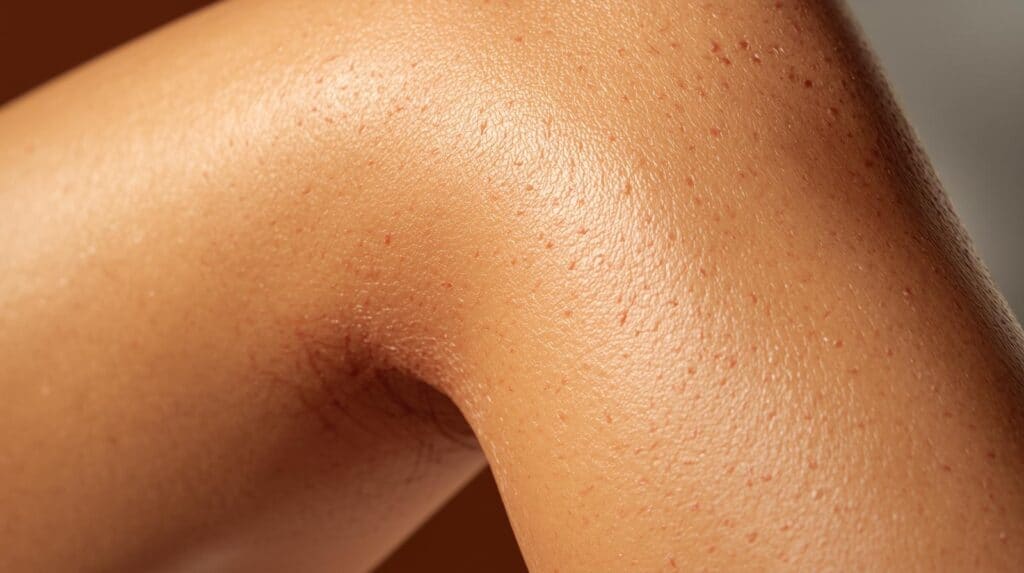
“Strawberry legs” is not a formal medical diagnosis. It is a descriptive term for visible dark dots or bumps around hair follicles.
The nickname comes from the way the dots resemble strawberry seeds, but similar-looking dots can have different causes.
Some people notice this more than others because of hair color, skin tone, shaving habits, keratosis pilaris, inflammation, or post-inflammatory pigmentation.
Look at how your skin feels as well as how it looks: flat dots, dry rough bumps, and tender spots need different approaches.
The appearance itself is often harmless, but inflamed, painful, itchy, or pus-filled bumps may point to folliculitis or another skin condition that needs different care.
If bumps are painful, draining, spreading, or repeatedly returning, get medical advice before trying to exfoliate them away.
Flat dots with visible stubble: hair beneath the surface may explain the shadow. Adding more acid will not give you a closer shave.
Bumps after hair removal: shaving irritation or ingrown hairs may be involved. Give irritated skin time to settle before introducing an exfoliant.
Sometimes a similar dotted or bumpy appearance is actually folliculitis, meaning the hair follicles are inflamed and sometimes infected.
Folliculitis can have bacterial, yeast, friction-related, shaving-related, or other causes, so an acid exfoliant is not automatically the right treatment.
Dry, sandpapery bumps: keratosis pilaris can create plugs of keratin around the follicles, often on the thighs. This is one situation where glycolic acid may help smooth the texture.
Flat marks left after bumps heal: these may be post-inflammatory pigmentation. They can linger after the original irritation has gone.
Avoid picking or squeezing dots to try to clear them. The extra irritation can leave more noticeable marks.
Not every dark dot is a blackhead, and appearance alone is not always enough to identify the cause.
Because “strawberry legs” can have several causes, the best treatment depends on whether the main issue is keratin buildup, shaving irritation, ingrown hairs, pigmentation, or active folliculitis.
The American Academy of Dermatology lists glycolic acid among ingredients used to reduce the dead-cell buildup associated with keratosis pilaris. It is an option for managing roughness, not a cure.
Here’s a great explanation of keratosis pilaris from Doctorly on YouTube.
How To Use Glycolic Acid For Strawberry Legs
Because glycolic acid exfoliates dead surface cells, it may help smooth rough follicular buildup and make some dark dots look less prominent over time.
Choose one exfoliating product to start. A toner, acid lotion, and exfoliating pad are alternatives, not three steps to layer together.
Check that the directions allow use on the area you want to treat. A rinse-off wash must be rinsed off; a professional-strength peel is not a substitute for an everyday body product.
Expect gradual changes over several weeks rather than a smooth finish after one application. Dark marks may take longer than roughness to improve.
Here’s how you can use glycolic acid for your strawberry legs:
- Start with clean, dry, unbroken skin for a leave-on formula. Cleanse gently and pat dry; there is no need to scrub first. Follow the label if it specifies a different method.
- Apply your glycolic acid product in a thin, even layer rather than scrubbing it in. You can find a glycolic acid solution on its own (like this one) or as part of a lotion (like this).
If you are on the go, you could also use glycolic acid pads as directed. - Follow with a plain, fragrance-free moisturizer. If your glycolic acid body lotion already leaves your skin comfortable, a second layer may be unnecessary. If your skin stings or feels irritated, stop the acid rather than just adding more lotion.
How Often Should You Use Glycolic Acid On Your Legs?
Daily use is not necessary for everyone. Your starting schedule should suit the specific formula and your skin, not someone else’s routine.
Keep the rest of your routine simple while you work out your tolerance: gentle cleansing, moisturizer, and sun protection.
For a leave-on product whose directions allow it, begin with one application a week. Increase cautiously only if your skin stays comfortable, and never exceed the label’s frequency.
Once you find a frequency that keeps the skin comfortable and smooth, you can maintain that schedule rather than increasing use unnecessarily.
Using glycolic acid too often can cause dryness, stinging, redness, peeling, and barrier irritation.
What You Should Know When Using Glycolic Acid On Your Legs
The goal is smoother, comfortable skin. Burning, peeling, or soreness are reasons to change your routine, not signs to push through.
Irritation
Glycolic acid can be too irritating for very sensitive, cracked, or already inflamed skin. If the label excludes your skin type or condition, choose another approach rather than trying to make it work.
When introducing glycolic acid, skip body scrubs and other exfoliating acids on the same area. If you use a prescribed retinoid there, ask your clinician how to fit exfoliation into your routine.
You do not need to keep adding more application days. The best frequency is the lowest one that gives you the result you want without irritation.
If your skin becomes irritated, very dry, or flaky, stop exfoliating until it has recovered. Use a gentle moisturizer in the meantime.
If your skin feels irritated after each use, stop the product. A lower-strength formula or a different exfoliant may be easier to tolerate.
The percentage on the bottle is only part of the picture. Acidity (pH), the rest of the formula, contact time, and frequency all affect tolerance, so equal percentages do not guarantee equal results.
Moisturize on days you do not exfoliate, too. Dryness can make rough texture more noticeable.
A body lotion combines exfoliation with moisturizing ingredients, while a liquid may need a separate moisturizer. Neither format is automatically gentle; judge it by its directions and how your skin responds.
Stinging
A brief mild tingle can happen with some glycolic acid products, but stinging is not proof that the product is working. Persistent or intense burning is a reason to rinse it off and stop.
If you develop burning, marked redness, or swelling, rinse the product off and stop using it. Seek medical advice for severe symptoms or irritation that does not settle.
Before your first full application, test a small area according to the product’s patch-test directions. Watch for a delayed reaction as well as immediate discomfort. A small-area test cannot guarantee that repeated use will be irritation-free.
Avoid applying glycolic acid to freshly shaved, waxed, or depilatory-treated legs. Use it on a different day once the skin is calm and intact, following both products’ instructions. Never apply it over cuts or razor burn.
Sun Exposure
If you want smoother legs for a beach trip, avoid starting a new acid routine just before you go. Give yourself time to check your tolerance.
Sun protection matters whenever your legs are exposed, including when you wear shorts or skirts away from the beach.
Glycolic acid and other AHAs can increase sensitivity to ultraviolet exposure, so exposed skin needs reliable sun protection.
The FDA advises sun protection during AHA use and for a week afterward. Applying glycolic acid at night does not remove that need.
Unprotected sun exposure can increase the risk of sunburn and can also worsen post-inflammatory dark marks.
Covering up and seeking shade help alongside sunscreen. Pause exfoliation if your legs are sunburned or irritated, and let them recover.
Use broad-spectrum SPF 30 or higher on exposed legs. Reapply according to the sunscreen label, including after swimming or sweating, and follow the glycolic acid label’s sun-sensitivity directions.
Other Skin Conditions
If you have another skin condition, do not assume glycolic acid will be appropriate simply because it is exfoliating.
For eczema, psoriasis, or a recurring unexplained rash, ask a dermatologist before adding an acid to the affected area.
Glycolic acid may help with keratosis pilaris, rough texture, some clogged pores, and post-inflammatory discoloration. It should not be used as a blanket treatment for folliculitis or psoriasis, and it can worsen active irritation or a damaged skin barrier.
If a well-tolerated routine is not helping after several weeks, reconsider the cause with a dermatologist rather than jumping to a stronger acid.
Final Thoughts
Glycolic acid can be a useful body-care ingredient for rough texture, keratosis pilaris, and some forms of follicular buildup, but it will not eliminate every cause of strawberry legs, razor irritation, or dark spots.
Choose a product suitable for body use, follow its leave-on or rinse-off directions, and start slowly. Keep moisturizing and protecting exposed legs from the sun. Comfortable skin matters more than increasing the strength or frequency.
Related Articles
How To Tighten Skin On Thighs Naturally
How To Lighten Stretch Marks On Calves
When Can You Shower After Waxing?