
How To Know If You Have Curly Hair
Figuring out whether your hair is naturally straight, wavy, curly, or coily can make styling much easier because you can stop fighting the pattern and start working with it.
Understanding your hair pattern, strand thickness, density, porosity, and elasticity can make it easier to choose products and styling methods that suit your hair.
If your hair often looks puffy, frizzy, unevenly textured, or much more voluminous than expected, you may be seeing signs of an underlying wave or curl pattern.
If your hair looks puffy, frizzy, or unevenly textured, it may have more wave or curl than you realize, especially if it has usually been brushed, stretched, or heat-styled straight.
The important clue is not volume alone, but whether the hair repeatedly forms bends, S-shapes, spirals, or ringlets when it is allowed to dry without being brushed straight.
Your curl pattern is useful information, but it is only one part of hair care. Porosity, density, strand thickness, scalp condition, and damage history matter too.
The goal is to observe how your hair behaves naturally and build a routine around what it actually needs.
Curly or wavy hair can be surprisingly easy to miss when it has been brushed dry, repeatedly straightened, or styled with products that weigh the pattern down.
How do you know if you have curly hair?
You may have naturally wavy or curly hair if your strands form S-shapes, spirals, or ringlets when wet and keep some of that pattern after air-drying. Other clues include shrinkage, humidity-sensitive texture, and better definition when you stop brushing the hair dry. Frizz or volume alone does not prove that hair is curly.
The easiest way to tell whether your hair is wavy or curly is to observe what it does with minimal manipulation. Wavy hair can sometimes look nearly straight when stretched or brushed, while curly hair usually forms more complete loops or spirals.
You do not need to identify an exact curl-type number immediately. A simple wash-and-air-dry test often tells you more than forcing your hair into a strict category.
Quick Test: Is Your Hair Naturally Curly Or Wavy?
- Wash your hair with a cleanser that removes obvious buildup, then condition as usual.
- While the hair is wet, look for S-shapes, bends, spirals, or ringlets forming without wrapping the hair around your finger.
- Apply only a light leave-in or styler if you need one, then scrunch gently rather than brushing the pattern straight.
- Let the hair air-dry or diffuse on a gentle setting without repeatedly touching it.
- Once fully dry, check whether the hair still shows waves, curls, shrinkage, or recurring bends. Repeat this over a few wash days before deciding on your pattern.
If your hair only becomes curly after you manually twist or wrap every section, that is different from a pattern that forms on its own. Styling can enhance natural texture, but it should not be the only reason the curl exists.
Curly Hair Vs. Wavy Hair
Wavy hair generally forms S-shaped bends rather than full ringlets, while curly hair forms more complete loops or spirals. Both can change noticeably with humidity, styling, product weight, and damage.
That overlap makes classification imperfect, and it is completely normal to have several patterns on one head, such as looser waves near the crown and tighter curls underneath.
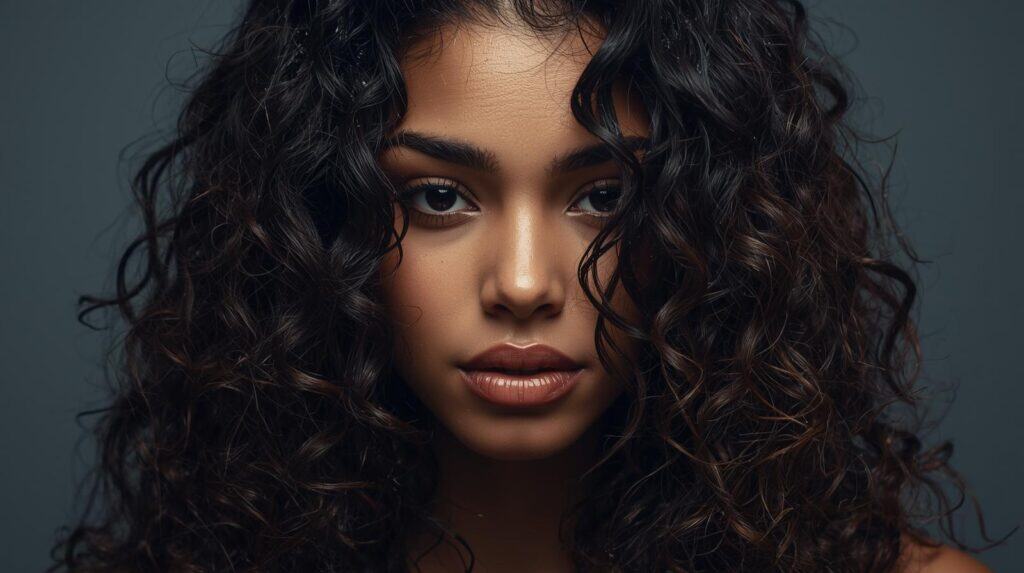
Some people with naturally wavy or curly hair routinely brush or heat-style it straight, which can make the natural pattern harder to recognize and may contribute to dryness or heat damage if done frequently.
Well, if wavy and curly hair can be similar, what makes them different?
A popular curl-typing system uses numbered and lettered categories, but it is best treated as a descriptive styling guide rather than a scientific diagnosis or a rule for which products you must use.
Hair Type Guide:
- Straight: 1A, 1B, 1C
- Wavy: 2A, 2B, 2C
- Curly: 3A, 3B, 3C
- Coily: 4A, 4B, 4C
Wavy Hair
According to Allure’s hair type guide, “Wavy hair is bendable, from fine to coarse, that has a definitive S pattern but lies closer to the head.”
One of the most useful indicators of wavy or curly hair is comparing the pattern when wet, while air-drying, and once fully dry.
Wet hair can give you an early clue. If sections naturally group into S-shapes, bends, or spirals, let them dry without brushing them straight and see how much of that structure remains.
Type 2 hair can range from nearly straight-looking waves to strong S-patterns with occasional spirals, so you do not need to force it into a strict “straight versus curly” category.
If your hair forms a strong S-pattern with some spirals, it may sit toward the stronger end of the wavy spectrum or overlap visually with looser curls.
This hair type can share characteristics with type 3 curly hair.
According to Wavy Hair Care, signs that your hair is wavy can include “your strands are wavy when wet, but they dry straight, it’s thick and puffy when you go for a haircut, your hair is frizzy when there is rain or humidity, among other characteristics.”
Wavy hair does not need to be treated as “almost straight” or “not curly enough.” Experiment with lightweight and richer routines to see what gives you the best definition, softness, and scalp comfort.
Give yourself a few wash days to observe the pattern because one styling attempt can be distorted by buildup, heat damage, brushing, or an unusually humid day.
Curly Hair
Allure’s hair type guide also defines that Curly hair “can range from loose, buoyant loops to tight, springy corkscrews which have some sheen but are prone to frizz.”
Curly and coily hair can vary widely in density, shrinkage, porosity, strand thickness, and scalp oiliness, so curl type alone cannot tell you exactly which routine will work.
Which Curly Hair Type Are You?
3A: This category is commonly used for loose, springy curls or ringlets. Strand thickness, shine, and scalp oiliness can still vary widely, so deep conditioning is optional rather than a requirement.
3B: This category is often described as having tighter, springy ringlets. These curls may appear more voluminous, but they are not automatically dry; dryness depends on porosity, cleansing, styling, and environmental factors.
3C: This category usually describes tight corkscrew curls that may visually overlap with looser coily patterns. A co-wash can work for some people, but others need regular shampoo to control buildup and keep the scalp comfortable.
Curly Girl Life shares the five most prominent signs you have curly hair:
- Humidity changes your hair pattern, volume, or frizz.
- Your hair has waves, curls, or ringlets, even when it’s wet.
- You often notice frizz, flyaways, or uneven texture around an underlying wave or curl pattern.
- Your hair tends to hold bends, waves, or curls easily after styling.
- Brushing it dry or styling it as straight hair often makes it look puffy or less defined.
These clues can suggest that your hair has a natural wave or curl pattern, but no single sign proves it on its own.
If you flat-iron your hair frequently to control frizz and puffy ends, try several wash days with minimal heat and let the hair air-dry or diffuse gently to see what pattern forms more naturally.
Other clues can help too, but none of them should be treated as a stand-alone test.
For example, some curly specialists prefer to assess or cut at least part of the hair dry so they can see how individual curls sit and shrink.
Some curly and coily hair benefits from a dry cut because the stylist can see shrinkage and curl placement, while other cutting methods work well too.
If you have had your hair cut while it’s wet, have you noticed that it dries down much shorter than anticipated after your cut?
Curly hair can shrink as it dries, so a wet cut may look shorter once the natural pattern returns. Experienced stylists account for this when choosing a cutting method.
Still feeling unsure? See a licensed hairstylist who specializes in curly and coily hair types.
They will be able to assess your hair and guide you through a proper hair care routine.
Do you style your hair as if it were straight? What products or hot tools do you use?
Another useful clue is watching how your hair behaves after you style it straight. If bends, waves, or curls repeatedly return with humidity or moisture, there may be a stronger natural pattern underneath.
Straightened curly hair can look smooth and polished when done well, but frequent heat or brushing may also leave the natural pattern looking frizzy or uneven between styling sessions.
For example, you may notice that the roots sit flatter while the ends puff, bend, or become frizzy once moisture or humidity reaches the hair.
Some cuts can also create a triangular silhouette if weight builds up around the ends, regardless of exact curl type.
If straight styling repeatedly leaves the hair puffy or undefined, try a curl-friendly wash day before assuming that frizz is simply something you have to smooth away.
Curly hair often responds well to routines that balance cleansing, conditioning, hold, and gentle handling. Finding the right combination usually takes some experimentation.
Signs Your Hair May Be Wavy Rather Than Curly
Wavy hair often forms longer S-shapes rather than complete ringlets, may lie flatter near the roots, and can be weighed down more easily by rich creams and oils. Curly hair generally forms more complete loops or spirals and may show more visible shrinkage as it dries.
There is plenty of overlap, though. You may have type 2 waves in one section and type 3 curls in another, so focus more on how individual areas behave than on finding one label for your entire head.
How To Care For Curly Hair
1. Moisture
Curls and waves often benefit from enough conditioning to stay flexible and defined, but the amount depends on porosity, strand thickness, density, and product buildup.
Because curls bend along the hair shaft, scalp oils may spread less evenly toward the ends than they do on very straight hair. That can contribute to drier-feeling lengths for some people.

Leave-in conditioners, masks, creams, oils, or moisturizing sprays can help with softness and manageability, but using too many rich products may weigh down finer curls or create buildup.
Conditioning can reduce dryness-related frizz, although humidity, damage, styling technique, and hold products also affect frizz.
2. Co-Wash
Co-washing means cleansing with a conditioner-like product rather than a traditional foaming shampoo. It can suit some curly or coily routines, but it is optional rather than a requirement.
According to Byrdie, a co-wash is a conditioner-like cleansing product used in place of shampoo for some wash days.
Co-washing can replace some shampoo days for people who tolerate it, but it does not mean you must stop using shampoo altogether.
Byrdie notes that co-washing is often used by people with textured or natural hair who want a gentler-feeling cleansing step.
Curly and coily hair can have dry-feeling lengths, but scalp oiliness varies from person to person and is not determined by curl pattern alone.
A healthy scalp benefits from appropriate cleansing and avoiding unnecessary irritation. Hair growth comes from the follicle and is not improved simply by leaving more oil on the scalp.
A co-wash can be gentler than some strong shampoos, but regular shampoo is still useful when you need to remove buildup, sweat, oil, or styling residue.
3. Deep Condition
Deep conditioning can improve softness and slip when curls feel dry or difficult to detangle.
Use a deep-conditioning mask for the amount of time recommended on the product label. Leaving it on longer does not necessarily improve the result.
Avoid assuming that overnight deep conditioning is better, especially with protein-rich or strongly fragranced formulas. Follow the label directions, and rinse the product out if it causes itching, scalp discomfort, or excessive softness.
4. Define Your Curls
A curl-defining cream or mousse can help add hold, reduce frizz, and encourage your natural pattern to clump more clearly.
A curl-defining cream can help with clumping and softness, especially on medium to coarse curls, while finer waves may prefer mousse, gel, or another lighter styler.
It is one useful styling option, but not every curly routine needs a cream.
A mousse can add lightweight hold and help support root volume, although results vary with density, haircut, and drying method.
You can layer a curl cream and mousse if your hair tolerates both, but one well-chosen styler may be enough.
If you do heat style your hair, opt for a heat protectant.
A heat protectant can reduce some heat-related damage during styling, but it cannot completely prevent it. UV protection is a separate claim, so check the product label rather than assuming every heat protectant provides it.
Choose styling products based on your hair’s need for weight, hold, moisture, and buildup control rather than assuming every curly routine needs the same products.
Curly Hair Identification FAQs
Can Hair Be Curly When Wet But Straight When Dry?
Yes. Loose waves can stretch as they dry, especially when the hair is long, heavy, brushed, or coated with rich products. If the wet pattern repeatedly disappears, try a lighter routine and avoid brushing it straight while drying before deciding that the hair is truly straight.
Does Frizz Mean You Have Curly Hair?
No. Frizz can occur with straight, wavy, curly, or coily hair and can come from humidity, damage, dryness, friction, or styling. It is more useful when you see frizz alongside a repeating wave or curl pattern.
Can Straightening Hide Your Natural Curl Pattern?
Yes. Frequent brushing, blow-drying, or flat-ironing can make a natural pattern harder to recognize, and repeated heat can also weaken how consistently curls spring back. Give the hair several low-heat wash days if you want to observe its natural behavior.
Do You Need To Know Your Exact Curl Type?
No. Curl typing can help describe shape, but porosity, density, strand thickness, scalp condition, damage, and styling goals are often just as important when choosing products.
Related Articles
Is My Straight Hair Actually Wavy?