
5 Best Curved Flat Irons
A flat iron that can straighten, wave, and curl your hair can be useful when you want several styling options without several hot tools.
If your drawer is already crowded with straighteners and curling irons, a versatile shape may help simplify your routine.
The key is choosing a tool that is comfortable to turn through your hair and offers suitable temperature control.
Flat irons straighten hair between heated plates, but many can also create bends and curls when you rotate the tool as you glide.
Plate width, edge shape, and the outer housing all affect how easily you can make those movements.
“Curved flat iron” is a broad shopping term. It may describe bevelled plate edges, a rounded body, or specially twisted plates, rather than one standard design.
But, how do you find the best curved flat iron for your hair?
Look for a rounded shape that suits curling, a plate width you can control, and adjustable heat with a low enough starting temperature for your hair. Plate material matters, but it does not make a tool damage-free. Check the exact model and its instructions before buying.
The heating plates do not have to wrap around the sides for a straightener to curl hair. A rounded outer body and smooth plate edges can also help the hair turn around the tool.
Below, we compare five options and explain how their shapes, controls, and limitations may fit different styling needs.
Regular Vs. Curved Flat Irons
A conventional flat iron has two heated plates that press a section of hair as you glide towards the ends.
Many ordinary straighteners already have rounded edges suitable for curls and waves. You may not need a separate tool if yours turns smoothly through the hair.
A rounded housing gives hair a surface to bend around, while bevelled plate edges soften the transition where hair leaves the plates.
That design can help reduce sharp bends, but clamping too hard or pausing in one place can still leave a dent.
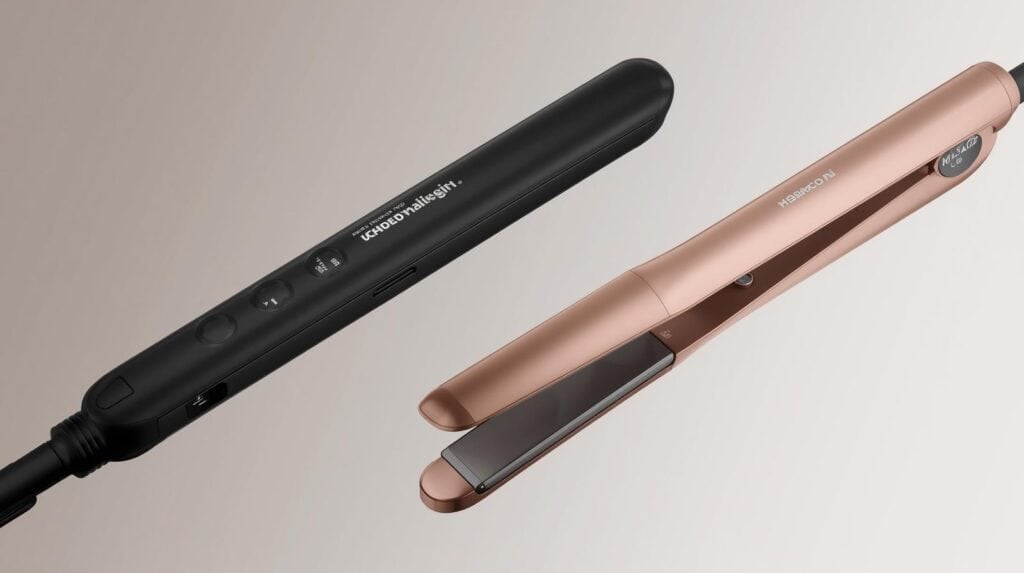
Some specialist tools use curved or twisted plates. Those are different from an otherwise flat plate inside a rounded housing, so inspect the product photos and description.
For curling, the overall shape, grip, and your technique matter together. A rounded body alone does not guarantee easy curls.
You can angle a section for a little root lift, but keep heated surfaces away from the scalp. Getting as close as possible is not the goal.
What To Look For In A Curved Flat Iron
Start with the styles you will use most: straightening, loose waves, tighter curls, or a mixture.
Then consider your hair length, strand thickness, and condition. Dense hair can still have fine or fragile strands.
Also check the cord, handle comfort, automatic shut-off information, warranty, and voltage rating, particularly if you plan to travel.
Plate Material
Plate material is one part of a tool’s performance. Temperature regulation, smoothness, alignment, and coating quality matter too.
There is no material that is automatically safe for every head of fine, thick, curly, or colour-treated hair.
Common descriptions include ceramic, titanium, and tourmaline. Read whether a plate is coated or made from the stated material:
- Ceramic plates may use solid ceramic or a ceramic coating over another material. Smooth surfaces and reliable temperature control can help with styling, but “ceramic” does not guarantee gentle heat or a frizz-free result.
- Titanium plates transfer heat efficiently and are often marketed for resistant textures. They are not automatically the right choice for dry or damaged hair, and the material name alone does not establish an ionic benefit.
- Tourmaline is commonly included in a coating or material blend, often alongside ceramic. Ionic and anti-frizz claims describe intended styling benefits; they do not mean the iron hydrates hair or prevents heat damage.
Combined-material and “infused” descriptions are common. They do not prove that a tool moisturises, repairs, or prevents damage to hair.
Heat Settings
Adjustable heat is especially useful when alternating between hair sections or styles.
Start at a lower setting and use only as much heat as needed for the result, following the model’s guidance.
Consider chemical processing and breakage as well as texture. Bleached or fragile hair may need a break from flat ironing rather than a different plate material.
A maximum temperature above 400°F is a capability, not a recommendation. There is no benefit in selecting the hottest setting simply because it is available.
Fine strands generally need less heat. For dense hair, try smaller, well-detangled sections before increasing the temperature.
Check the lowest setting and how large the steps are between temperatures. A wide maximum range is less helpful if the minimum is too hot for your needs.
Use a heat protectant according to its directions, but do not treat it as a guarantee against heat damage.
For the conventional irons discussed here, style fully dry hair. If a preparation spray dampens it, allow it to dry before applying the plates.
Plate Size
Plate width affects how easily you can reach shorter sections and turn the iron for curls.
Check the width of the exact listing; a model family may offer several sizes with different handling.
Narrower plates can be easier around short layers or a fringe. Wider plates can cover more hair at once but may feel awkward for tight turns.
A one-inch plate is a practical starting point for mixed straightening and curling. It is not automatically the best size for very short or very long hair.
The Best Curved Flat Irons
These comparisons focus on design and manufacturer information, not hands-on testing of every iron. Check the model number, regional voltage, included accessories, and current availability before ordering.
| Rank | Product | Key Features |
|---|---|---|
| 1. | T3 Micro Lucea 1” Professional Straightening Iron | Ceramic plates, 9 heat settings, works for any hair type and texture, smooth and frizz-free with one pass |
| 2. | FURIDEN Professional Hair Straightener | Ceramic plates, 15 second heat up, floating, curved plates to eliminate snagging hair, heats up to 450°, ideal for straightening or curling |
| 3. | Remington Pro 1” Multi-Styler | Ceramic titanium plates, 5 heat settings and Heat Control Sensor, twisted design helps achieve different styles of waves and curls, 30 second heat up |
| 4. | Hot Tools Pro Artist Ionic Salon Flat Iron | Ceramic titanium plates, up to 455°, LED digital temperature reading with audio tone when temperature is reached, automatic 2-hour shut off, MicroShine Technology to reduce friction and damage |
| 5. | NITION Professional Salon Hair Straightener | Ceramic-coated heating plate, infused with tourmaline and titanium, 10 second heat up, 6 heat temperatures ranging from 265-450°, 60-minute automatic shut off |
1. T3 Micro Lucea 1” Professional Straightening Iron
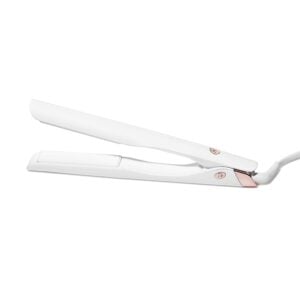
Best suited to: Someone who wants a conventional one-inch straightener with several heat levels for both straight and bent styles.
The T3 Lucea is a styling tool, not a treatment for damaged hair. A shinier finish does not establish that the strands are healthier.
The Lucea 1-inch model uses ceramic plates. Check that you are comparing it with the same version, rather than the Lucea ID or a wider model.
The one-inch width offers a balance between covering a section and turning the iron for waves.
To create a bend, rotate the tool slightly as you glide. Keep tension light rather than squeezing tightly around the hair.
T3 lists nine temperature settings for the Lucea 1-inch in its temperature guide. Use that guidance alongside the condition of your hair, rather than assuming every setting is appropriate.
Keep in mind: More settings offer control, but they do not remove the risk from repeated passes. Check that the handle and buttons feel comfortable for turning as well as straightening.
2. FURIDEN Professional Hair Straightener
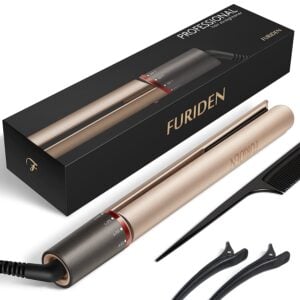
Best suited to: Someone who wants a rounded body and rotating temperature control for switching between straight and curled styles.
FURIDEN describes this style of iron as having floating tourmaline-ceramic plates and a rounded barrel.
“Floating” means the plates have some movement to help maintain contact. It does not mean they follow every angle without pulling.
The rounded housing can help guide a curl, but work in manageable sections and stop if the hair catches.
The manufacturer’s product page lists five settings from 250°F to 450°F and a claimed 15-second heat-up time. Confirm those details against the exact unit sold in your region.
Keep in mind: The upper temperature is unnecessary for many users. Check the lowest setting, control increments, and voltage label rather than relying on “all hair types” marketing.
3. Remington Pro 1” Multi-Styler
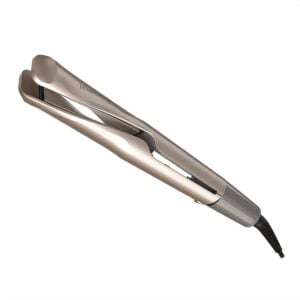
Best suited to: Someone interested in plates specifically shaped to guide curls and waves, rather than just a rounded exterior.
The Remington Pro Multi-Styler uses a twisted design and is also intended to straighten hair.
That shape may feel different from a regular straightener. Follow its straightening and curling directions rather than assuming the same wrist movement will work for both.
Check the plate coating and features for your model number. Similar-looking Remington releases should not automatically be treated as identical.
Remington’s current product page identifies an S16A11A version, while the retained Amazon link names S16A10. Verify the temperature controls and heat-up information for the version you buy.
A temperature sensor is not a detector of hair damage and cannot guarantee protection against colour fading or overheating of a section held too long.
Keep in mind: Choose this for the distinctive styling shape if you are willing to learn its technique. A conventional rounded iron may feel more familiar if straightening is your main priority.
4. Hot Tools Pro Artist Ionic Salon Flat Iron
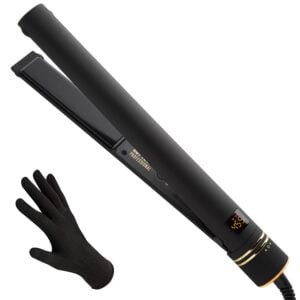
Best suited to: Someone who values visible temperature controls and a rounded grip for loose curls as well as straightening.
The Hot Tools Black Gold Evolve has a cylindrical body and rounded edges designed for versatile styling.
The brand describes ceramic-titanium plates and an ion generator. Neither feature makes the result damage-free.
Its official specifications list variable heat up to 455°F. That high maximum should not be a reason to use more heat than your hair needs.
Floating plates can help maintain contact through a section. Smooth movement also depends on detangling and avoiding product buildup on the plates.
The digital display, rotating dial, and ready tone make it easier to check the selected temperature. Be aware of the last-setting memory if someone else uses the iron.
Keep in mind: Confirm shut-off timing and included accessories in the exact model’s manual or package. Switch off and unplug after use even if an automatic shut-off is fitted.
5. NITION Professional Salon Hair Straightener
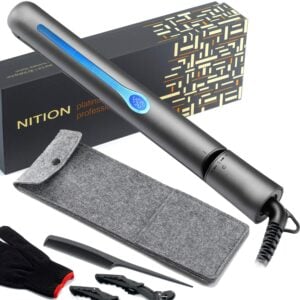
Best suited to: Comparing a rounded NITION styler with adjustable temperature, provided the listing clearly identifies the model and plate construction.
Claims about argan oil, silver, or other plate infusions should not be taken to mean the iron conditions hair or locks in all moisture during heating.
NITION markets multiple straighteners with different plate descriptions. Check the settings on the exact unit instead of transferring specifications from another model.
Confirm the heat-up time, shut-off feature, and instructions before buying. Fast heat-up is convenient but is not evidence of lower damage.
Temperature-control technology can help regulate the tool, but it cannot decide how much heat your particular hair can tolerate.
Keep in mind: Stop if hair catches or the plates feel rough. Rounded edges cannot compensate for damaged coatings, poor alignment, or a section that is too large.
Styling Tips And Final Thoughts
A curved or rounded iron takes practice, particularly if you are used to curling with a barrel and clamp.
Practise the hand movement with the tool switched off and cool first. This helps you find a comfortable grip without reheating the same section repeatedly.
Before styling, detangle fully dry hair, apply heat protection as directed, and divide it into manageable sections.
For straightening, close the plates lightly around a section and glide steadily towards the ends without pausing.
For a loose bend, rotate the iron slightly as you move through the length. Follow any model-specific instructions for twisted plates.
Do not clamp harder to force a curl. If the hair catches, release it, check for tangles, and reduce the section size.
For root lift, angle the section away from the scalp while keeping hot surfaces clear of the skin.
Dents often come from pausing, sharp changes of direction, or excessive pressure. A rounded tool can still leave them.
Let the section cool before brushing out a curl or deciding it needs another pass.
Keep the tool away from water, set it on a suitable heat-resistant surface, and let it cool completely before storing. Clean only as directed when unplugged and cool.
Choose according to the lowest usable heat setting, comfortable handling, plate width, and the styles you actually wear.
No model is guaranteed to be snag-free or safe for every hair condition. Reduce heat styling if you notice increasing roughness or breakage.
The right design may let one tool handle several styles, but gentle technique and controlled heat remain more important than a “curved” label.
Related Articles
Best Flat Irons For Silk Press