
11 Best Wet To Dry Flat Irons
Wet-to-dry flat irons promise to shorten styling time by letting you straighten towel-dried or damp hair without a separate full blow-dry first.
That convenience comes with an important caveat: wet hair is more vulnerable to structural heat damage, especially when very hot plates rapidly turn water inside the fiber into steam.
Research on heated styling has found substantially more structural damage when high heat is applied to wet hair than to dry hair, and case reports describe “bubble hair” after hot tools were used on damp strands.
Modern wet-to-dry tools use vents, airflow, or other moisture-release designs, but that does not make every flat iron safe for wet hair.
Only use a tool on damp hair if the manufacturer explicitly says that exact model is designed for wet-to-dry use, and towel-dry thoroughly first.
The tricky part is that not every product marketed alongside wet-to-dry tools is actually approved for damp hair. Before buying, check the instructions for the exact model rather than relying on a marketplace title or a vented-looking plate design.
So what are the best wet-to-dry flat irons?
Look first for genuine wet-to-dry instructions from the manufacturer, then compare plate width, adjustable heat, venting or airflow design, auto shutoff, and how low the temperature can be set. The safest choice is the lowest effective heat for your hair.
Any flat iron can damage hair when it is too hot, held in one place, or passed over the same section repeatedly. With damp hair, correct tool design and technique matter even more.
To make the comparison easier, we looked at whether each model is genuinely intended for damp hair, along with plate width, heat control, venting, safety features, and how practical it is for different hair lengths and textures.
Below, we separate the true wet-to-dry models from older or mismatched listings that should not be treated as damp-hair tools without current manufacturer confirmation.
How To Pick Your Straightener
Plate Thickness
Plate width changes how quickly and precisely a flat iron moves through the hair, so it is worth matching the size to your length, density, and styling habits.
A narrower plate is easier to position close to the roots and around bangs or short layers, while a wider plate can cover more hair in each pass.
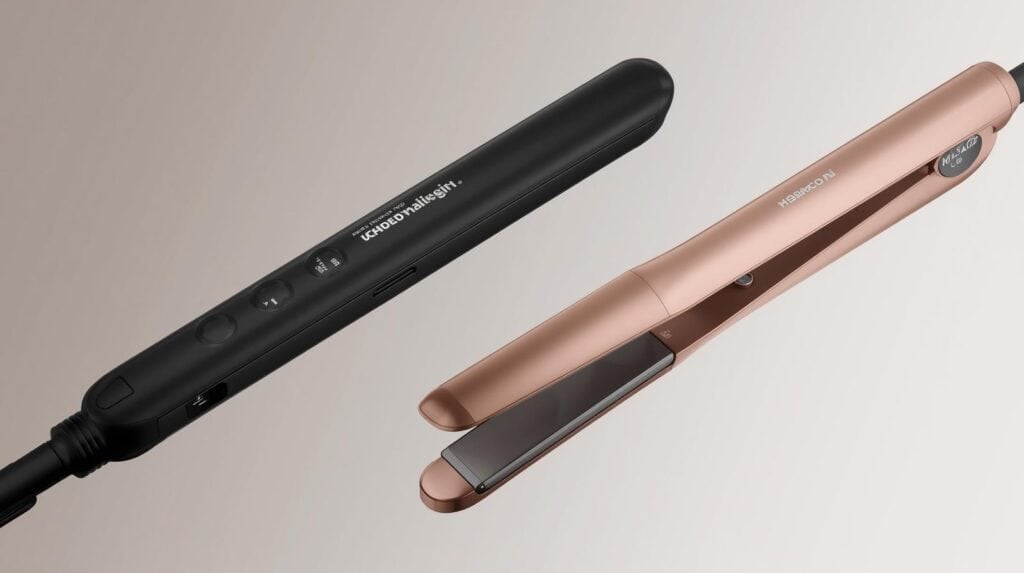
If you have short or fine hair, a narrower iron is usually easier to control and gives you more precision around the hairline.
For longer or thicker hair, wider plates can cover more surface area per pass and may reduce styling time, although they are less precise around roots, bangs, and short layers.
If you also use your straightener to create bends or curls, plate width and the shape of the housing matter too.
You do not need two straighteners unless you genuinely want one wide tool for bulk straightening and a narrower one for roots, bangs, curls, or touch-ups.
A wider tool is efficient for long sections, while a narrower tool gives more control for roots, face-framing pieces, and smaller touch-ups.
Heating Capability
More heat is not automatically better. What matters is reaching an effective temperature without exposing the hair to more heat than it needs.
Look for a flat iron with adjustable heat so you can start lower and increase only if the hair is not straightening efficiently.
Many modern flat irons reach 450°F, but that maximum is a capability, not a recommended everyday setting.
Fine, bleached, relaxed, porous, or already-damaged hair generally needs a more conservative approach, and even coarse hair can be damaged by excessive heat.
Do not use 450°F as a default. High temperature increases the chance of protein and cuticle damage, and even professional chemical services do not make that temperature universally safe.
Coarse or resistant hair may need more heat than fine hair, but use the lowest setting that straightens efficiently rather than automatically jumping to a tool’s maximum.
Higher heat can make straightening faster, but fewer passes at a moderate effective temperature may be preferable to repeated passes at maximum heat.
There is no universal temperature chart that fits every “normal,” curly, or textured hair type. Start lower, increase only if needed, and reduce heat for bleached, relaxed, chemically processed, fragile, or already-damaged hair.
Hair that straightens easily may need only moderate heat, which can reduce unnecessary thermal exposure and repeated passes.
Fine or fragile hair benefits from tools with lower adjustable settings, giving you room to find an effective temperature without unnecessary exposure.
With fragile hair, unnecessarily high heat can increase dryness, breakage, roughness, and loss of elasticity over time.
Wigs need their own heat rules because synthetic fibers can behave very differently from human hair.
If you style a synthetic wig, check whether the fiber is heat-safe before using any flat iron at all.
With synthetic wigs, do not use a regular flat iron unless the fiber is specifically labeled heat-resistant and includes a permitted temperature range.
Heat limits vary dramatically by synthetic fiber, so follow the wig manufacturer’s instructions rather than relying on a generic 140-170°F rule.
Temperature Mechanism
Knowing the actual temperature matters because the same numbered setting can mean very different heat levels from one tool to another.
For that reason, a clearly labeled dial or digital temperature display is more useful than vague low, medium, and high controls.
Common controls include temperature dials, indicator lights, and digital displays.
Indicator lights are simple, but they are most useful when each setting is tied to a clear temperature range.
A labeled temperature dial makes it easy to select a repeatable setting each time you style.
Either style of control can work well as long as the markings are clear and the heat can be adjusted in a useful range.
A digital temperature display is especially convenient because you can see the selected heat at a glance.
Many digital models use “-” and “+” buttons or preset steps, so you can make small, repeatable adjustments instead of guessing.
For most people, digital controls are the easiest option when precise heat adjustment is a priority.
Controls become less useful when the settings do not tell you the approximate plate temperature.
A number-only dial can be harder to interpret unless the manual explains what each number represents.
If the manual does not map those numbers to temperatures, it becomes harder to reproduce a safe, effective setting from one styling session to the next.
A fixed-temperature iron gives you even less flexibility.
Some flat irons operate at only one preset temperature.
A single-temperature tool is not automatically poor quality, but adjustable heat is much more useful when you want to tailor exposure to your hair’s condition and texture.
The Best Wet-to-Dry Flat Irons
| Rank | Product | Key Features |
|---|---|---|
| 1. | BaBylissPRO Nano Titanium Flat Iron | 5" nano titanium plates, one-pass styling |
| 2. | Croc Premium Flat Iron | Patented design, nano titanium, even heat |
| 3. | Remington Wet 2 Straight Hair Straightener | 32 heat settings, reduces damage |
| 4. | Remington Pro Wet2style Flat Iron | Reduces hair damage, 10 heat settings |
| 5. | Parwin Pro Beauty Flat Iron | Auto shut-off, ceramic tourmaline |
| 6. | Conair Tourmaline Wet/Dry Flat Iron | Smoothing, up to 350°, 25 heat settings |
| 7. | Thairapy 365 Wet or Dry Flat Iron | Wide plates, 4 temp settings |
| 8. | Jose Eber Wet And Dry Flat Iron | Dual voltage, ideal for dry or thick hair |
| 9. | FOXSMZZ Hair Iron | Heavy-duty, wide, up to 450°F |
| 10. | RoyalCraft Wet And Dry Hair Straightener | Ideal for fine or damaged hair |
| 11. | Instyler Max | Up to 425°, smooths and adds shine |
1. BaBylissPRO Nano Titanium Flat Iron – Not A Wet-to-Dry Model
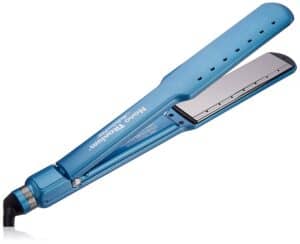
The linked BaBylissPRO Nano Titanium Ultra-Thin Flat Iron is a current titanium straightener, but it does not belong in a true wet-to-dry roundup.
This makes it easy for the plates to slide over your hair.
The current manufacturer directions say to glide it through dry hair, not damp hair.
The titanium plates are designed for fast, even heating and a smooth glide, which can be useful for efficient styling on dry hair.
Current BaBylissPRO product information for the Ultra-Thin model does not describe wet-hair use or steam-release vents.
It does have extended 5-inch plates and adjustable heat up to 450°F, but use this model on dry hair only unless your exact manual says otherwise.
The slim, lightweight body is also easier to maneuver during longer styling sessions. Its main limitation here is simple: this specific model should be treated as a dry-hair flat iron.
2. Croc Premium Flat Iron
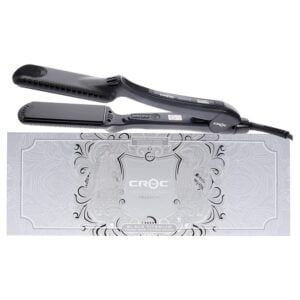
The CROC Premium 1.5-inch is a genuine wet-to-dry titanium flat iron still supported by current retailer documentation.
Its titanium plates, digital controls, and wider 1.5-inch format make it more practical for long or dense hair than a narrow one-inch tool.
Current listings describe ceramic heaters, digital temperature control, floating titanium plates, and a ventilation system designed for wet-to-dry use.
The curved housing and slip-resistant grip are designed to make the tool easier to hold during repeated passes.
Durability will depend on use and care, so treat longevity claims as product positioning rather than a guarantee.
If you leave this iron on, it will automatically shut off after 30 minutes for safety, and it includes a colour-changing heat indicator so you know when it’s on and heated.
3. Remington Wet 2 Straight Hair Straightener
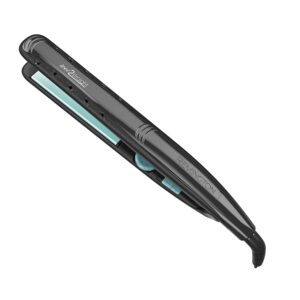
Remington Wet 2 Straight S7310 is an older wet-to-dry model that still appears through marketplace and international sellers.
Its defining feature is a vented plate design intended specifically for wet-to-dry styling.
The steam vents provide a path for moisture to escape while damp sections are being straightened.
As the damp hair is heated, moisture turns to steam and is released through the vents rather than being trapped between solid plates.
The vents are designed to let moisture escape as steam while you straighten, but wet-to-dry styling still exposes damp hair to significant heat.
Older Remington marketing attached large percentage-based damage-reduction claims to Wet 2 Straight models. Treat those as brand-specific laboratory comparisons, not proof that wet ironing is damage-free.
Another useful detail is its wet-to-dry indicator.
The wet-to-dry style indicator helps distinguish the settings intended for damp styling from those intended for dry hair.
On this model, a green light indicates the wet-styling range and an amber light indicates the dry-hair range, making the mode easier to read during use.
The S7310 listing describes a 1-inch plate, heat up to about 420°F, and multiple settings. Start below the maximum and increase only if needed.
Its 32 heat settings give you more room to adjust downward instead of relying on the maximum temperature, which is especially important for finer or more fragile hair.
4. Remington Pro Wet2style Flat Iron
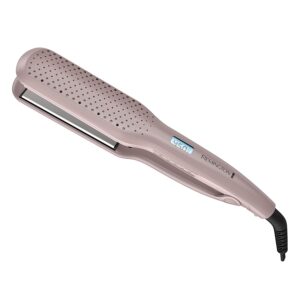
Remington Pro Wet2Style 1¾-inch Flat Iron is the strongest current, manufacturer-confirmed wet-to-dry pick in this roundup.
Its venting system is specifically designed to remove excess moisture while styling damp hair.
As you style, the vented plates allow excess moisture to escape as steam.
The important distinction is that this model was intentionally engineered for damp-hair use. A standard flat iron without wet-to-dry instructions should not be used as a substitute.
The appeal is convenience: it is designed to combine part of the drying and straightening process into one step.
A roughly 30-second heat-up also keeps the setup time short.
Remington currently claims 20% faster styling and 50% more protection versus standard drying and straightening with Remington tools in its lab testing, so those percentages should be read as a brand comparison rather than a universal result.
The tool can also switch between its damp-hair and dry-hair styling modes without changing devices.
On this model, holding the “+” control toggles the Wet2Style function, so check the indicator before starting on damp hair.
It has 10 digital heat settings and reaches 450°F, but curly or thick hair does not automatically require maximum heat. Use the lowest setting that works efficiently.
At 1¾ inches wide, the plates cover more surface area per pass, which can be useful for long, thick, or dense hair.
5. Parwin Pro Beauty Flat Iron – Verify Before Wet-Hair Use
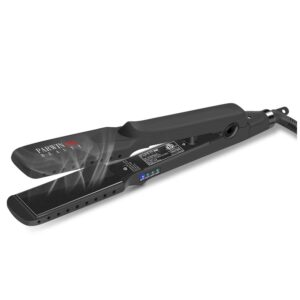
The preserved Amazon link points to an older PARWIN PRO BEAUTY plate-style straightener. Current documentation for similar Parwin models describes standard heated-plate use, while the brand’s newer true wet-to-dry product is a separate airflow straightener.
Because the exact linked model is not currently verified by the manufacturer as a damp-hair tool, do not use it on wet or damp hair unless the manual for your exact unit explicitly allows it.
Its useful verified features are adjustable heat, quick warm-up, auto shutoff, and ceramic-style plate construction.
The PTC heating system is listed with a fast warm-up time, which is convenient for quick dry-hair styling.
Auto shutoff is another practical safety feature.
It can reduce the risk of accidentally leaving the hot tool powered on for an extended period.
If you have forgotten to turn your iron off, it will turn itself off after 60 minutes without use.
It heats up to a maximum temperature of 450°F, and comes with 4 digital heat settings (starting at 330°F).
A 1.25-inch plate is a versatile width, but a high minimum temperature can still be too hot for some fragile, bleached, or very fine hair.
An 8-foot power cord gives you more freedom to position the tool around a vanity or styling area.
The ceramic and tourmaline-infused plates are designed to distribute heat and improve glide, but the finish will still depend on hair condition, products, temperature, and technique.
6. Conair Tourmaline Wet/Dry Flat Iron
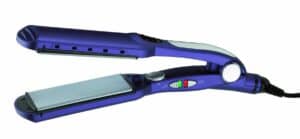
Conair’s Dry ‘N Straight Tourmaline Ceramic Wet/Dry Flat Iron is a genuine vented wet-to-dry design, although it is an older model.
Conair’s model stands out because its wet/dry positioning is supported by a vented design rather than simply being a standard flat iron sold beside damp-hair tools.
Like the Remington wet-to-dry models, it uses steam vents to give moisture a path out of the tool.
The side-venting system is designed to channel moisture from damp hair and release it as steam. That design helps moisture escape, but it does not eliminate heat damage.
No flat iron is damage-free. The realistic advantage here is that Conair designed this specific model for damp hair and included multiple heat settings rather than requiring one fixed temperature.
The ceramic and tourmaline plates are intended to provide even heat and a smoother glide through the hair.
Its multiple settings are useful if you need to stay below the tool’s maximum temperature, although fine hair still requires cautious heat selection.
Current catalog information for Conair’s 2-inch Wet/Dry model lists high heat around 400°F and 25 heat settings, so the older 350°F specification in this article should not be treated as current.
But if it works for you, you’ll love how precise a temperature choice you can get, as this iron comes with 25 different heat settings.
7. Therapy 365 Wet or Dry Flat Iron
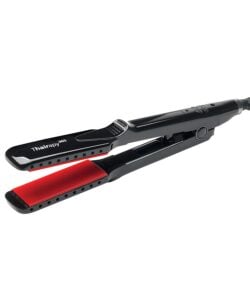
Thairapy 365 Wet or Dry Flat Iron is a legacy product that now appears mainly through resale and marketplace listings rather than a current first-party product page.
It is reasonable to be cautious with an older wet-to-dry design, especially because damp hair can be more vulnerable to heat-related structural damage.
That does not mean every wet-to-dry tool should be avoided, but it does mean the exact model, temperature, and technique matter.
If you already own this model, follow its original manual. If you are buying used or old stock, inspect the cord, plates, controls, and housing carefully before use.
The potential benefit is a shorter routine, not guaranteed protection from heat damage. It still applies direct heat to damp hair.
The model uses steam vents so moisture can escape as damp sections are heated.
Do not treat the tool as damage-free. High heat acts on the hair fiber, and repeated wet-to-dry styling can still contribute to dryness and breakage.
Its 1.5-inch plates can cover larger sections, which may appeal to people with long, thick, or dense hair.
It has a light-up temperature gauge, the lowest temperature being 320°F and the highest being 430°F, with 4 different temperature settings.
8. Jose Eber Wet And Dry Flat Iron
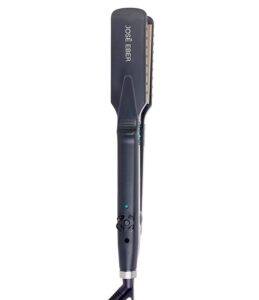
José Eber Wet or Dry Styling Iron is still listed by the brand as a wet/dry straightener, making it one of the better-supported products in this older roundup.
One useful feature of the José Eber flat iron is dual voltage, which can make it more practical for international travel when used with the appropriate plug adapter.
Current listings describe dual voltage and wide plates, but always confirm plug compatibility and voltage instructions before international travel.
For frequent travelers, that can be more useful than a model designed only for one voltage range.
José Eber markets the tool for both damp and dry hair. Towel-dry first, use a compatible heat protectant, and work in small sections rather than clamping soaking-wet strands.
The lightweight body is another advantage if you expect to pack it regularly.
Tourmaline-coated plates and ionic features may improve slip and reduce static, but they do not add water back into dry or damaged hair.
Any frequent high-heat straightening routine can leave hair feeling drier and increase breakage over time.
If your hair is already very dry or fragile, reduce heat and frequency rather than relying on “moisture-locking” claims to prevent damage.
The 1.5-inch width can be efficient on thick or textured hair, but its 450°F maximum should not be treated as the default setting.
One usability complaint worth noting is the placement of the power button.
Some user reviews report accidentally pressing it while styling, so hand placement may take some adjustment.
9. FOXSMZZ Hair Iron
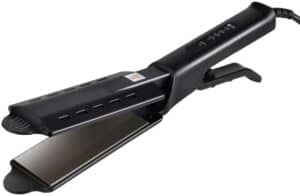
FOXSMZZ is another older marketplace-style listing with limited current first-party documentation.
Because current manufacturer instructions are difficult to verify, use damp hair only if the manual included with your exact unit explicitly confirms wet-to-dry operation.
The extra-wide format may feel less precise if you are used to a narrow one-inch straightener.
At nearly 2 inches wide, it is best suited to covering large sections of long or dense hair rather than detailed work near the roots.
The widened plate area is the main practical difference from a standard-width iron.
It can cover more hair per pass, although the actual styling time will depend on length, density, section size, and how many passes are needed.
Its venting layout is different from the clearly documented steam-release systems on some of the other models.
the vented design may help moisture escape, but it cannot guarantee that damp hair will stay moisturized or avoid thermal damage.
A finger guard at the end gives you a designated area to steady the tool while styling.
That can make the wide tool easier to control, but you should still avoid touching the heated plate area.
The listed heat range is broad, but the lower end still starts relatively hot.
With settings from 330°F to 450°F, it offers several choices, but a 330°F minimum may still be too hot for some fine, fragile, bleached, or highly porous hair.
10. RoyalCraft Wet And Dry Hair Straightener
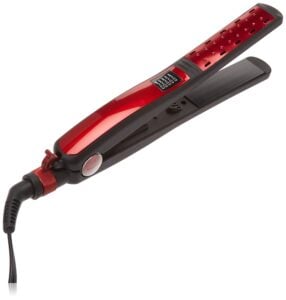
RoyalCraft Wet & Dry Professional Straightener remains visible through marketplace sellers as an older 1-inch wet/dry ceramic-tourmaline tool.
Marketplace documentation lists wet/dry use, water-drying vents, adjustable heat, dual voltage, and auto shutoff. Because first-party support is limited, verify the manual for the exact unit before damp-hair styling.
It should not be singled out as ideal for damaged hair; chemically processed or fragile strands need especially conservative heat regardless of plate material.
Its 1-inch plates are more precise than the wider models, while the high maximum temperature still calls for conservative heat selection.
The listed 30-second heat-up time is convenient, but the 450°F maximum is not a reason to use the tool at full heat.
Ionic features may reduce static and improve the feel of the finished style, but they do not reverse heat damage or literally moisturize the hair fiber.
A 360-degree swivel cord can make the tool easier to reposition while straightening, flipping, or curling sections.
The locking mechanism also keeps the plates closed for more compact storage.
That is useful for travel or for keeping the tool tidy in a drawer.
11. InStyler Max – Check The Exact Model
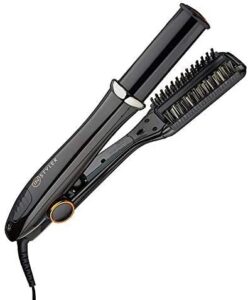
InStyler currently lists MAX 2-Way and MAX Wet-to-Dry as separate models in its manual library.
The InStyler design is different from a conventional flat iron because it pairs a rotating heated barrel with a brush rather than two flat plates.
That design gives it more styling versatility, but it also makes model identification especially important.
The rotating-barrel design can curl, straighten, or add volume, but it should not be described as incapable of heat damage.
The versatility is useful, but it does not make the tool heat-damage proof.
The preserved Amazon link is for the MAX 2-Way Rotating Iron. Do not assume that model is the same as the separate MAX Wet-to-Dry version.
Because it can straighten, curl, and add bend, it is built differently from a traditional clamp-style flat iron.
Instead of two heated plates, it uses a rotating barrel paired with a brush section that guides the hair as you style.
The design is distinctive, but results still depend on the exact model, temperature, section size, and technique.
The brush is intended to separate and guide strands around the heated barrel, helping the tool apply tension and heat more evenly.
The linked model uses a 1.25-inch barrel, a versatile size for smoothing or adding a bend, but remember that the preserved listing is not automatically the wet-to-dry version.
If wet-to-dry use is your priority, confirm that the product name and manual specifically say MAX Wet-to-Dry before using it on damp hair.
Use the temperature range specified for your exact InStyler model and choose the lowest effective heat, particularly on color-treated, fine, or fragile hair.
Wet-to-Dry Flat Iron FAQs
Can You Use A Regular Flat Iron On Damp Hair?
No. Unless the manufacturer specifically states that the exact model is designed for wet-to-dry use, wait until your hair is fully dry before using it. A vented appearance alone is not enough to confirm that a straightener is intended for damp hair.
How Wet Should Hair Be Before Using A Wet-to-Dry Iron?
Follow the manual for your exact tool. In general, wet-to-dry models are intended for towel-dried or damp hair, not dripping-wet hair. Remove as much excess water as the instructions recommend before you start styling.
Are Wet-to-Dry Flat Irons Damage-Free?
No heated straightener is damage-free. Wet-to-dry tools are designed to handle moisture more safely than a standard flat iron, but temperature, repeated passes, styling frequency, chemical processing, and the condition of your hair all affect the risk of dryness and breakage.
Should You Still Use Heat Protectant?
If the manufacturer allows it, use a heat protectant that is compatible with damp hair and with your styling tool. Apply it evenly, avoid soaking the hair with product, and follow both the product and appliance directions.
Related Articles
Steam Straightener Vs Flat Iron
Eyebrow Swelling After Waxing – What’s Going On?
How Long Should Pubic Hair Be To Wax?