What Will Happen If You Put Red Dye Over Green Hair?
If you love changing your hair colour, you already know that applying a new shade over an old one can create very unexpected results. That is especially true when you are trying to go from vivid green to red.
The more vivid or fashion-coloured your hair currently is, the more important it becomes to think about the existing pigment before applying a new shade.
That’s because many hair dyes are not fully opaque, so the colour already in your hair can influence how a new shade develops.
This gets especially tricky when the pigments you are layering can neutralize each other on the colour wheel.
With red over green hair, the result can look red, auburn, brownish, burgundy, muddy, or uneven depending on how much green remains and how deep the new red is.
So what will happen if you put red dye over green hair?
If the green is very faded, a deeper red may cover it reasonably well, although some areas can turn auburn or red-brown. If the green is still bright and saturated, red and green are more likely to neutralize each other and create a muted brownish, burgundy, muddy, or uneven result instead of a clean red.
If a clean, vivid red is your goal, the safest plan is usually to assess how much green is left, strand test, and fade or remove excess green first rather than assuming a red dye will completely cover it.
What Happens When You Put Red Dye Over Green?
Let’s start with the basics: different hair colours work in different ways. Some mainly deposit pigment on or near the cuticle, while permanent oxidative dyes also create colour changes inside the hair fibre.
When you add another colour over a previous dye, the existing pigment can still affect the result rather than simply disappearing underneath the new shade.
This means whenever you’re dyeing your hair multiple times, you need to consider how the old color will look mixed with the new color.
Depth matters just as much as hue. A deeper red can cover a pale, faded green more effectively than a light red can cover a dark or vivid green, but the underlying pigment can still shift the finished shade.
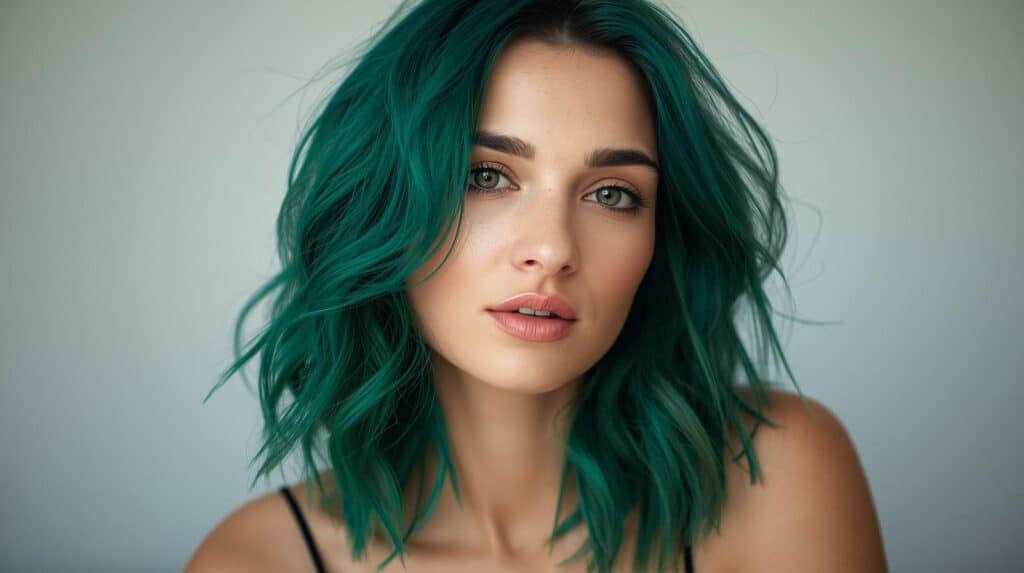
If the new colour is similar in depth or lighter than what is already there, the underlying pigment is more likely to show through and shift the result.
So, here’s what you can expect when you put red dye over green hair, depending on the lightness and vibrancy of each color:
If You Start With Faded Green On Light Hair
If your current hair color is a faded green, and your hair was light to begin with (for example, if you had blonde hair before you dyed it green), you’re in luck.
A vibrant red that is slightly deeper than the faded green may show up clearly, especially on a light base. Still, do a strand test first because leftover green can mute the red or pull it toward auburn or brown.
Areas with more green underneath may neutralize the red more strongly, so the finished colour can vary from red to auburn, brown-red, or a duller tone depending on how even the fade is.
If you want the red to look closer to the shade on the box or swatch, fade or remove as much green as practical first. A compatible colour remover may help with some artificial pigments, but direct dyes can be stubborn and may not disappear completely.
If You Start With Faded Green On Dark Hair
Let’s say you’re a brunette (brown hair or darker) who dyed your hair green a few months ago.
The green was probably deep and dark, too, if you never bleached it.
But now it has faded, and you only notice slight green undertones.
Can you dye your hair red?
If the green is very faded, a red dye may still show, but remember that depositing red does not automatically make a dark base lighter. On brunette or darker hair, the result is more likely to read as auburn, mahogany, burgundy, or a deep red than a bright fire-engine shade.
However, since your hair is already dark, the red will not come out bright like a firetruck.
Any areas holding onto more green may look browner or more muted than the rest, which is why an even fade and a strand test matter before a full-head application.
If you like a deep auburn or red-brown finish, that remaining muted effect may be perfectly workable. If you want a vivid true red, you will usually need a lighter, more even starting canvas.
To get a much brighter red on a dark base, some degree of lightening may be needed, but bleach is not the only possible route and it may not be appropriate for damaged hair.
Bleach can lighten both natural pigment and some artificial colour, but the result may pass through red, orange, yellow, or uneven stages rather than turning predictably yellow.
A lighter, more even base generally gives vivid red dye a better chance to look bright and true to the swatch.
If You Start With A Bright Green
If you currently have bright, saturated green hair, applying red directly over it is the least predictable scenario.
The two strong pigments can neutralize each other, leaving you with a muted brownish, burgundy, muddy, or patchy result rather than a clean, vibrant red.
This kind of neutralization may be useful if your goal is to move toward a more natural-looking shade, but it is still unpredictable enough that a strand test is worth doing first.
However, if you’re really itching to become a redhead, this isn’t the way to go about it.
To get the red color to show up, you’ll have to put in some work to get rid of the green color first.
In general, the more faded and even the green is, the better chance the red pigment has of reading clearly instead of being heavily neutralized.
So, before you dye your hair red, consider gentler fading methods first, then a compatible colour remover or professional lightening only if your hair can handle it.
How To Get Red Hair If You Have Green Hair
If your goal is a clear red result, start by deciding whether the remaining green is faint enough to cover or strong enough that it should be faded first. The more vivid the green is, the more useful fading or removal becomes.
These are the main ways to reduce or correct the green before going red, from gentler fading to more intensive colour correction:
Go To A Salon
If your green is very uneven, your hair has already been bleached several times, or you want a dramatic change in one appointment, going to a salon is the lowest-guesswork option.
A colourist can assess your current pigment, porosity, and hair condition before deciding whether you need fading, colour removal, lightening, or direct recolouring.
A good stylist can choose a lower-risk correction plan, although any colour-removal or lightening process can still cause some dryness or damage.
And if a little green remains, a stylist can adjust the red formula and depth to reduce unwanted muddiness and improve the odds of an even result.
To hear from a professional about removing green tones from hair, take a look at this video from Mirella Manelli on YouTube.
Try A Color Remover
If a salon visit is not practical, a colour remover may be worth considering before bleach, provided it is designed for the type of dye currently in your hair.
You can find colour removers online, like the Color Out System from PowerTools, and at beauty-supply stores or pharmacies.
Different colour removers work differently. Some reduce oxidative dye molecules so they can be rinsed out, while others are formulated more like fading or stripping treatments.
Some oxidative dye removers are designed to target artificial colour with limited effect on natural pigment, but you should not assume every remover works that way.
Tread carefully, however. Colour removers can leave hair dry, rough, or fragile depending on the formula and how many chemical services the hair has already had.
They can make your hair weaker and more prone to breakage.
Some colour removers have a strong sulfur-like odour, so use them in a well-ventilated area and follow the package safety directions.
Application varies by product, so do not assume every colour remover is used like hair dye. Mix, apply, process, and rinse only according to the instructions supplied with the specific remover.
Follow the instructions on the package for the best results.
After rinsing, you may reveal warmer underlying tones or an uneven base, and the green may not be completely gone, especially if it came from a direct dye.
After a removal service, condition the hair well and reassess how it feels before adding another chemical process.
Do not assume the hair is ready for another chemical service the next day. Follow the remover instructions and wait longer if the hair feels weak, overly elastic, rough, or fragile.
Try Bleach
Hair bleach can lighten the base and break down some artificial pigment, but it is the most aggressive option in this list and is not automatically necessary just because your hair is green.
Unlike many dye removers, bleach oxidizes natural melanin and can also break down some artificial pigments, so it changes both your natural base and existing colour.
If you’re a brunette underneath your green dye, bleaching can lift the base lighter, but reaching blonde may take more than one session and is not guaranteed or always safe.
A lighter, more even base can help you achieve a brighter red, but preserving the condition of the hair matters more than forcing it to a particular level in one session.
If you do not want to lighten the overall base, look for a remover that is specifically intended for your type of artificial dye and verify what effect it may have on natural pigment.
Bleach can be highly damaging, especially on previously lightened or repeatedly coloured hair, so a strand test and professional help are worth considering.
Developer strength and processing time should be chosen according to the bleach product, starting level, hair condition, and target. Avoid guessing at developer volume, and never exceed the manufacturer’s directions.
Bleach might not fully remove green pigment, and some direct dyes can shift unpredictably when lightened. Stop and reassess if the colour becomes patchy or the hair feels compromised.
Try Clarifying Shampoo
A clarifying shampoo like this one from Kenra Clarifying Shampoo can help fade your green hair color if the green dye you used was semi-permanent.
Use a clarifying shampoo occasionally according to its directions rather than washing 4-5 times in one session. Repeated back-to-back cleansing can leave the hair and scalp very dry or irritated.

Clarifying shampoo is generally a gentler first step than bleach, although it can still be drying. It works best on some semi-permanent or direct dyes and may take several washes over time to create noticeable fading. Follow with conditioner if your hair feels dry, and stop if your scalp becomes irritated.
Red Over Green Hair FAQ
Will Red Cancel Out Green Hair?
Red and green can neutralize each other, but that does not mean applying red will automatically create a perfect natural brown. The result depends on the depth, saturation, and evenness of both colours, so strong pigments can leave the hair looking brownish, burgundy, muddy, or patchy.
Can I Put Red Dye Over Faded Green Hair?
Often, yes. If the green is very faded and fairly even, a deeper red may show clearly enough for the result you want. A strand test is still important because sections holding more green can turn more muted or brown than the rest.
Do I Have To Bleach Green Hair Before Going Red?
No. Bleach is only one correction option. Depending on your starting colour and hair condition, gradual fading, clarifying shampoo, a compatible colour remover, or a professional correction may be more appropriate. Bleach becomes more relevant when you need a significantly lighter base for a brighter red, but it should not be the automatic first step.
Why Is A Strand Test So Important?
A strand test shows you how the remaining green and your chosen red interact on your actual hair. It can reveal unexpected browning, muddiness, unevenness, or excessive dryness before you apply the dye everywhere.
Final Thoughts
Dyeing green hair red is possible, but the cleanest result usually comes from matching the plan to your starting point. Very faded green may accept a deeper red with only slight muting, while vivid green is much more likely to neutralize the red and turn brownish, burgundy, muddy, or uneven.
If vibrant red is the goal, fade or remove as much excess green as your hair can safely tolerate, then strand test the red before committing to the full application.
Prioritize an even base and healthy hair over rushing the colour correction. A slightly deeper red on well-conditioned hair is usually a better outcome than repeatedly processing fragile strands just to chase maximum brightness.
Related Articles
Bleached Hair Turned Green (What To Do)