
Do Shampoo and Conditioner Freeze?
Hair-care storage is easy to overlook, especially when bottles spend time in bathrooms, cars, garages, delivery trucks, or other places where temperatures can swing from warm to freezing.
If you have ever found a bottle left in a cold car or received a winter delivery that feels partly frozen, the obvious question is whether the product is still usable.
The best storage conditions depend on the formula, but shampoos and conditioners generally stay most stable when they are stored within the manufacturer’s recommended temperature range and protected from extreme heat or cold.
That matters for hair care because freezing can affect the texture and uniformity of a formula even when the bottle looks normal from the outside.
Here is what can happen to shampoos and conditioners in freezing temperatures, how to thaw them, and which changes are signs that the product should be replaced.
So, do shampoo and conditioner freeze?
Yes, many shampoos and conditioners can partially or fully freeze if they get cold enough, but there is no single freezing temperature for every formula. Low temperatures can make a product thicken, turn slushy, separate, or freeze solid, and the expanding contents can also stress the packaging.
An accidental freeze does not automatically mean a bottle is ruined, but the product should be allowed to thaw completely before you judge its condition.
Can Shampoo And Conditioner Freeze?
Yes. Many shampoos and conditioners are water-based, so sufficiently low temperatures can make them thicken, become slushy, separate, or freeze.
There is no reliable universal freezing point such as 26°F (-3°C) for every shampoo or conditioner. Surfactants, salts, glycols, alcohols, oils, polymers, and other ingredients can shift when a particular formula starts to thicken, separate, or freeze.
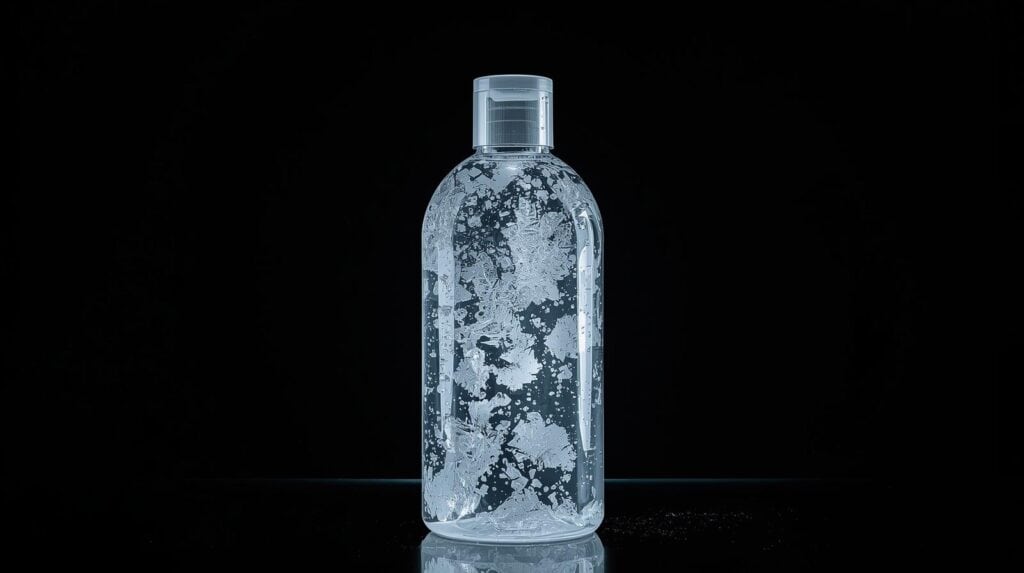
Water is a major component in many rinse-off hair products, but the finished formula does not behave exactly like plain water because it contains many dissolved and dispersed ingredients.
At low enough temperatures, some of that water can form ice crystals. As this happens, surfactants, conditioning agents, oils, thickeners, and other ingredients may become distributed unevenly. After thawing, the formula may return to normal, or it may remain watery, grainy, clumpy, or separated.
Will My Shampoos And Conditioners Turn Rock Solid?
Whether a product turns rock solid, stays partly liquid, becomes slushy, or simply gets much thicker depends on the individual formulation and how cold it becomes.
That freezing behavior is not a useful test of product quality.
Two products can react very differently to the same temperature because their proportions of water, surfactants, humectants, oils, salts, polymers, preservatives, and other ingredients are different.
A shorter ingredient list or more “natural” marketing does not reliably tell you how quickly a shampoo or conditioner will freeze.
Freezing behavior depends on the complete formula and ingredient concentrations, not whether the label describes the product as natural, clean, salon-quality, or anything similar.
If a bottle becomes slushy rather than solid, that simply means some parts of the formula have remained liquid at that temperature. It does not tell you whether the product is better or worse than one that freezes solid.
It also does not prove the formula contains a high percentage of alcohol. Several water-soluble ingredients can lower or broaden the freezing range.
There is little practical benefit to deliberately freezing a sample at home. Manufacturers use controlled stability testing because a kitchen-freezer experiment cannot tell you whether a formula still meets its original quality specifications after a freeze-thaw cycle.
If you want to know the recommended storage range for a specific bottle, check the label or contact the manufacturer rather than relying on a generic temperature rule.
Will My Products Change After They Defrost?
Freezing can change the texture and physical stability of a shampoo or conditioner, although one accidental freeze does not automatically mean the product is permanently damaged.
The outcome depends on the formula, how cold the product became, how long it stayed cold, the packaging, and whether the contents return to a uniform appearance after they are fully thawed.
Repeated freeze-thaw cycles are more concerning because they repeatedly stress emulsions, suspensions, thickeners, pumps, seals, and bottles.
When part of the water freezes, the remaining liquid can temporarily contain a higher concentration of the other ingredients.
That shift can contribute to phase separation or texture changes, but freezing by itself does not prove that the preservative system has failed.
Some products return to a uniform texture after thawing and gentle mixing, while others remain separated, grainy, watery, or unusually thick. Freezing alone does not automatically introduce bacteria, but a cracked container, broken seal, leak, or formula that no longer looks normal is a reason to be more cautious.
Are Thawed Shampoo And Conditioner Safe For My Hair?
If a thawed shampoo or conditioner does not return to a reasonably uniform appearance, smell, and texture, replacing it is the more cautious choice. Do not judge it while it is still partly frozen because the formula may not yet be evenly mixed.
A shampoo is not expected to make hair suddenly fall out at the root simply because it went through one freeze-thaw cycle.
However, a permanently separated formula may cleanse, condition, foam, spread, or rinse differently because the ingredients may no longer be distributed as intended.
Repeated exposure to temperature extremes can reduce product stability, but there is no universal rule for how much one freeze or several freezes will shorten shelf life.
Regardless of whether the product froze, an unexpected odor, color change, persistent separation, swelling, leaking container, or visible contamination is a reason to stop using it.
A changed smell does not specifically prove that cleansing performance is gone, but it can be a sign that the product has deteriorated. If the odor is clearly different from when the bottle was new, discarding it is the sensible option.
What To Do If Shampoo Or Conditioner Freezes
- Let it thaw completely at room temperature: Keep the bottle upright and wait until the contents are fully liquid or back to their normal consistency. Avoid microwaving, boiling, placing the bottle on a radiator, or using very hot water, which can damage the packaging or formula.
- Check the container: Freezing water expands, so inspect the cap, pump, seams, and bottle for cracks, leaks, bulging, or a broken seal. If a pump is frozen or stiff, do not force it.
- Mix gently only after thawing: Once the product is fully thawed, gently shake or roll the container if that is appropriate for the packaging. Vigorous shaking will not reliably fix a formula that remains permanently separated.
- Compare the texture, color, and smell: Look at the product after it has fully thawed. Persistent clumps, watery separation, graininess, a new odor, or a major color change are reasons to replace it.
- Ask the manufacturer when in doubt: The brand knows the intended storage range and stability testing for its own formula, so it can give more specific guidance than a generic freezing rule.
Frozen Shampoo And Conditioner FAQs
What Temperature Does Shampoo Freeze At?
There is no single freezing temperature for every shampoo. Pure water freezes at 32°F (0°C), but shampoo is a mixture. Salts, surfactants, glycols, alcohols, and other ingredients can change the temperature range in which the finished product thickens, becomes slushy, separates, or freezes.
Is Shampoo Ruined If It Freezes Once?
Not necessarily. Some formulas return to a normal-looking consistency after one accidental freeze-thaw cycle, while others remain separated or change texture. Let the bottle thaw fully, inspect the packaging, then compare the product’s appearance, smell, and consistency with how it normally behaves.
Can Freezing Make Shampoo Grow Bacteria?
Freezing does not automatically contaminate a sealed bottle. More practical concerns are physical instability, damaged packaging, a compromised seal, or a formula that no longer looks or behaves as intended after thawing.
Can You Keep Shampoo In A Cold Garage Or Car?
It is better to avoid repeated temperature extremes, so a cold garage, car trunk, porch, or other unheated space is not ideal for long-term storage. The FDA advises protecting cosmetics from temperature extremes because storage conditions can affect texture, color, smell, and overall stability.
Final Thoughts
Shampoo and conditioner are generally best stored according to the manufacturer’s directions rather than deliberately placed in a freezer or left somewhere that regularly drops below freezing.
If a bottle freezes accidentally during shipping, travel, or winter storage, let it thaw gradually at room temperature before deciding whether it is still usable. A partly frozen product can look uneven simply because it has not fully returned to its normal state.
Do not microwave, boil, or aggressively heat a frozen bottle to speed thawing. Once it is completely thawed, check the seal, packaging, smell, color, and texture. If the product remains separated or otherwise abnormal, the container is damaged, or the manufacturer advises against use after freezing, replace it.
Related Articles