
How To Use Stridex Pads
If you’ve been dealing with acne long enough, you’ve probably heard about Stridex pads.
Stridex pads are a popular over-the-counter acne treatment because they deliver salicylic acid in a quick, pre-soaked pad.
Stridex has been around since the ’70s, helping clear up faces for over 50 years now.
The reason this product has remained popular is that salicylic acid is an established acne ingredient, although results vary by skin type and the kind of breakout you have.
If you struggle with clogged pores or acne, Stridex pads can be one option to consider, especially if your skin tolerates leave-on salicylic acid.
But how do you use Stridex pads?
The simplest way to use Stridex pads is to cleanse your face, let the skin dry, gently swipe one pad over acne-prone areas while avoiding the eyes and lips, let the solution dry, and follow with moisturizer. Start less often if your skin is sensitive.
In this post, we’re going to go over how to use Stridex pads, how often you should use them, how quickly you can expect to see results, and what pitfalls to avoid for clearer skin.
What Are Stridex Pads?
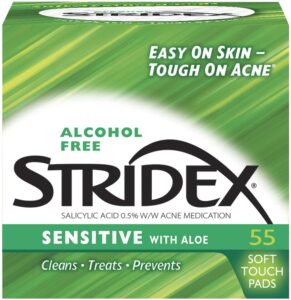
Before we dive in, let’s talk about what exactly Stridex pads are.
If you haven’t used anything like them before, they can seem a little mysterious.
Stridex is a brand that makes pre-soaked pads containing salicylic acid, a beta-hydroxy acid used to exfoliate inside pores and help manage certain types of acne.
The pads can help loosen dead skin cells and oil inside pores, which is especially useful for blackheads, whiteheads, and clogged pores.
The Maximum Strength version contains 2% salicylic acid, while other Stridex versions use lower concentrations. Always check the current label because formulas and product lines can change.
Both salicylic acid and benzoyl peroxide are commonly used for acne, but they work differently. The study linked here compared specific formulations and should not be taken to mean salicylic acid is universally better for every type of acne.
Salicylic acid is a beta-hydroxy acid (BHA) that helps exfoliate dead surface cells and penetrate oily pores, which is why it is often used for comedonal acne.
Sounds like a great tool for acne-prone skin?
They can be useful when used correctly, particularly for oily or clog-prone skin. The main challenge is finding a frequency that improves breakouts without causing excessive dryness or irritation.
How To Use Stridex Pads
Stridex pads are best used at the beginning of your skincare routine, right after cleansing.
Below is a sample skincare routine that incorporates Stridex pads, but bear in mind that yours may look a little different:
- Cleanse your face with a face wash.
- Let your face dry completely or pat it dry with a clean cloth.
- Gently swipe a single Stridex pad over acne-prone areas. Avoid the eyes, eyelids, lips, corners of the nose, and broken or irritated skin.
- Discard the Stridex pad.
- Allow the solution to dry on the skin. Unless the current label says otherwise, this is generally used as a leave-on treatment.
- Follow with a moisturizer. If you use other active treatments, introduce combinations cautiously instead of layering several potentially irritating products at once.
As you can see, using a Stridex pad is fairly easy and intuitive.
The product is already packaged in a ready-to-use format.
All you have to do is unscrew the jar, pull out a Stridex pad, and gently wipe it on your face.
When you pull out the Stridex pad, it will be soaked in the treatment solution.
Don’t wring it out. The pad is meant to be damp with the treatment solution, but you also do not need to scrub or repeatedly swipe the same spot to make it work.
In What Order Should Stridex Pads Be Used?
It is best to use the Stridex pads somewhere in the early stages of your skincare routine, after cleansing.
This is because Stridex is best treated as a leave-on medicated exfoliant rather than as a replacement for your regular cleanser.
An ideal order looks something like this:
- Makeup remover (if applicable)
- Cleanser/face wash
- Hydrating toner (optional, if it does not irritate your skin)
- Stridex pad
- Other treatment products, only if your skin tolerates the combination
- Serum
- Eye cream
- Moisturizer
Of course, your individual skincare routine may vary. You may use fewer or more products than this, and you might follow a slightly different order.
As a simple rule, use the Stridex pad after cleansing and before moisturizer. The exact placement of hydrating toners or serums is flexible, but avoid stacking irritating actives just because they appear in a routine list.
Do Stridex Pads Replace Toner?
In some cases, using a Stridex pad can replace your need for a toner.
This depends on what type of toner you usually use.
If your toner is an astringent or exfoliating type, using it in the same routine as Stridex may add unnecessary dryness or irritation. In that case, it is often simpler to use one active exfoliating step at a time.
You do not need an extra astringent step simply to make the skin feel more stripped or oil-free.
Also, the alcohol in the astringent toner, combined with the ingredients in the Stridex pad, may become irritating.
On the other hand, a simple hydrating toner may fit into the same routine if it does not sting or contain another strong exfoliant. Whether you use it before or after Stridex matters less than avoiding irritation.
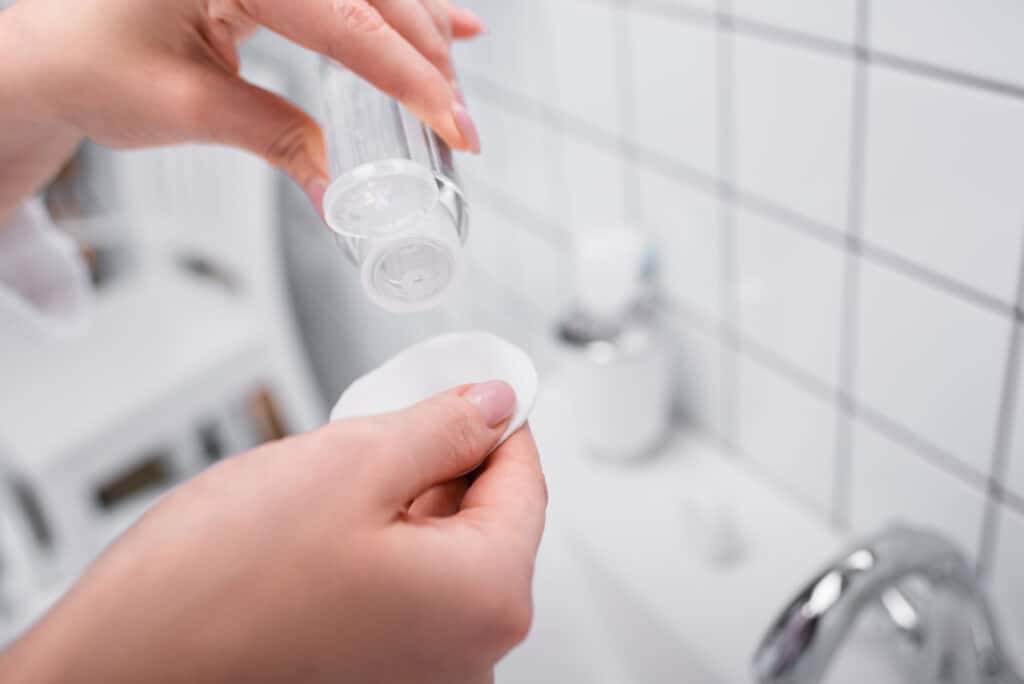
A hydrating toner applied gently after the Stridex solution dries will not automatically cancel the treatment. What matters more is whether the combination is comfortable and whether the toner itself contains potentially irritating actives.
Do Stridex Pads Replace Face Wash?
Since Stridex pads remove dirt and oil from your pores, it may be tempting to use them instead of a cleanser. But don’t make that mistake.
Stridex pads mainly work as a salicylic-acid treatment, not as a complete cleansing step for sunscreen, makeup, sweat, and surface debris.
But for them to do that effectively, you should first wash off the layer of oils, dirt, and makeup that has accumulated on your face during the day or night.
This is best accomplished with some water and a cleanser. Once your face is cleansed, you are ready to use the Stridex pads.
Should You Wash Your Face After Using Stridex Pads?
When you use a Stridex pad, it deposits some of the solution onto your skin.
Unless the current product directions say otherwise, the salicylic-acid solution is intended to remain on the skin rather than be rinsed off immediately.
Most people can leave it as is and apply other products over it once it dries.
That said, some people with sensitive skin may experience irritation from the Stridex solution.
If the product repeatedly causes burning, persistent redness, peeling, or significant discomfort, reduce how often you use it or stop and choose a gentler option rather than relying on a timed rinse-off workaround.
Salicylic acid does not need a special 30-to-60-minute contact window to be effective. Following the current label and adjusting frequency to your skin is more reliable.
You might also want to consider Stridex’s “Sensitive Skin” line, which has a lower salicylic acid concentration (0.5% instead of 2%) and includes aloe.
A lower-strength version may be easier to tolerate, although even lower concentrations can irritate very sensitive skin.
How Long After Using Stridex Pads Can You Moisturize?
After applying your Stridex product, you do not need to wait a fixed amount of time before moisturizing.
At a minimum, you should allow the Stridex solution to fully dry on your face.
Once the solution has dried enough that you are not rubbing it around, you can continue with a moisturizer or other gentle products.
For most routines, waiting until the skin feels dry is enough.
There is no need to build a mandatory 30-minute waiting period into your routine.
But not everyone has that much time to spare, especially if you’re getting ready for work or school in the morning.
You can apply a serum and/or moisturizer after the Stridex solution has dried. If your skin is easily irritated, a simple moisturizer is often more useful than layering several additional actives.
What Should You Avoid Mixing With Stridex Pads?
You do not necessarily have to avoid every other active ingredient forever, but combining too many exfoliating or drying treatments in one routine can make irritation much more likely.
Be especially cautious when using Stridex in the same routine as other salicylic-acid products, glycolic or lactic acid, strong exfoliating toners, retinoids, or benzoyl peroxide. Some people can combine these successfully, but it is usually easier to introduce one active at a time or alternate them on different days.
If your skin begins to sting, peel, feel unusually tight, or stay red, scale back the active products and focus on a gentle cleanser, moisturizer, and sunscreen until the skin feels comfortable again.
Do You Need Sunscreen With Stridex?
Yes, sunscreen is a good idea whenever acne treatments are part of your routine. Salicylic acid itself is not a substitute for sun protection, and irritated or over-exfoliated skin can be more uncomfortable in the sun.
In the morning, finish with a broad-spectrum sunscreen that you are comfortable wearing consistently. If Stridex makes your skin dry or sensitive, simplify the rest of the routine rather than trying to compensate with more actives.
How Often Should You Use Stridex Pads?
Some people can tolerate Stridex pads daily, while others do better using them only a few times per week.
Using salicylic acid twice a day may be too irritating for many people, especially when starting. More frequent use is not automatically more effective.
Many current Stridex pad formulas are marketed as alcohol-free, but alcohol-free does not mean irritation-free. Salicylic acid itself can still cause dryness, peeling, or stinging.
For sensitive skin, using twice a day or even once a day may still be too much, however.
If you know you have sensitive skin, start gradually, such as two or three times per week, and increase only if your skin remains comfortable.
It’s worth noting that everyone is different, so your mileage may vary.
Try out different schedules and see what works best for you.
How Soon Can You See Results From Stridex Pads?
As with most skin care products, the answer depends on your unique skin type and acne situation.
Some people notice fewer clogged pores within a few weeks, but acne treatments often need several weeks of consistent use before you can judge the overall result.
Some people might need more time to notice a difference.
As with most acne treatments, there may be a period of adjustment at the beginning of your treatment.
Some people report a temporary increase in blemishes after starting exfoliating actives, but not every breakout after a new product is a harmless “purge.”
If your skin looks worse, pay attention to the pattern. New breakouts in your usual acne-prone areas may be different from widespread redness, burning, itching, or peeling.
There is no guarantee that worsening acne will automatically resolve while you continue the product, so do not push through significant irritation.
If your skin is tolerating the product, give it several weeks of consistent use before deciding whether it is helping. Stop sooner if you develop a strong reaction.
Most acne treatments have to be used consistently for this long to see good results.
If after 6 weeks you are not seeing any improvement, it might be time to explore other products, including stronger treatments available from a licensed dermatologist.
Can Stridex Pads Make Acne Worse?
Your skin can sometimes look worse after starting a new acne treatment, but that does not automatically mean the product is working.
What people call “purging” usually refers to breakouts appearing sooner in areas where acne commonly occurs after starting an ingredient that increases cell turnover or exfoliation.
It is not automatically a good sign. Burning, intense redness, widespread bumps, swelling, or persistent peeling are reasons to reduce use or stop the product.

If you develop new breakouts after starting the product, look at where they appear and whether you also have irritation before deciding how to proceed.
Salicylic acid helps loosen dead cells inside pores, but worsening skin can also come from irritation, overuse, or a product that simply does not suit you.
New breakouts are not caused by salicylic acid “overwhelming” the skin and clogging pores. If breakouts increase, consider irritation, frequency of use, other products in your routine, and the possibility that the treatment is not a good fit.
If the treatment is helping, improvement is usually gradual rather than a guaranteed change after only a couple of days.
There is no predictable point at which breakouts will suddenly decrease exponentially. Judge progress over several weeks and adjust if irritation is increasing.
So the short answer is yes, acne can sometimes look worse after starting Stridex, but do not assume every worsening is a temporary purge. Irritation and product intolerance can look similar.
Please keep in mind that purging is not the same as irritation or an allergic reaction.
If your skin is showing signs of irritation, such as redness or peeling, it may indicate the product is too harsh for you.
You could try another acne product that is better for sensitive skin (Stridex has one, or you can look into another brand).
Or you might be allergic to salicylic acid, which is possible, albeit uncommon.
If you suspect an allergy, stop using the product immediately.
Do Stridex Pads Really Work For Breakouts?
Stridex pads can be effective for clogged pores, blackheads, whiteheads, and some inflammatory acne, particularly when salicylic acid is a good match for your skin.
They are not a replacement for regular cleansing. Their main advantage is the salicylic acid, which can penetrate oily pores and help reduce congestion.
Stridex pads and other salicylic acid products are mainly useful for clogged pores and acne vulgaris. They should not be treated as a proven treatment for so-called fungal acne, which is a different condition.
This means it works well for a wide range of people.
The most common problems are dryness, stinging, peeling, and irritation, especially if you use the pads too often or combine them with multiple strong actives.
Although the product contained alcohol in the past, it no longer uses it in the ingredients, which is a massive step in the right direction after a series of past complaints of irritation and dryness.
If you haven’t tried them before, they may be worth considering if your main concerns are oiliness and clogged pores. Start gradually and judge the product by how your own skin responds.
Finding The Best Stridex Pads For You
Stridex has released a few versions of its famous pads to tackle different skin types.
You should choose the right Stridex pad for your skin and the current level of your breakout.
Below are their most common products that you’ll be able to find on the market:
- Stridex Maximum Pads: These are the highest-strength option in the main lineup and are commonly sold with 2% salicylic acid.
They may suit oilier, more clog-prone skin, but stronger does not necessarily mean better if your skin becomes irritated.
You’ll usually recognise this product by its red packaging. Check the current label before buying. - Stridex Essential Pads: This version is commonly sold with 1% salicylic acid, which may be easier to tolerate than the 2% option while still targeting clogged pores.
Packaging and supporting ingredients can change, so check the current ingredient list rather than relying only on the jar color. - Stridex Sensitive Pads: This lower-strength option may be more comfortable if your skin is easily irritated. It is commonly sold with a lower salicylic acid concentration and soothing ingredients such as aloe.
Lower strength does not guarantee zero irritation, so start gradually and check the current label for the exact formula. It is often sold in green packaging.
Stridex occasionally releases other lines of acne pads and other products, but these three are their main offerings.
Stridex pads are straightforward to use, but they are still an active acne treatment. Introduce them gradually, moisturize consistently, and avoid piling on extra exfoliants if your skin is already dry or irritated.
We hope this post helps you in your journey towards clearer skin!
Stridex Pads FAQs
Can You Use Stridex Pads Every Day?
Some people can, but daily use is not required for everyone. Start a few times per week and increase only if your skin stays comfortable and your acne is improving.
Should You Moisturize After Stridex?
Yes. A simple moisturizer can reduce dryness and make it easier to tolerate salicylic acid consistently. You can apply it after the Stridex solution has dried.
Can You Use Stridex Pads On Your Body?
Salicylic-acid pads are sometimes used on acne-prone areas such as the chest or back, but follow the current product directions and avoid broken, freshly shaved, or irritated skin.
When Should You Stop Using Stridex?
Stop or scale back if you develop persistent burning, marked redness, swelling, hives, significant peeling, or worsening irritation. If acne is severe, painful, scarring, or not improving with over-the-counter care, consider seeing a dermatologist.
Related Articles
The Best The Ordinary Products For Fungal Acne
How To Trim False Eyelashes – Step By Step
Is It OK To Wear False Eyelashes Every Day?