
Benefits Of Oatmeal Soap
Oatmeal is not only a breakfast staple. In skincare, finely milled colloidal oatmeal is also used to help soothe and protect dry, itchy, or irritated skin.
Its best-supported benefits are soothing irritation, reducing itch, supporting the skin barrier, and helping skin hold onto moisture. It is not a cure-all, and the benefits depend on the product formula.
Many people are familiar with colloidal oatmeal baths, which are commonly used to help relieve dry, itchy skin from conditions such as eczema or temporary irritation.
Oatmeal soap can also be a useful option if you enjoy a bar cleanser and want the added feel of oats in your routine.
Oat-based skincare can suit many people, especially those dealing with dryness or itchiness, but not every oatmeal product is automatically gentle or suitable for every skin type.
Colloidal oatmeal is best known as a skin protectant and soothing ingredient. It may help relieve minor irritation and support moisture retention, but it should not be treated as a replacement for medical care when a skin condition is persistent or severe.
Ground oats can also provide very mild physical exfoliation, although heavily textured bars or aggressive scrubbing can irritate sensitive skin instead of improving it.
If you prefer simple formulas or oat-based skincare, an oatmeal cleanser or bath product can be an easy way to incorporate the ingredient.
DIY oatmeal products are possible, but making true soap with lye requires careful handling and accurate formulation. A simple colloidal oatmeal bath or mask is a lower-risk home option than making soap from scratch.
Still, oatmeal soap is also available on the market.
Do not assume that oatmeal soap contains no detergents, surfactants, fragrances, or other additives. Commercial formulas vary, so check the ingredient list if your skin is sensitive.
What are the benefits of incorporating oatmeal soap into your routine?
Oatmeal soap may help cleanse while offering some of the soothing and skin-protective qualities associated with oats. The biggest benefits come from the overall formula, especially whether it is gentle, fragrance-free, and appropriate for your skin.
Below, we'll look at what oatmeal soap is, which benefits are realistic, who may enjoy it, and how to use oat-based skincare without overdoing exfoliation or irritation.
What Is Oatmeal Soap?
Oatmeal soap is simply a soap or cleansing bar formulated with oats, often in the form of colloidal oatmeal or finely ground oat particles.
Colloidal oatmeal contains compounds such as beta-glucans, lipids, proteins, and antioxidant avenanthramides that can contribute to its soothing and barrier-supportive effects.
Oat-based products can be helpful for dry, itchy, or sensitive-feeling skin, but the cleansing base still matters. A strongly fragranced or high-pH soap may be irritating even if it contains oatmeal.
Oatmeal itself is not a complete cleanser. In an oatmeal soap, the soap or surfactant system does the cleansing, while the oats may add soothing, conditioning, or textural benefits.
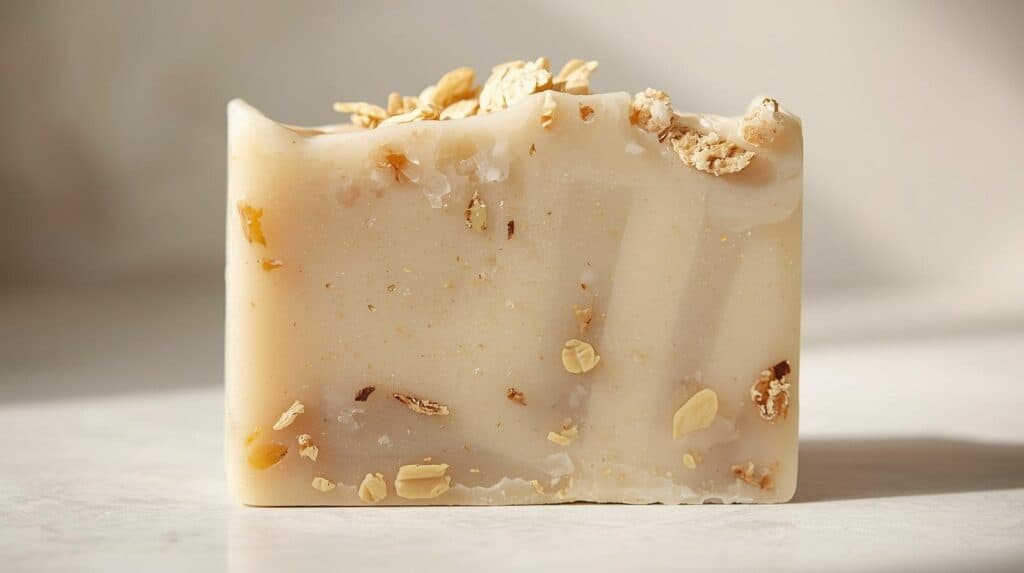
A well-formulated oatmeal cleanser can clean the face or body without feeling overly harsh, but true soap bars are alkaline and may still feel drying on some skin types.
Oatmeal can appear in cleansers, bath treatments, moisturisers, masks, and exfoliating products, each with different contact times and benefits.
In skincare, colloidal oatmeal refers to oats that are processed into very fine particles so they can disperse more evenly in water or a cosmetic formula.
This fine particle size helps colloidal oatmeal spread across the skin more evenly than coarse oat flakes, which is one reason it is commonly used in soothing bath and skincare products.
Benefits Of Oatmeal Soap
The most evidence-backed benefits of oatmeal are soothing itch, supporting the skin barrier, and helping protect dry or irritated skin. Oatmeal soap may offer some of these benefits, although rinse-off products have shorter contact time than baths or leave-on creams.
Oatmeal can be a useful skincare ingredient, but claims should be kept realistic. It can support comfort and moisture, while the rest of the formula determines how gentle the finished soap actually is.
Oatmeal is often well tolerated, but it is not automatically suitable for all skin types without exception. Fragrance, essential oils, exfoliating particles, and soap pH can all affect irritation risk.
Colloidal oatmeal is commonly used to calm dry, itchy skin and provide temporary relief from minor irritation.
It is often used as part of supportive care for eczema-prone or itchy skin, and oatmeal baths may also soothe irritation from conditions such as poison ivy or chickenpox. It does not treat the underlying infection or replace prescribed care.
An oatmeal bath can provide temporary soothing relief, especially for dry or itchy skin, but results vary and are not necessarily immediate for everyone.
If a bar contains visible oat particles, it may also provide mild physical exfoliation.
Keep pressure light. Gentle exfoliation can smooth flaky skin, while vigorous scrubbing can worsen redness or irritation.
Removing loose surface flakes can make skin feel smoother and look more even temporarily, but oatmeal does not chemically resurface the skin or erase pigmentation.
Oats contain antioxidant compounds, including avenanthramides, which are one reason colloidal oatmeal is studied for soothing irritated skin.
These compounds may contribute to the ingredient's anti-inflammatory and anti-itch properties, although the effect you get from a rinse-off soap depends on concentration and contact time.
For oily or breakout-prone skin, an oatmeal cleanser may feel soothing, but oatmeal itself is not an acne treatment.
There is not good evidence that oatmeal soap reduces the skin's natural sebum production. Oil control is more dependent on the cleanser base and the rest of your routine.
Likewise, oatmeal should not be expected to prevent breakouts on its own. Acne-prone skin usually benefits more from proven acne ingredients and a gentle, non-irritating cleanser.
For normal to dry skin, colloidal oatmeal can help support the skin barrier and reduce water loss, especially in leave-on creams or bath products.
Oatmeal does not need to “balance” the skin's pH to be useful. In fact, the pH of the finished cleanser matters more than the oats themselves.
Colloidal oatmeal can also feel soothing on mildly sun-irritated skin, but sunburn still requires sun avoidance, gentle care, and medical attention if it is severe or blistering.
Its main role is to temporarily soothe dryness and irritation while supporting the skin barrier as it recovers.
One important distinction: colloidal oatmeal itself can be soothing, but an oatmeal soap is only as gentle as its full formula. Fragrance, essential oils, rough oat pieces, and a high-pH soap base can all make a product less suitable for reactive skin.
Another thing to consider is contact time. A rinse-off soap stays on the skin briefly, so a colloidal oatmeal bath or leave-on moisturiser may provide more noticeable soothing benefits for very dry or itchy skin.
If you are choosing oatmeal soap mainly for itch relief or eczema-prone skin, look for a simple, fragrance-free formula and avoid aggressive scrubbing.
Even a gentle-looking product can cause irritation in some people, so patch testing is sensible if you have highly reactive skin or a history of contact allergies.
Oatmeal can help calm itch and dryness, but persistent rashes, spreading redness, broken skin, or signs of infection should be evaluated rather than repeatedly scrubbed or washed.
For eczema, psoriasis, poison ivy, or chickenpox, oatmeal is best thought of as supportive symptom relief. It does not cure these conditions or replace appropriate treatment.
Oatmeal baths may feel soothing, but they should not be described as guaranteed to have immediate effects for everyone.
Coarse oatmeal particles can physically exfoliate, while colloidal oatmeal itself is valued more for soothing and skin protection than for scrubbing.
If you want exfoliation, use a light touch and stop if the skin becomes red, stings, or feels more irritated afterward.
For dull or flaky skin, removing loose surface cells can make the skin look smoother temporarily, but it will not permanently brighten or change your natural skin tone.
Oatmeal contains antioxidant compounds that may help support its soothing effect on irritated skin.
Its anti-inflammatory properties are most relevant to minor irritation and itch, not as a stand-alone treatment for inflammatory skin disease.
Oily or breakout-prone skin can still use oatmeal products, but the best cleanser is one that removes excess oil comfortably without leaving the skin tight or irritated.
Oatmeal does not directly switch off oil production. If excess oil is a concern, look at the complete formula and your wider skincare routine.
Reducing irritation can sometimes make skin look calmer, but that is different from preventing acne breakouts.
Dry skin may benefit from colloidal oatmeal's barrier-supportive and moisturising properties, especially when paired with a fragrance-free moisturiser after cleansing.
Again, oatmeal is not proven to “balance” the skin's pH. If your skin is easily dried out, a gentle low-pH cleanser may be more comfortable than traditional soap.
Oat-based products can feel calming after mild environmental irritation, but sun protection and avoiding further exposure are more important than any single soothing ingredient.
Think of oatmeal as a supportive skin-comfort ingredient, not a treatment that speeds every type of skin repair.
If you have a known oat allergy or repeatedly notice itching, swelling, or a rash after using oat products, stop using them and speak with a healthcare professional if symptoms are significant.
Differences Between Regular Soap And Oatmeal Soap
Whether oatmeal soap is better than a regular bar depends on the entire formula, not the presence of oatmeal alone.
A mild fragrance-free syndet bar may be gentler than a traditional oatmeal soap, while a well-formulated oatmeal cleanser may feel better than a heavily fragranced soap.
Oats contain lipids and antioxidant compounds, but describing oatmeal soap as rich in vitamin E can be misleading because the amount present and its effect vary widely by formulation.
Oatmeal does not replace the cleansing system, so oatmeal soap still requires soap or surfactants. Some formulas are simple, while others contain fragrances, colours, exfoliants, or additional skincare ingredients.
Traditional high-pH bar soap can feel drying on sensitive skin, while gentler syndet bars or cleansers are often better tolerated.
If your oatmeal bar contains coarse oat pieces, use it gently on the body. For the face, a smoother cleanser is often a better choice if your skin is sensitive or acne-prone.
Any cleanser can feel too drying if it is too harsh for your skin, used too often, or followed by no moisturiser.
That dryness can lead to tightness, flaking, itchiness, and a rougher-looking texture.
How To Use Oatmeal Soap Or Oatmeal In Skincare
There are several ways to use oatmeal or colloidal oatmeal in a skincare routine, from cleansers to baths and leave-on moisturisers.
If you want an oat-based facial cleanser, choose a formula made specifically for the face (we love this one from Aveeno).
A commercial facial cleanser is generally easier to assess for ingredients and pH than a homemade true soap.
How often you use it should depend on your skin. If your face feels tight, stings, or becomes flaky, reduce frequency or switch to a gentler cleanser.
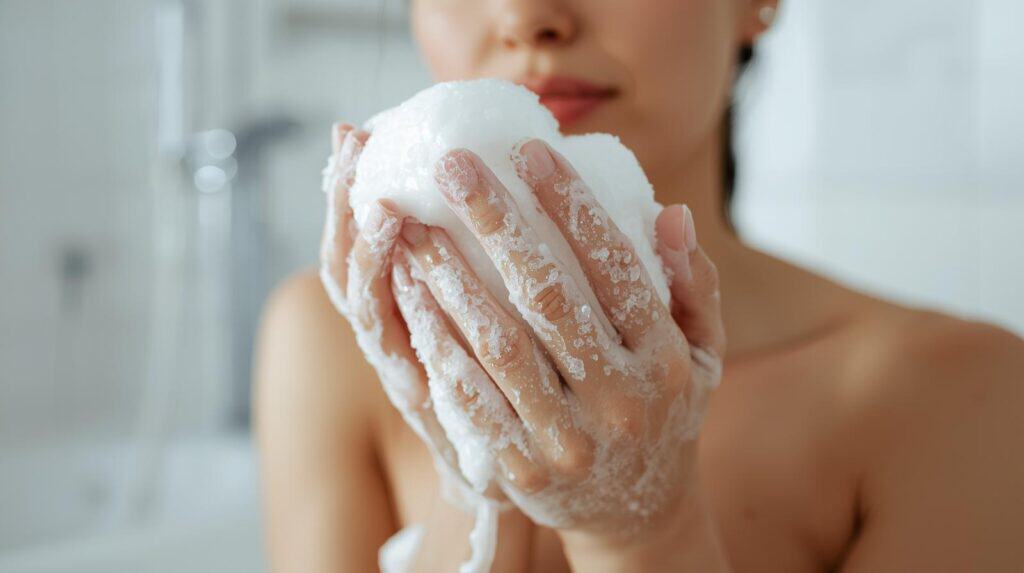
If you want light exfoliation, an oat-based scrub or wash can be used carefully on the face or body (we suggest trying this one from St. Ives).
Do not assume oatmeal makes every manual exfoliator gentle. Particle size, pressure, and frequency all matter, especially if your skin is sensitive.
There is no universal need to exfoliate several times a week. Start infrequently and adjust based on how your skin responds.
Oatmeal also appears in masks and leave-on treatments (check out this one from Aveeno), where the longer contact time may be more useful for soothing dry skin.
An oatmeal face mask is not automatically right for every skin type. Check the full ingredient list, especially for fragrance, essential oils, or other potential irritants.
For oily skin, choose a lightweight non-comedogenic formula. Oatmeal itself should not be expected to control sebum or prevent acne.
Oatmeal soap can also be used as an all-over body cleanser.
Bar formulas are convenient for the shower, but the most important factors are gentleness, fragrance level, and how your skin feels after rinsing.
If you have sensitive or itchy skin, a fragrance-free oat cleanser may feel soothing. Avoid scrubbing inflamed areas with rough oat particles.
For widespread dryness or itch, an oatmeal bath (we love using this soothing bath treatment from Aveeno) can be a comfortable way to use colloidal oatmeal over a larger area of skin.
Colloidal oatmeal baths are commonly used to help temporarily relieve itch from conditions such as eczema, poison ivy, or chickenpox. They do not treat the underlying cause.
They can also be used simply as a soothing bath for dry skin. Keep the water lukewarm rather than hot, and moisturise soon after bathing.
Types Of Oatmeal Soap
When used in skincare, oatmeal may appear as finely milled colloidal oatmeal or as more visibly textured ground oats, depending on the product.
Colloidal oatmeal is processed finely so it can disperse through water or a formula and sit more evenly on the skin.
Oatmeal cleansing bars are available in many formulas, including true soaps and gentler soap-free cleansing bars.
Some have a smooth texture, which may be more comfortable for sensitive skin.
Others contain larger oat particles for physical exfoliation. Those can feel scratchy on inflamed, eczema-prone, or freshly shaved skin.
DIY oat-based masks and baths can be simple, but true soapmaking is a chemical process and requires correct lye calculations, protective equipment, and safe curing practices.
For an easy at-home option, a colloidal oatmeal bath or simple oat mask is much more beginner-friendly than making lye soap.
Homemade oat products should be prepared fresh and kept clean, since water-based DIY mixtures generally do not contain preservatives.
If you are shopping for oatmeal soap, compare the full ingredient list rather than focusing only on whether the label says “natural.”
Traditional soap can be made with the cold-process method, where oils and lye are mixed without prolonged external cooking after combination.
With the hot-process method, additional heat is used to speed the saponification process. Both methods still require careful lye handling and an accurately formulated recipe.
Oatmeal soap can also contain ingredients such as honey, oils, butters, fragrance, or clays. These additions may change texture and feel, but they can also affect irritation risk.
Honey is sometimes paired with oatmeal because it is a humectant and can contribute to a moisturising feel.
Do not expect honey in a rinse-off soap to permanently brighten discoloration or even out skin tone. Those claims are much stronger than the evidence supports.
Oatmeal can gently smooth flaky surface skin, but it does not reliably fade pigmentation or unclog pores simply because it is physically exfoliating.
Honey can act as a humectant, helping attract water in cosmetic formulas, but the effect depends on concentration and the finished product.
Oatmeal and honey can make a pleasant combination, but neither ingredient guarantees redness reduction or irritation relief for every user.
Both ingredients are popular in skincare, but it is best to focus on their moisturising and soothing potential rather than broad “healing” claims.
When combined in a well-formulated product, oatmeal and honey may suit many people, but fragrance, soap pH, and other ingredients can matter just as much.
When making an oat-based DIY product, use oats that are suitable for skin contact. If you buy whole, natural oats, they are not the same thing as cosmetic-grade colloidal oatmeal.
Colloidal oatmeal is finely processed for skincare use. Simply grinding kitchen oats at home may not produce the same particle size, dispersion, purity, or consistency.
If you want to include honey, remember that “raw” does not automatically mean safer or more effective for skincare. Clean handling and a properly formulated product matter more.
Oatmeal products can suit many skin types, but people with oat allergy or a history of reactions to oat-based skincare should avoid them or discuss use with a healthcare professional.
Conclusion
Overall, oatmeal soap can be a soothing cleansing option, particularly if the formula is gentle and your skin tolerates it well.
Its most realistic benefits are supporting comfort, reducing the feeling of dryness, and adding a mild oat-based skincare element to your routine.
Whether you choose a pre-made bar or another oat-based product, focus on formula quality, fragrance level, and how your skin responds rather than assuming “natural” automatically means gentle.
Oatmeal soap comes in many formulations, from traditional bars to soap-free cleansing bars with colloidal oatmeal.
If your main goal is to calm widespread dry or itchy skin, a colloidal oatmeal bath may be more useful than scrubbing the area with a textured soap bar.
In the shower, use oatmeal soap gently and avoid aggressive scrubbing. A bar with coarse oat pieces may provide exfoliation, but that is not ideal for every skin type.
For the face, choose a product that is specifically formulated for facial skin. Oatmeal itself does not control oil or treat acne, and some traditional soaps may be too drying.
A leave-on oat mask or moisturiser can provide longer contact with the skin than a rinse-off cleanser, which may be preferable when soothing and hydration are the main goals.
Do not rely on oatmeal soap to balance the skin's pH. Instead, pay attention to the pH and cleansing strength of the complete product.
Oat-based skincare can work across many skin tones and types, but the best results come from matching the whole formula to your individual skin.
Colloidal oatmeal is a well-established soothing skin-care ingredient, especially for dryness and itch.
Oatmeal soap can be one way to use it, but it is not automatically better than every other cleanser. Choose the format that best fits your skin and your routine.
Related Articles
Best Razors With Soap Attached