
How Long Does Hair Need To Be For Extensions?
Hair extensions can be a useful option if you want to add length, volume, or fullness without waiting for your natural hair to grow out.
They can also add noticeable volume and thickness, depending on the extension type, placement, and how much hair your natural strands can safely support.
If you’re thinking about getting hair extensions, one of the first questions is whether your natural hair is long enough for them to blend and attach securely.
Very short hair can make extension attachment points harder to conceal, but some methods work better on short hair than others.
With the right method, colour match, placement, and cut, extensions can blend into relatively short hair.
So, how long does hair need to be for extensions?
There is no single minimum length for every extension method. As a general guide, many professional methods work best once natural hair is around 3 to 5 inches long, while some clip-in styles need more length for the clips and wefts to stay hidden.
You do not necessarily need long hair to wear extensions, but length, density, and hair condition all matter.
Below, we’ll look at common extension types, the approximate amount of natural length they usually need, and what to consider before installation.
Hair Lengths For Getting Extensions
There is no universal rule that 3 inches is automatically enough for every extension method. The safe and natural-looking minimum depends on your hair density, the installation technique, and how well the attachment points can be concealed.
But the type of hair extensions matters.
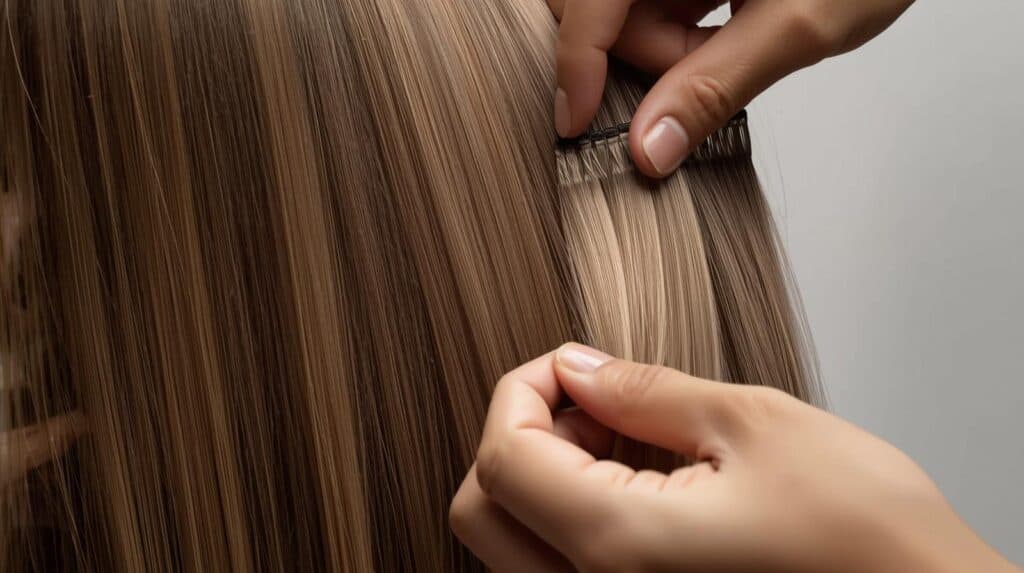
Some methods work better with more length than others, so the figures below should be treated as practical estimates rather than hard rules. A professional extension stylist can assess your individual hair more accurately.
Tape-In Extensions
Tape-in extensions are a popular semi-permanent option that uses thin wefts attached close to the scalp.
The extension wefts come with an adhesive strip and are usually installed by sandwiching a thin section of natural hair between two taped pieces.
Your stylist positions the tape close to, but not directly on, the scalp. Many tape-in systems use pressure-sensitive adhesive and do not require heat activation, although installation instructions vary by brand.
Tape-ins usually need to be moved up or reinstalled as your hair grows, often within several weeks rather than being left untouched for months.
Removal typically involves a solvent made for the adhesive system so the tapes can slide apart without excessive pulling.
For short hair, tape-ins generally need enough length and density to hide the adhesive tabs. Around 3 to 4 inches may work for some people, but more length often gives a more seamless result.
The goal is not just to attach the extension, but to have enough natural hair above it to conceal the tape and blend the shorter layers into the added length.
Keep in mind that your hair will fall over the extensions, creating the illusion of shorter layers draped over longer ones.
Sewn-In Extensions
Sewn-in extensions, often called sew-ins or weaves, are typically attached to a braided foundation or another secure base created with the natural hair.
They can feel secure because the weft is sewn to the prepared base rather than attached strand by strand.
A secure install still depends on the braid pattern, hair density, scalp comfort, and how much tension is used.
Cost and maintenance vary widely. Sew-ins usually need regular professional maintenance and eventual removal rather than simply being left in indefinitely.
For a traditional sew-in, many stylists prefer at least 4 to 5 inches of natural hair so there is enough length to braid, secure, and blend the leave-out if you are using any.
Some installs may be possible with shorter hair, but very short strands can make braiding, concealment, and tension control more difficult.
More length usually gives the stylist more flexibility to create a stable foundation and disguise the attachment points.
Clip-In Extensions
Clip-in extensions (we love the amazing ones available on Amazon) are a temporary option that you can usually apply and remove yourself.
They come in small bunches of hair with a clip attached at the root area.
Whenever you want longer hair, you clip them in at the base of your natural hair and let your top layers drape over them.
The best thing about clip-in extensions is that you can put them in and take them out whenever you like.
Because clip-ins are removable, they are best taken out before sleeping, exercising heavily, or doing anything that could put extra tension on the clips.
These extensions require no commitment on your part, making them a popular choice for many people.
If you’ve decided to get clip-in extensions, how long does your hair need to be to wear them comfortably?
Clip-ins generally need more natural length than tiny professional attachment methods because the clips and wefts need enough hair above them to stay hidden. Around 5 to 7 inches can be a useful starting point, although placement and hair density matter just as much.
If you’ve never worn clip-in extensions and want to give them a try, take a look at this tutorial from Luxy Hair on YouTube.
Beaded Extensions
Beaded extensions include several methods that use small beads or rings to secure extension hair without glue.
Depending on the system, a bead may secure an individual extension strand or help anchor a weft.
These methods avoid adhesive, but they are not automatically gentler than every other option. Too much weight, tight placement, or poor maintenance can still cause tension and breakage.
Installation can take several hours, especially for strand-by-strand methods, and the final result depends heavily on the stylist’s technique.
Beaded extensions usually need to be moved up as the hair grows. Maintenance timing varies by method and individual growth rate.
If you’re considering beaded extensions, around 3 to 4 inches of natural hair may be enough for some systems, but extra length and density make concealment easier.
Keratin Bond Extensions
Keratin bond extensions, also called fusion or pre-bonded extensions, use small keratin-based bonds to attach extension strands to the natural hair.
They are usually installed strand by strand, so the process can take several hours.
When colour, density, bond size, and placement are matched well, keratin bonds can look very natural and discreet.
They can be worn for an extended period, but they still require maintenance and should be removed or repositioned according to the stylist’s guidance.
Professional removal usually involves a bond-removal product and careful mechanical breakdown of the attachment rather than simply pulling the extension away.
Many stylists prefer at least 4 inches of natural hair for keratin-bonded extensions so there is enough length to conceal the bonds and blend the finished style.
Is There A Maximum Natural Hair Length For Extensions?
Most extension advice focuses on minimum natural hair length, because very short hair is harder to blend and attach discreetly.
But is there a maximum length?
There is generally no maximum natural hair length that prevents someone from wearing extensions.
In fact, many people do.
People with already-long hair may use extensions to add density, colour effects, or extra fullness, not just length.
Extension hair is sold in many lengths, and some brands offer very long pieces. Availability varies, so there is no universal maximum such as 30 or 32 inches.
If your natural hair is longer than the extensions you buy, the added pieces can still be used for density or colour, but they need to be cut and blended carefully so the difference in length is not obvious.
You could make it work by getting layers cut into your hair and incorporating the hair extensions among some of your layers.
A layered cut can sometimes help the natural hair and extensions blend more smoothly.
What Are The Best Hair Extensions For Short Hair?
If your hair is on the shorter side, the best extension method is the one that can be installed securely while keeping the attachment points hidden and avoiding too much tension.
You want the extensions to blend naturally, but protecting the condition of your hair and scalp is just as important as concealment.
You also want the attachment area to be discreet enough that it does not show through your top layers.
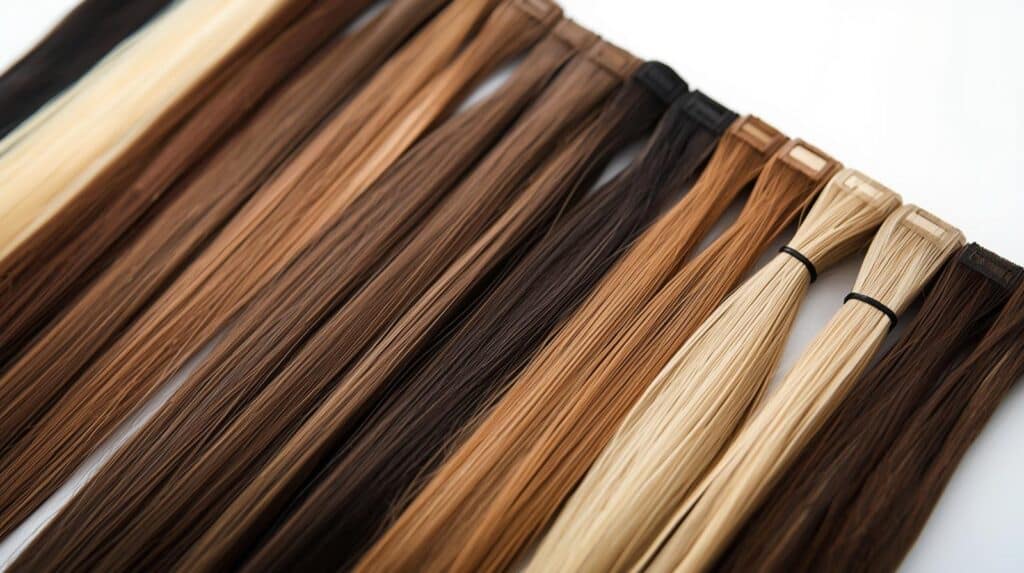
Beaded extensions can work on some short hairstyles because the attachment points can be small and placed close to the scalp, but they are not automatically the best choice for everyone.
How discreet they look depends on the bead size, placement, density of your natural hair, and how much hair is available to cover the attachments.
Some beaded systems may be possible once the hair is around 3 to 4 inches long, although a stylist should confirm that your strands are strong enough to support the added weight.
If you have a little more length, keratin bonds, tape-ins, or another professional method may also work depending on your density and the finished look you want.
The most natural option for short hair is usually the one your stylist can place discreetly and blend without overloading small sections of natural hair.
Do Hair Extensions Damage Your Hair?
Hair extensions do not automatically damage your hair, but any extension method can contribute to breakage, traction, or scalp irritation if it is too heavy, too tight, poorly maintained, or removed incorrectly.
If your hair is already fragile, thinning, or breaking, it is worth having a stylist or dermatologist assess the cause before adding more tension or weight.
Extensions can give an immediate cosmetic change, but they do not treat underlying thinning, shedding, or breakage.
Still, they won’t address the core problem, and might actually exacerbate it (see our article: My Hair Is So Thin After Extensions – How to Get Your Volume Back).
Fragile hair can be more vulnerable to breakage under the added weight and tension of extensions.
This risk is not limited to one or two methods. Keratin bonds, sew-ins, tape-ins, beaded systems, and clip-ins can all cause problems if they are too tight, too heavy, or repeatedly placed on the same weak areas.
The safest approach is to match the extension weight and placement to the strength and density of your natural hair, and to remove the extensions properly.
If your hair is fragile but you still want temporary length or volume, clip-ins may reduce the amount of continuous wear time because you can remove them at the end of the day.
However, clips can still cause tension or breakage if they are too heavy or repeatedly attached to the same small sections.
Rotate placement when possible, keep the pieces lightweight, and remove them gently rather than sleeping in them.
If you want something more permanent, ask an experienced extension stylist which method can be customized with the least weight and tension for your particular hair.
No extension type is universally “gentle enough.” Good results depend on proper installation, appropriate weight, regular maintenance, and careful removal.
Related Articles
My Hair Is So Thin After Extensions – How To Get Your Volume Back
Micro Bead Hair Extensions Pros And Cons
Least Damaging Hair Extensions