How To Fix Eyelashes That Grow In Different Directions
Eyelashes help protect the eyes, and it is common for a few lashes to sit at slightly different angles. The important distinction is whether the issue is simply cosmetic or whether a lash is actually turning inward and rubbing the eye.
For harmless cosmetic unevenness, lash lifts, clear mascara, a clean spoolie, or an eyelash curler can make the visible lashes look more uniform. These methods style the hair that is already there rather than changing the follicle.
Your natural eyelashes grow from individual follicles, and each follicle’s position and angle helps determine the direction of the lash.
Genetics influence lash length, density, growth cycle, curl, and follicle orientation, which can make some lashes naturally point in different directions.
Most uneven lash direction is harmless and related to follicle orientation, but lashes that suddenly turn inward, rub the eye, or appear with pain and redness can signal an eyelid or lash disorder that needs medical evaluation.
For cosmetic unevenness, temporary styling methods can make the lash line look more aligned even though they do not permanently redirect the follicle.
How can you fix eyelashes that grow in different directions?
You can temporarily guide lashes with a clean spoolie, clear mascara, a lash curler, or a professionally performed lash lift. These methods change how the lashes sit, not the direction the follicle grows. If lashes turn inward and touch the eye, seek an eye-care professional rather than trying to train them at home.
If a lash repeatedly touches the eye, causes pain, or is accompanied by persistent redness, tearing, light sensitivity, or vision changes, an optometrist or ophthalmologist is more appropriate than a cosmetic lash service.
For mild cosmetic unevenness, grooming is usually enough. For inward-growing or symptomatic lashes, professional evaluation is the safer route.
Quick Guide: Cosmetic Unevenness Or An Eye Problem?
- A few lashes cross, point sideways, or sit lower than the rest: usually a cosmetic issue that can be groomed with a spoolie, clear mascara, or curler.
- Lashes point inward but do not touch the eye: avoid aggressive plucking or chemical services and monitor for irritation.
- A lash repeatedly rubs the eye: this can be consistent with trichiasis or another eyelid problem and is worth professional evaluation.
- Pain, persistent redness, tearing, light sensitivity, discharge, or vision changes: seek eye-care advice promptly rather than relying on cosmetic lash styling.
Why Do Eyelashes Grow In Different Directions?
A few lashes pointing differently from the rest is common and does not necessarily mean anything is wrong.
It is relatively normal for lashes to grow at slightly different angles because each follicle has its own position and orientation.
The cause can range from completely normal follicle orientation to previous eyelid inflammation, scarring, trauma, or a condition that redirects lashes toward the eye.
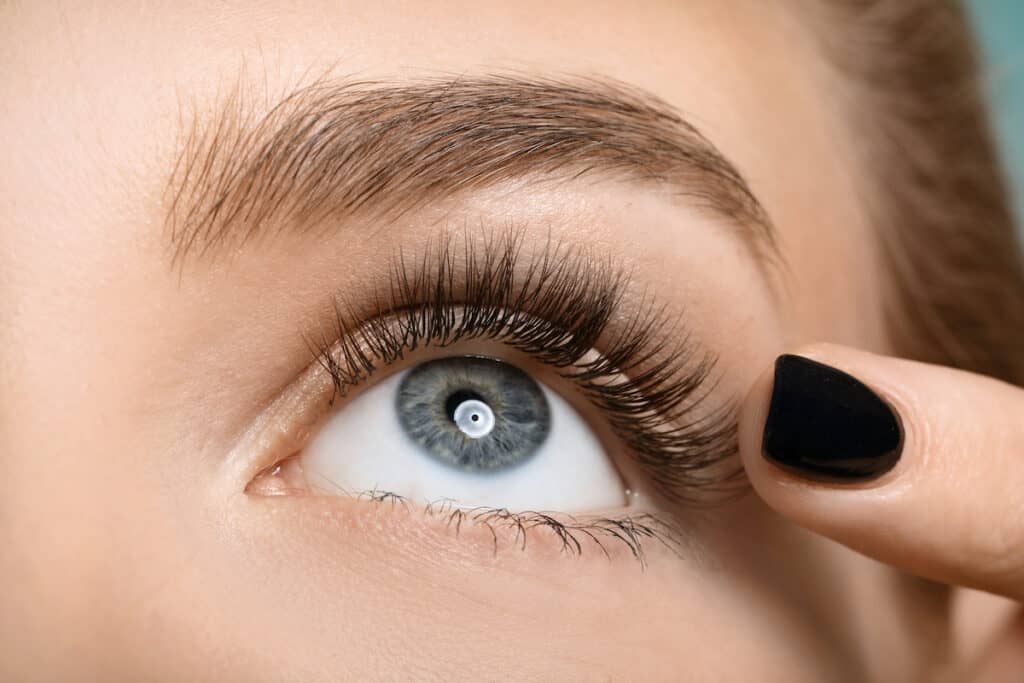
Common explanations include natural follicle direction, previous eyelid or lash trauma, inflammation, and conditions such as trichiasis. Natural follicle orientation usually cannot be permanently changed with cosmetics.
Genetics/Follicles
The position and shape of the lash follicles influence the angle and curl of the hairs that grow from them.
Genetics also influence the lash growth cycle, length, density, and curl pattern, alongside age, hormones, health, and medications.
So, if your lashes are naturally crisscrossed, it may be due to the natural shape of your follicles.
You cannot reliably change the follicle’s permanent growth direction with cosmetics, but you can adapt your eyelash routine to make the visible lashes sit more evenly.
A new or pronounced change in lash direction can also follow trauma, inflammation, scarring, or an eyelid condition.
Trauma
Trauma or inflammation around the eyelid margin can sometimes affect how lashes regrow, particularly if the follicle itself is damaged or scarred.
Examples include repeated pulling, eyelid injury, burns, surgery, or chronic inflammation. A dirty curler is more of a hygiene and irritation concern than a direct cause of altered follicle direction, and hormonal changes are not the same thing as physical trauma.
Certain medications can affect hair growth or texture, although a sudden directional change in lashes deserves evaluation if it is persistent or symptomatic.
Damage to the follicle or eyelid margin can sometimes alter how a replacement lash emerges, while ordinary surface friction usually affects the lash shaft rather than permanently redirecting the follicle.
Lashes grow in cycles, so replacement after shedding or trauma can take weeks to months. The timing varies and does not guarantee that a new lash will grow in a different direction.
Eyelash Conditions
When lashes point inward toward the eye rather than simply crossing or fanning unevenly, an eyelid or lash disorder becomes more important to rule out.
Misaligned lashes can irritate the eyelid or ocular surface, while styes and ingrown hairs have different causes. The main concern with inward-pointing lashes is repeated rubbing against the eye.
Persistent inward-pointing lashes should be assessed by an eye-care professional, especially when they touch the ocular surface.
If you have pain, marked redness, light sensitivity, discharge, or vision changes, avoid cosmetic lash treatments until the cause has been evaluated.
What Is Trichiasis?
Trichiasis is a condition in which one or more eyelashes are misdirected toward the eye and can rub against the cornea or conjunctiva.
The American Academy of Ophthalmology states, “Sometimes people get trichiasis, and there is no known cause. Anyone can develop trichiasis.”
Trichiasis can occur without an obvious cause, or after eyelid inflammation, scarring, trauma, surgery, infection, or certain inflammatory conditions.
If you suspect trichiasis because lashes repeatedly rub the eye, seek an optometrist or ophthalmologist rather than trying to redirect or pluck them repeatedly at home.
Symptoms
Trichiasis is more than a lash that simply looks crooked. The key concern is whether the lash is directed toward and irritating the eye.
Several eyelid and lash conditions can cause irritation or abnormal lash direction, so symptoms are more useful than appearance alone when deciding whether medical evaluation is needed.
Common symptoms include redness, light sensitivity, and tearing.
If lashes repeatedly rub the eye, they can cause corneal irritation or abrasions, which is why persistent symptoms should be assessed promptly.
Because these symptoms can have several causes, an eye-care professional can determine whether the problem is trichiasis or another eyelid or ocular-surface condition.
Treatment
Treatment depends on how many lashes are involved, whether they recur, what caused the abnormal direction, and whether the cornea is being irritated.
A clinician may temporarily remove a misdirected lash with forceps, but it can regrow because the follicle remains intact.
Repeatedly plucking a troublesome lash at home may provide temporary relief, but it does not treat the underlying follicle and can delay proper evaluation if the problem keeps returning.
For recurrent cases, an eye-care professional may discuss procedures that target the follicle or correct the eyelid position, depending on the cause and severity.
Treatment can include repeated epilation, electrolysis, laser or cryotherapy, or eyelid surgery in selected cases, so there is no single standard procedure for everyone.
However, other eyelash conditions may have different routes of treatment that may be less invasive.
How To Fix Eyelashes That Grow In Varying Directions
If the lashes are not touching the eye and the issue is only cosmetic, start with the least aggressive styling option.
For minor cosmetic unevenness, you can try a clean spoolie, clear mascara, eyelash curler, or professional lash lift. A lash serum may affect length or fullness depending on the product, but it is not a reliable way to redirect follicle growth.
The best option depends on how stiff the lashes are, how long you want the effect to last, and whether your eyelids or eyes are sensitive.
Styling changes are immediate but temporary. Growth-related changes, if any, depend on the product and lash cycle and should not be promised within a fixed 3- to 6-month window.
Start With Gentle At-Home Styling
- Use a clean spoolie to separate crossed or tangled lashes.
- If needed, use a lash curler on clean, dry lashes with light pressure before mascara.
- Add a small amount of clear mascara to hold mildly misdirected lashes in place.
- Remove eye makeup gently at night and avoid repeatedly pulling or picking at the same lash.
- If the lash still turns inward or touches the eye, stop treating it as a styling problem and get it assessed.
Opt For A Semi-Permanent Lash Service
A professional lash service can improve the appearance of mildly uneven lashes, but it should not be used to disguise lashes that are rubbing the eye.
The most popular semi-permanent eyelash services are eyelash extensions and lash lifts.
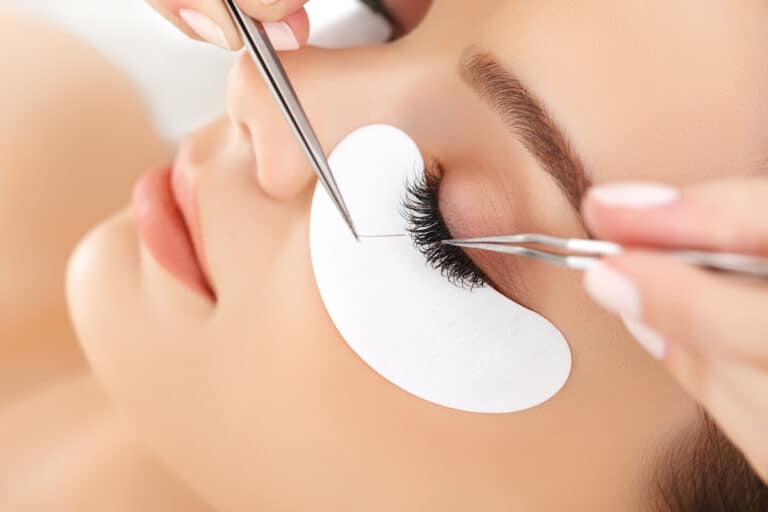
Eyelash extensions involve attaching individual extension fibers to suitable natural lashes with adhesive, rather than gluing fibers directly to the skin or lash line.
Extensions can make the lash line look more even by adding controlled length, curl, and placement, although the natural lash underneath still grows in its original direction.
Lash lifts use chemical processing and a shield or rod to reshape the visible lash hairs into a more lifted, uniform-looking curve. They do not change the follicle’s growth direction.
Use Eyelash Serum Only For Length Or Fullness
Cosmetics cannot reliably change the direction of new growth because that is determined mainly by the follicle.
An eyelash serum may be considered if your goal is lash length or fullness. Latisse, for example, is a prescription treatment rather than a simple cosmetic conditioning serum.
Some products can improve lash length or appearance, but they should not be expected to make lashes grow in a more uniform direction.
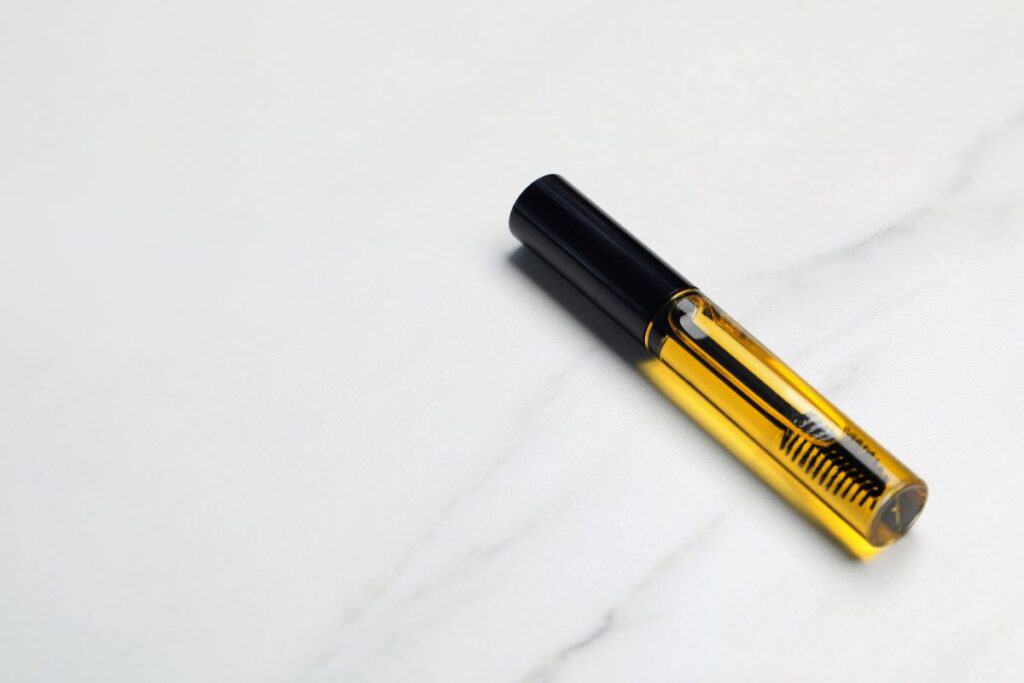
If you use an eyelash serum, judge it by its intended effect on length, fullness, or conditioning rather than expecting it to straighten or redirect misaligned lashes.
Follow the product directions carefully around the eyes. Stop use if you develop persistent redness, swelling, pain, or vision symptoms, and seek medical advice when appropriate.
Use Clear Mascara
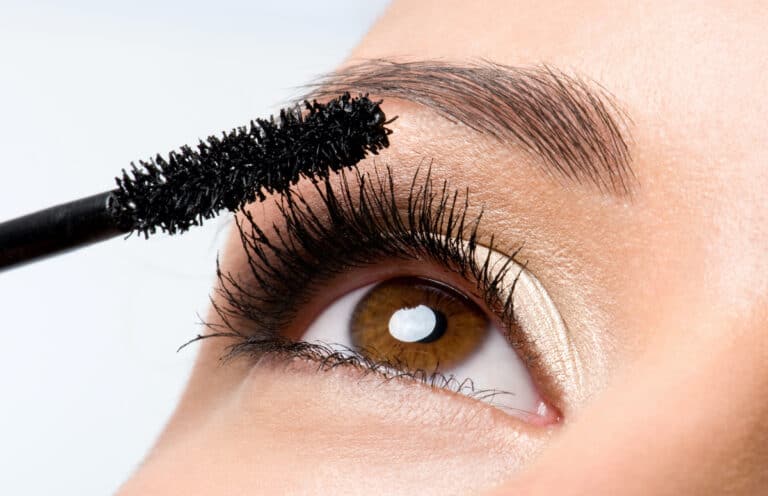
Clear mascara can temporarily hold one or two mildly misdirected lashes in a more uniform position for cosmetic purposes.
It is also an option if you want light hold without adding dark pigment.
Hold time varies by formula and lash stiffness. Remove it gently with an eye-safe cleanser or makeup remover rather than rubbing the lashes.
Remove Makeup Nightly
Gentle nightly eye-makeup removal can reduce residue and unnecessary mechanical stress on the lashes.
Your eyelashes help protect the eyes, and leaving eye makeup on overnight can contribute to irritation, residue, and lash breakage. It does not usually change the direction of follicle growth.
Rubbing, tugging, or repeatedly sleeping in heavy eye makeup can stress the lashes, but it should not be described as making them permanently grow “crazy.”
Gentle nightly makeup removal helps limit residue and unnecessary mechanical stress on the lashes.
Brush Your Lashes Daily
You can gently comb lashes with a clean spoolie when they need separating or grooming, especially if you wear extensions.
This is especially useful with eyelash extensions, which can twist or cross as the natural lashes grow and shed.
You can take a clean mascara wand or spoolie to gently separate and arrange the lashes. Do not scrape the eyelid margin or use a dirty brush.
Brushing can guide the visible hairs temporarily, but it does not train the follicles to produce future lashes in a new direction.
Use An Eyelash Curler
An eyelash curler can temporarily make downward- or sideways-pointing lashes look more aligned when used gently.
When used carefully, an eyelash curler can make the visible lashes look more lifted and uniform for several hours.
Keep your eyelash curler clean, replace worn pads, and avoid pulling while the clamp is closed to reduce breakage or pinching.
You can also find an individual eyelash curler to curl a few hairs at a time if your lash hairs are hard to reach.
Use gentle pressure and avoid repeated hard clamping, especially on lashes coated with dried mascara because they may be more brittle.
Can You Train Your Eyelashes?
You can repeatedly style the visible lashes into a preferred direction, but this is temporary grooming rather than permanent lash training.
A spoolie, clear mascara, curler, or lash lift can change appearance, while a growth serum should only be used for its intended indication and will not reliably redirect follicles.
Use the least aggressive styling method that gives you the appearance you want, and stop if the eye or lash line becomes irritated.
For extra temporary hold, you can use clear mascara such as this Wet n’ Wild option, provided it does not irritate your eyes.
Seek Medical Attention
Seek medical attention if lashes are rubbing the eye or you develop persistent redness, pain, tearing, light sensitivity, discharge, or vision changes.
Eyelid inflammation, scarring, trichiasis, or other eye conditions can alter lash direction and may require treatment beyond cosmetic grooming.

An eye-care professional can examine the lash direction, eyelid position, and ocular surface and recommend treatment based on the actual cause.
A dermatologist can help with eyelid-skin disease, while an optometrist or ophthalmologist is more appropriate when lashes rub the eye or vision symptoms are present.
Eyelashes Growing In Different Directions FAQs
Can You Permanently Train Eyelashes To Grow In A New Direction?
Not reliably. Curlers, clear mascara, spoolies, and lash lifts can change how the visible lash sits, but new growth is still largely determined by the follicle’s orientation.
Why Do A Few Eyelashes Suddenly Point Sideways?
A single lash can emerge at a different angle because of its follicle position or after shedding and regrowth. A sudden persistent change involving several lashes is more worth checking if there has also been eyelid inflammation, trauma, scarring, or eye irritation.
Should You Pluck A Lash That Is Growing Inward?
Repeated home plucking is not a good long-term solution for a lash that rubs the eye because it can regrow and the underlying cause remains. An eye-care professional can determine whether temporary epilation or a more lasting treatment is appropriate.
Can A Lash Lift Fix Eyelashes Growing In Different Directions?
A professional lash lift can make mildly uneven lashes look more uniform for cosmetic purposes, but it does not change the follicle and should not be used as treatment for lashes that are rubbing the eye.
Takeaway
Eyelashes help protect the eyes, and minor differences in their direction are often completely normal.
They also contribute to the appearance of the eye area and can be styled in different ways.
A few crossing, downward, or uneven lashes can usually be managed cosmetically if they are not irritating the eye.
Uneven lash direction can come from natural follicle orientation, genetics, previous trauma, inflammation, scarring, or an eyelid condition.
Prior trauma, inflammation, or scarring can also affect how some lashes regrow.
For minor cosmetic unevenness, styling tools can temporarily improve alignment. If lashes point inward or cause eye symptoms, medical evaluation is the safer route.
Related Articles
Why Do My Eyebrows Grow Upwards?
Why Won’t My Eyelashes Curl Anymore?
Why Do My Eyelashes Go Down When I Apply Mascara?