
Emsculpt Vs Coolsculpting
If you are comparing Emsculpt vs. CoolSculpting, the first thing to know is that they target different tissues and are designed for different body-contouring goals.
Both are non-surgical body-contouring treatments, but Emsculpt uses high-intensity electromagnetic stimulation to contract muscle, while CoolSculpting uses controlled cooling to reduce localized subcutaneous fat.
That difference matters because Emsculpt and CoolSculpting are not interchangeable weight-loss treatments or full-body reshaping procedures. One targets muscle conditioning, while the other targets a localized fat bulge.
Session length and number of treatments vary by device, applicator, body area, and treatment plan, so a consultation is more useful than relying on one fixed 30-35 minute estimate.
So, what are Emsculpt and CoolSculpting?
Emsculpt is primarily a muscle-conditioning treatment, while CoolSculpting is a localized fat-reduction treatment. Neither is a weight-loss procedure, and neither guarantees a permanent body shape because muscle tone, remaining fat cells, weight changes, aging, and lifestyle can all change the result over time.
CoolSculpting is intended for visible, pinchable fat bulges in specific cleared treatment areas. Emsculpt is more relevant when the goal is improving muscle tone or conditioning in an area approved for the device being used.
Below, we’ll compare how each procedure works, realistic results, treatment areas, downtime, contraindications, costs, and the risks that deserve attention before you book either one.
What Is Emsculpt?
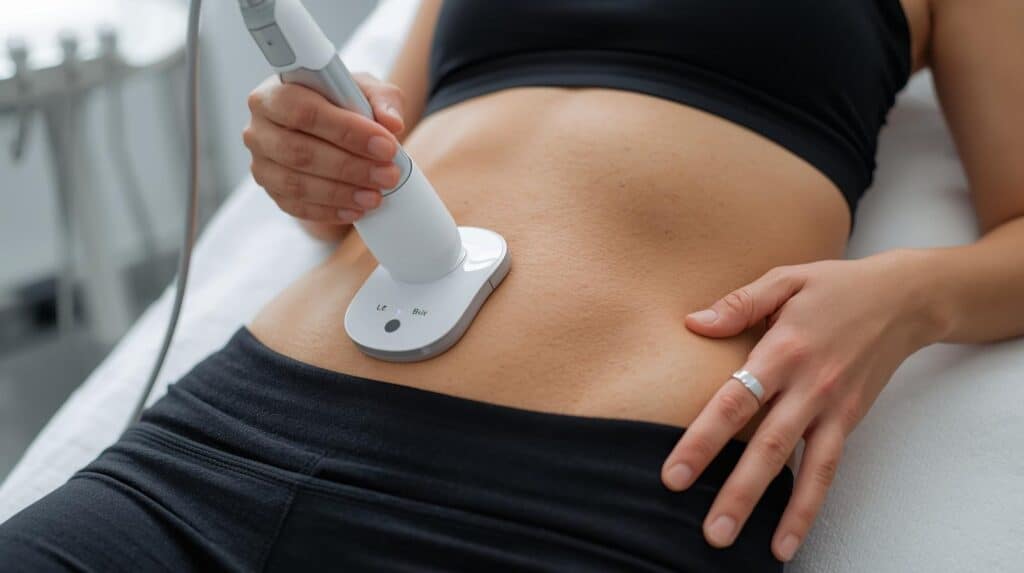
Emsculpt is a non-invasive powered muscle-stimulation treatment that uses a strong electromagnetic field to trigger repeated muscle contractions in the targeted area.
In the U.S., Emsculpt devices are cleared as powered muscle stimulators for muscle conditioning. The treatment can temporarily affect muscle contraction, strength, tone, or conditioning depending on the specific device and treatment area.
You will often see Emsculpt marketed as producing around 20,000 contractions in a 30-minute session. That is a marketing shorthand for the number of device-driven contractions, not a proven one-to-one equivalent to doing 20,000 voluntary crunches or squats.
Older studies and manufacturer materials have reported changes in muscle thickness and subcutaneous fat after Emsculpt treatment, but fixed figures such as 19% fat reduction or 16% muscle increase should not be presented as guaranteed results for every patient, body area, or Emsculpt model.
Emsculpt should not be used as a substitute for exercise, nutrition, or medical weight-management care when those are the actual goals.
If you pursue Emsculpt for cosmetic body contouring, the visible result is more likely to remain stable when body weight and regular physical activity remain relatively consistent.
Where Can Emsculpt Be Used?
Emsculpt treatment areas depend on the exact device, applicator, and regulatory clearance. The abdomen and buttocks are among the best-known treatment areas.
Some Emsculpt-family systems and applicators are also used on areas such as the thighs, calves, and arms. Confirm that the exact device and applicator your provider uses are intended for the area you want treated.
Benefits Of Emsculpt
Emsculpt usually requires little to no procedural downtime, although temporary muscle soreness, fatigue, cramping, or tenderness can occur after treatment.
U.S. Emsculpt devices are FDA-cleared powered muscle stimulators, but clearance does not mean the treatment is appropriate for every person.
A typical session is often around 30 minutes, but the “20,000 crunches or squats” comparison should be understood as marketing language for repeated device-induced contractions rather than a direct exercise equivalent.
There is no universal six-month or one-year guarantee. Muscle conditioning can diminish if it is not maintained, and maintenance recommendations vary by provider, device, lifestyle, and treatment goal.
Side Effects Of Emsculpt
Emsculpt is generally described as having a favorable short-term tolerability profile, but it is not accurate to say that no serious or lasting adverse events have ever been reported. Medical-device adverse-event reports exist, and contraindications still matter.
Expected effects can include intense contractions during treatment and temporary muscle soreness, fatigue, tenderness, or cramping afterward.
Emsculpt should not be performed during pregnancy.
Contraindications include pacemakers, implanted defibrillators, neurostimulators, other electronic implants, drug pumps, and certain metal implants in or near the treatment field. The device manual also lists other medical contraindications, so disclose all implants, surgeries, medications, and medical conditions before treatment rather than relying on a short online checklist.
Emsculpt Procedure
A commonly used Emsculpt protocol is four sessions of about 30 minutes, but the exact schedule, spacing, and number of sessions should come from the device protocol and your provider.
During treatment, the Emsculpt applicator is secured over the target area while the high-intensity electromagnetic field triggers repeated muscle contractions.
The manufacturer commonly describes these as supramaximal contractions, meaning contractions generated by the electromagnetic stimulation at an intensity not achieved voluntarily in the same way.
Intensity is adjusted during the session. Sensation varies from person to person, so do not assume treatment will always be painless; tell the provider if you experience unexpected or severe pain.
A traditional four-session course is often scheduled over roughly two weeks, with sessions spaced a few days apart, but protocols vary.
Some people report changes in muscle firmness within a few weeks, while visible contour changes may continue developing over the following months. Results vary, so standardized photos or measurements are more useful than expecting a fixed two-week or three-month milestone.
Maintenance sessions may be offered, but there is no single evidence-based interval that every patient needs.
Muscle conditioning can decline over time, just as it can after stopping regular exercise, while changes in weight or activity can alter the overall contour.
An active lifestyle can help maintain muscle conditioning, while optional maintenance sessions may be discussed if you want additional definition or if results fade over time.
Cost Of Emsculpt
Emsculpt pricing can vary substantially depending on your location, provider, device model, treatment area, and whether you are paying per session or for a package.
There is no reliable national price that stays current. Clinics may charge per session, per treatment area, or by package, and pricing can differ substantially by city and device model.
As with many other cosmetic procedures, you may have the option to pay for sessions individually as you schedule them or purchase a package that covers all the sessions at once.
If you are interested in Emsculpt, ask the treating clinic for the total expected cost, including the planned number of sessions and any optional maintenance treatments.
Emsculpt Recovery Time
One of the biggest benefits of Emsculpt is the minimal downtime required for recovery.
Most patients can return to normal activities after treatment, although temporary soreness may make an intense workout less appealing immediately afterward.
Some slight muscle soreness may be apparent after the treatment, but you will generally be able to return to normal function after your procedure.
Post-treatment soreness may feel similar to exercise soreness. Normal hydration is reasonable, but drinking extra water has not been established as a specific treatment that prevents Emsculpt soreness.
Who Is A Good Candidate For Emsculpt?
Emsculpt is not a weight-loss procedure. Its FDA device classification centers on muscle conditioning; any fat-related claims depend on the specific Emsculpt model, treatment protocol, and evidence being discussed.
Do not assume that muscle contraction automatically destroys a predictable percentage of fat. Emsculpt NEO also uses radiofrequency, so it should not be confused with the original electromagnetic-only Emsculpt system.
This treatment is not recommended for everyone.
A better candidate is someone seeking localized muscle conditioning rather than major weight loss and who has no contraindication to a strong electromagnetic field. A medical history and implant review should come before cosmetic goals.
What Is CoolSculpting?
CoolSculpting is a brand of cryolipolysis, a non-surgical fat-reduction technology that uses controlled cooling to injure subcutaneous fat cells in a treatment area.
Fat cells are more susceptible to controlled cold injury than surrounding tissues under the intended treatment conditions. The damaged fat cells are gradually cleared over time, which can reduce the visible fat bulge.
CoolSculpting is not a weight-loss treatment; it targets a specific area to eliminate fat cells.
CoolSculpting and CoolSculpting Elite are FDA-cleared for visible fat bulges in areas including the abdomen, flanks, thighs, upper arms, bra fat, back fat, under the chin, under the jawline, and underneath the buttocks. The buttocks themselves are not simply a generic cleared fat-treatment area.
It is also cleared for submental and submandibular fat and to affect the appearance of lax tissue with submental treatment.
Benefits Of CoolSculpting
CoolSculpting is FDA-cleared, not FDA-approved, for specific visible fat bulges. It is a non-surgical fat-reduction treatment, not a treatment for obesity or overall weight loss.
Fat cells destroyed by cryolipolysis do not regenerate in the same way, but the remaining fat cells can enlarge with weight gain, and body contour can still change with aging, pregnancy, or weight fluctuation.
CoolSculpting is often described as having little to no downtime, but numbness, tenderness, swelling, bruising, tingling, or pain can persist for days or weeks.
Side Effects Of CoolSculpting
Common temporary effects include redness, swelling, bruising, firmness, tenderness, aching, cramping, stinging, tingling, itching, and numbness.
Sensation changes can persist for several weeks in some patients, and under-chin treatment can temporarily cause throat discomfort or a feeling of fullness.
A rare but important complication is paradoxical adipose hyperplasia (PAH), where the treated fat grows into a firm visible bulge instead of shrinking.
Current CoolSculpting safety information estimates PAH at about 1 in 3,000 treatments, or 0.033%. The FDA notes that PAH does not resolve on its own and may require surgery.
PAH generally appears two to five months after treatment, rather than as ordinary early swelling.
Coolsculpting Procedure
Many CoolSculpting applicators use vacuum suction to draw tissue between cooling panels, although applicator design varies by treatment area.
The goal is selective cooling of fat, but it is inaccurate to say that only fat cells are affected. Skin, nerves, and surrounding tissue can experience temporary or, rarely, more serious complications.
During treatment, people may feel pulling, tugging, pinching, intense cold, stinging, aching, cramping, or discomfort before the area becomes numb. Pain perception varies.
Treatment time varies by applicator and area, so use the provider’s current protocol rather than expecting every CoolSculpting cycle to last 30 minutes.
Depending on the targeted area, applicator, and amount of treatable fat, more than one treatment session or cycle may be recommended.
Larger or multi-zone areas may require multiple applicator cycles or treatment sessions, so ask for the full treatment plan rather than assuming one appointment will be enough.
Smaller areas, including the submental region, may sometimes need fewer cycles, but the exact plan still depends on anatomy and the applicator being used.
Some patients notice changes after several weeks, but CoolSculpting’s current patient information says results are commonly noticed around one to three months after treatment.
The contour can continue changing as the body clears injured fat cells. The final timeline depends on the area, number of cycles, and individual response.
Destroyed fat cells are removed from the treatment area, but remaining fat cells can still enlarge, so maintaining a stable weight helps preserve the contour.
Cost Of CoolSculpting
CoolSculpting costs vary with the provider, city, treatment area, number of applicators or cycles, and whether more than one session is planned.
There is no single current national average that applies everywhere. Pricing depends on the number and type of applicators, treatment area, number of cycles, provider, and city.
CoolSculpting Recovery Time
Most people can return to normal activities quickly, but “no downtime” does not mean “no recovery symptoms.” Tenderness, swelling, numbness, bruising, or nerve-related discomfort may temporarily affect comfort.
Who Is A Good Candidate For CoolSculpting?
Much like Emsculpt, CoolSculpting is not appropriate for every person or every type of body-contouring concern.
It is not intended for weight loss. Its role is reducing a suitable, localized subcutaneous fat bulge in an approved treatment area.
CoolSculpting is generally aimed at people seeking localized fat reduction rather than weight loss. A provider should determine whether the fat bulge can be safely and effectively treated with an approved applicator.
Some vacuum applicators require enough pinchable subcutaneous tissue for the applicator to couple correctly, but candidacy is more specific than a DIY “pinch test.”
CoolSculpting should not be used in people with cryoglobulinemia, cold agglutinin disease, or paroxysmal cold hemoglobinuria. Tell the provider about pregnancy, hernias, impaired circulation, neuropathy, recent surgery, skin conditions, medications, and cold sensitivity before treatment.
Overall Similarities And Differences
Emsculpt and CoolSculpting are fundamentally different treatments: one centers on muscle stimulation and conditioning, while the other centers on controlled reduction of localized subcutaneous fat.
Emsculpt may suit a goal focused on muscle conditioning or definition in a treatment area cleared for the device being used.
CoolSculpting is designed to reduce a visible localized fat bulge in one of its cleared treatment areas. It does not build muscle.
Neither procedure is intended for significant weight loss, and neither should replace nutrition, exercise, or medical obesity treatment when those are the actual goals.
Both are non-surgical, but effectiveness and comfort vary. Emsculpt commonly causes intense muscle contractions and soreness, while CoolSculpting can cause cold-related discomfort, bruising, numbness, and rare serious complications.
Results from either treatment can change over time. CoolSculpting removes some fat cells from the treated area, while Emsculpt muscle-conditioning effects can diminish if not maintained. That does not make one universally “longer-lasting” for every person.
Both treatments require screening for contraindications and a discussion of side effects, limitations, and realistic outcomes.
Can You Do Both?
Some clinics may offer Emsculpt and CoolSculpting to the same patient because they target different tissues, but combining them only makes sense when there is a clear separate goal for both muscle conditioning and localized fat reduction.
If both goals matter, a qualified provider can discuss whether separate fat-reduction and muscle-conditioning treatments make sense for your anatomy and medical history.
There is no universal rule that CoolSculpting must come first.
Sequencing depends on the treatment area, amount of fat, device being used, tissue recovery, and what the provider is trying to achieve.
Emsculpt may then be considered if muscle conditioning is a separate goal, but visible definition still depends on anatomy and the amount of overlying fat.
Combining procedures also increases cost and complexity, so the treatment plan should explain what each device is expected to contribute rather than assuming two procedures are automatically better than one.
Ask the treating clinician whether combining or sequencing these procedures is appropriate for you and what evidence supports the proposed plan.
Final Thoughts
The most useful way to compare these treatments is by tissue target, treatment goal, contraindications, and risk profile, not by asking which one is universally “better.”
Emsculpt is primarily a muscle-conditioning option, while CoolSculpting is a localized fat-reduction option. A stable lifestyle can help preserve either cosmetic result.
Before booking either treatment, verify the exact device model, provider training, treatment area, expected number of sessions, contraindications, total cost, and complication plan. A medical review is especially important if you have implants, hernias, cold-related disorders, neuropathy, recent surgery, pregnancy, or other significant health conditions.
Neither procedure is designed for a total body transformation or meaningful weight loss. They are targeted body-contouring tools with limited, area-specific goals.
If your main goal is weight loss, improved fitness, or treatment of obesity, discuss evidence-based lifestyle or medical options instead of relying on body-contouring devices.
For a simple takeaway: consider Emsculpt when the primary goal is muscle conditioning, consider CoolSculpting when the primary goal is reducing a suitable localized fat bulge, and book neither until a qualified provider has screened you for the relevant contraindications, confirmed the exact device and treatment area, and explained realistic results.
Related Articles