
Can Gel Polish Air Dry?
Fresh manicures can help you feel put together or express your personality, but the drying or curing step can make a big difference to the final result.
The practical question is how long you are willing to wait for the polish to dry or cure.
Regular polish can take a while to dry completely, which is one reason some people choose gel polish for a faster set between coats.
Gel polish is popular for its glossy finish, durability, and fast curing time under a compatible nail lamp, but that lamp is part of the chemistry rather than an optional extra.
However, if you plan to apply true UV-curable gel polish at home, you need the compatible curing lamp specified for that gel system.
Can gel polish air-dry?
True gel polish does not air-dry like regular nail lacquer. Its photoinitiators need the correct UV wavelengths from a compatible curing lamp to start the polymerisation reaction that hardens the coating. If a product is marketed as “gel-like” but dries in air, it is a different type of polish.
If UV-curable gel is left in normal room air, it can remain wet, soft, or tacky instead of forming the hardened film you expect.
Regular nail polish mainly hardens as solvents evaporate. Gel polish uses a different curing process that depends on light-activated chemistry rather than simple air drying.
So, the right way to cure gel polish is to use the lamp and curing time recommended for that specific gel.
Using the correct lamp matters because a lamp that does not match the gel’s photoinitiators can leave the product under-cured.
Proper curing helps the gel form a durable coating. Under-cured product can leave more unreacted acrylate or methacrylate ingredients available to contact the skin and may increase the risk of irritation or allergic sensitisation.
The key is understanding how gel curing differs from ordinary polish drying and why lamp compatibility matters.
What Is Gel Polish?
Gel polish is a light-cured nail coating designed to combine polish-like application with a harder, longer-wearing finish.
Many people choose gel polish because it can wear longer than regular nail polish. However, gel is not automatically gentle on natural nails: over-filing, peeling it off, repeated acetone exposure, and improper removal can all contribute to thinning, dryness, or brittleness.
Gel polish contains reactive monomers and oligomers plus photoinitiators and other ingredients that give it its gel-like consistency and allow it to cure under light.
When the gel receives the correct wavelength and sufficient light dose, the photoinitiators trigger polymerisation, linking reactive ingredients into a hardened coating.
Once the gel is properly cured, it forms a hard, glossy coating designed to resist ordinary smudging and everyday wear.
Wear time varies, but many gel manicures remain presentable for around two weeks before growth, lifting, or chipping becomes noticeable.
Benefits Of Gel Polish
The main benefits of gel polish are fast curing between coats, a glossy finish, and longer wear than many conventional lacquers.
A major reason people choose gel is that each coat can be cured in a short lamp cycle rather than waiting for solvents to evaporate.
That means you do not have to protect each freshly applied layer from smudging for as long as you would with regular nail lacquer.
Once the final coat has been correctly cured and any required inhibition layer has been handled according to the product directions, the finish should resist ordinary smudging.
Soak-off gel polish is generally removed with acetone according to the brand’s directions. Hard gels that do not soak off need careful filing. Avoid peeling, scraping, or aggressively drilling the natural nail because removal technique is a major source of nail damage.
Some gel systems are designed for extensions or overlays, while ordinary gel polish is mainly a color coating. Follow the intended use of the specific product.
Compared with conventional polish, a properly cured gel coating is usually more resistant to smudging and everyday wear.
What Is Curing?
You will often hear the term curing when discussing gel polish.
Curing is the chemical hardening process that occurs when a compatible gel is exposed to the correct light from a nail lamp for the required time.
The lamp delivers the wavelength needed to activate the gel’s photoinitiators so the coating can polymerise. This is different from simply “drying” a wet polish.
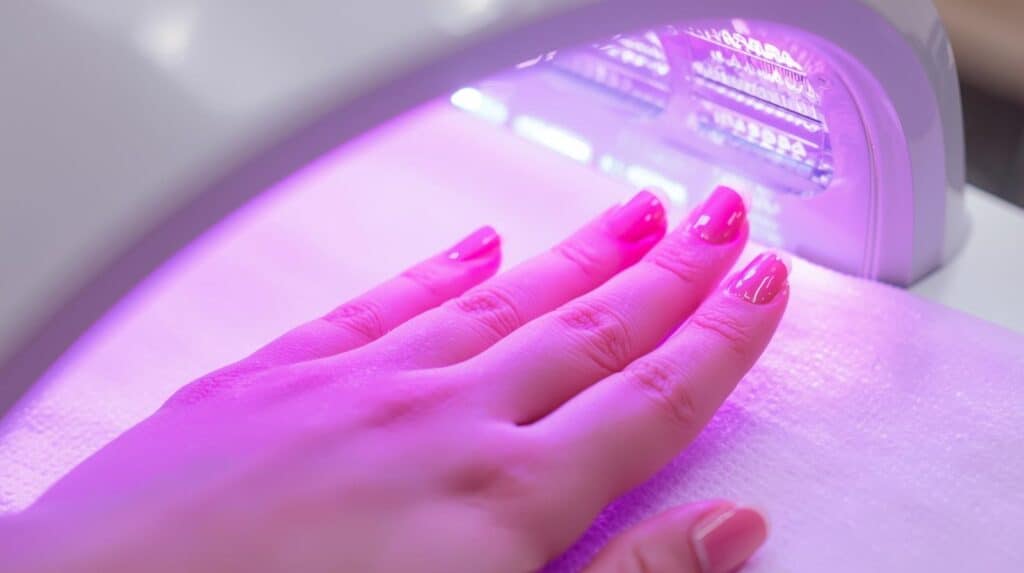
Gel systems commonly contain reactive acrylate or methacrylate ingredients, oligomers, and photoinitiators.
During the curing process, the reactive ingredients polymerise into a more solid network that creates the gel’s durable finish.
A properly cured gel manicure has received the lamp exposure required by the manufacturer. A surface that feels hard or dry does not always prove that deeper layers have fully polymerised.
True UV-curable gel polish cannot complete this reaction by air drying alone.
Why Can’t Gel Polish Air Dry?
Gel polish and regular nail polish harden in fundamentally different ways.
Traditional lacquer hardens mainly through solvent evaporation, while gel relies on light-triggered polymerisation.
For UV-curable gel, the safe approach is to use the specific lamp or compatible wavelength range recommended by the gel manufacturer.
Leaving UV-curable gel exposed to room air for longer will not replace the photochemical curing step.
The product may remain wet, soft, or tacky and should be removed according to the product directions rather than left on the skin or nails uncured.
Can You Dry Gel Polish Without A Nail Lamp?
It is common to wonder whether you can cure gel without a lamp, especially if you do not own one at home.
Online searches may suggest household hacks such as cooking spray, ice water, or quick-dry sprays, but these do not replace a curing lamp.
Methods such as cooking spray, ice water, or quick-dry sprays may affect the surface of regular lacquer, but they do not supply the UV wavelength needed to cure gel.
Many brands also sell “gel-like,” “gel effect,” or long-wear polishes that do not require a lamp.
These are best understood as air-dry alternatives that mimic some of gel’s shine or wear, not substitutes for curing a UV-reactive gel formula.
Do not try to “partially cure” true gel with a household hack. Under-cured gel can leave more unreacted ingredients available to contact the skin, which may increase irritation and sensitisation risk.
How Does A Nail Lamp Work?
Gel polish and nail lamps are designed to work together as a matched curing system.
What matters is not simply how bright or powerful the lamp seems, but whether its wavelength output and curing time match the gel formula.
Nail lamps usually use either fluorescent UV bulbs or UV-emitting LEDs. Both rely on ultraviolet radiation to activate compatible gel chemistry.
Traditional lamps often use fluorescent UV bulbs, while many newer lamps use UV-emitting LEDs. “LED” describes the light source, not an absence of UV radiation.
The emitted wavelengths activate the gel’s photoinitiators and start the polymerisation reaction that hardens the coating.
Curing time may range from seconds to a few minutes per layer depending on the gel and lamp. Use the manufacturer’s specified time rather than guessing from surface hardness, wattage alone, or how quickly the top feels dry.
UV Vs. LED Nail Lamps
The main differences between traditional UV and LED nail lamps are their light source, wavelength range, curing speed, and gel compatibility.
Both traditional fluorescent and LED-based curing lamps can work when they are matched to a compatible gel system.
Both emit UV wavelengths, but they can differ in wavelength range, intensity, curing speed, and compatibility.
Older fluorescent UV lamps generally emit a broader UVA range and may require longer curing cycles, while LED curing lamps usually emit a narrower range tailored to compatible photoinitiators.
LED curing units use semiconductor diodes rather than replaceable fluorescent bulbs, which is one reason they can be more compact and long-lasting.
LED systems often cure faster and can reduce total curing time, but they still emit UV radiation. If you want to limit routine exposure, broad-spectrum SPF 30+ on exposed hand skin or dark, opaque fingerless UV-protective gloves are commonly recommended precautions.
The most important factor is compatibility between the gel and lamp. Do not assume that any lamp will fully cure every gel brand or formula.
Many newer lamps are marketed as UV/LED because their LED arrays cover wavelengths used by a broader range of gels.
Best Gel Polish Nail Lamps
If you are wondering whether you can air-dry gel nails because you do not have a nail lamp at home, choose a true air-dry polish instead of leaving UV gel under-cured.
Take a look at our article on the best nail lamps for gel polish, or compare a few examples below.
1. Young Nails UV/LED Curing Light
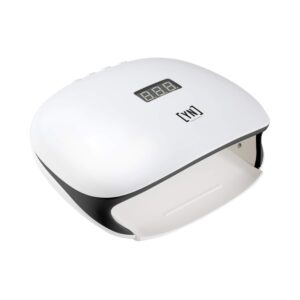
Young Nails offers this curing lamp for gel systems that fall within its supported wavelength and timing specifications.
The main reason to consider a brand-matched or professionally specified lamp is more predictable compatibility with the gel system you are using.
This UV/LED curing light offers timed curing cycles for compatible products.
Young Nails advertises short curing cycles for compatible hard gels and gel polishes. Follow the gel product’s own instructions rather than assuming one time works for every formula.
Place the coated nails under the lamp for the specified curing cycle, making sure the hand is positioned as directed and keeping uncured gel off the surrounding skin.
Other features of this nail lamp include UV/LED sources, an easy-to-read timer, and simple controls.
Its compact design may also be convenient for at-home storage if you use the system regularly.
2. Gelish Harmony Pro LED Polish Curing Lamp
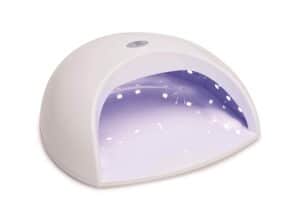
Gelish is a well-known brand in the soak-off gel polish category.
Soak-off formulas can be easier to remove without heavy filing, but acetone, scraping, picking, or repeated manicures can still leave natural nails dry or brittle.
The Harmony Pro LED Gel Nail Soak Off Polish Curing Lamp is designed around short preset cycles for compatible Gelish products.
Gelish markets this lamp with short preset curing cycles for its compatible products. Use the time specified for the exact Gelish formula you apply.
The LED lamp is relatively lightweight, and its LED light source avoids the routine bulb replacement associated with older fluorescent curing units.
Its controls are simple, but curing still needs to follow the exact timing specified for the gel formula being used.
This 18W lamp uses LEDs and simple controls, but beginners still need to avoid skin contact with uncured gel and follow cure times carefully.
3. SUNUV UV LED Nail Lamp
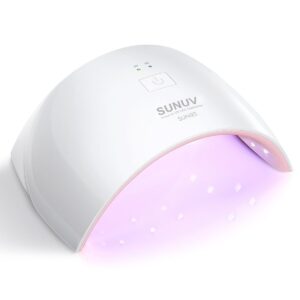
SUNUV offers a widely available option for people applying compatible gel products at home.
The UV LED Nail Lamp is designed for curing compatible gel polishes and hard gels with timed cycles.
Its full-hand design lets you position several nails under the LEDs at once, but even curing still depends on hand placement and gel compatibility.
This lamp uses UV-emitting LED beads and includes simple timer controls.
SUNUV includes timer settings and an automatic sensor. Choose the curing interval required by your gel rather than automatically selecting the longest cycle.
The SUNUV UV LED Nail Lamp has a portable full-hand design that can be convenient for home use or storage.
Its open-back design also provides more room for positioning a hand or foot during a manicure or pedicure.
Takeaway
Gel nail polish is a popular option for people who want a glossy, durable manicure with relatively fast curing between coats.
Gel and acrylic systems have different properties, but neither should be described as damage-free. Nail damage is often related to preparation, repeated wear, over-filing, picking, and removal technique.
Gel polish often wears for around two weeks, although longevity varies with nail growth, preparation, formula, and daily wear.
However, true UV-curable gel polish cannot air-dry like ordinary lacquer.
True UV-curable gel needs a compatible nail lamp to trigger the polymerisation reaction that hardens it.
Modern curing lamps may use fluorescent UV bulbs or UV-emitting LEDs. An LED curing lamp is still a source of ultraviolet radiation.
Whichever lamp style you use, match it to the gel system and follow the specified cure time. A lamp that seems bright or powerful is not automatically compatible with every gel.
If you try to air-dry UV-curable gel polish, it can remain wet, soft, or tacky. Remove uncured product rather than leaving it in contact with the nail folds or skin.
Therefore, cure true gel with the correct lamp, correct exposure time, and careful application that keeps uncured product off the skin. If you do not want to use a curing lamp, choose a polish specifically formulated to air-dry instead.
Related Articles
Painting Nails Black – Ultimate Guide
How To Remove Gel Nail Polish With Sugar