
Good Molecules Vs The Ordinary
Both The Ordinary and Good Molecules are known for ingredient-focused skincare at accessible prices, which is why shoppers often compare them product by product.
The brands overlap in categories such as niacinamide, peptides, exfoliating acids, hydrators, and antioxidant treatments, but their formulas, textures, supporting ingredients, packaging, and product ranges are not identical.
That means the better choice usually comes down to the specific product, your skin type and sensitivity, and how simple or customisable you want your routine to be.
Good Molecules launched through Beautylish and built its range around straightforward product names, detailed ingredient information, and colourful packaging.
The Ordinary takes a more clinical-looking approach, with many products named after their main active ingredients and concentrations.
Because the price points and ingredient-led approach are similar, it is easy to assume the brands are interchangeable. In practice, the supporting ingredients, texture, concentration, pH, and directions can make two seemingly similar serums behave very differently on skin.
The most useful comparison is therefore product by product, rather than trying to pick one entire brand as universally better.
So, what is the difference between Good Molecules and The Ordinary?
Good Molecules and The Ordinary differ most in formulation style, product range, packaging, ingredient transparency, availability, and ownership. Both offer affordable skincare, but the better fit depends on the exact formula, the rest of your routine, and your skin’s tolerance.
Both brands have popular, budget-friendly products, but a low price does not automatically make every formula suitable for sensitive skin or compatible with every routine.
Below, we compare the two brands and then look more closely at their niacinamide and peptide serums.
Good Molecules
Good Molecules is a relatively young skincare brand that launched through Beautylish and quickly became known for its affordable, ingredient-focused formulas.
Rather than treating it as a direct replacement for The Ordinary, it is more useful to view Good Molecules as another option in the accessible, active-focused skincare category.
One reason the brand stands out is its emphasis on understandable ingredient information without luxury-level pricing.
Good Molecules was created by Beautylish co-founder Nils Johnson, giving the brand a direct connection to the beauty retail platform where it first launched.
The range has since expanded beyond its original launch while keeping its focus on relatively simple, concern-based skincare.
Good Molecules offers products for concerns such as uneven tone, dehydration, texture, breakouts, and visible signs of ageing, with many products priced within the same general budget category as The Ordinary.

Its bright packaging and descriptive product names can make the range feel approachable, especially if you prefer to shop by skin concern or product type rather than by ingredient names alone.
Another useful feature is the brand’s ingredient transparency. Many Good Molecules product pages disclose percentages for individual ingredients, although the current package and official product page should still be checked because formulas can change.
Good Molecules also identifies its products as cruelty-free, and many individual formulas are labeled vegan. Always check the current product page if vegan status matters to you.
The Ordinary
The Ordinary, available through DECIEM, helped popularise straightforward, active-focused skincare at relatively low prices.
DECIEM is the company behind The Ordinary, and the brand is now sold through its own website as well as many beauty retailers around the world.
The Estée Lauder Companies completed its acquisition of DECIEM in 2024, after first investing in the company years earlier.
That ownership change does not mean The Ordinary stopped being cruelty-free. DECIEM states that it does not test on animals or ask others to do so, and it carries Leaping Bunny certification; The Ordinary is also identified by DECIEM as vegan.
The Ordinary is known for product names that often identify the main active ingredient and concentration, such as Niacinamide 10% + Zinc 1%.
That naming system can be helpful once you know what the ingredients do, but it may feel less intuitive if you are building your first skincare routine.
Its minimalist, clinical-looking packaging is recognizable, and the brand keeps many formulas at an accessible price point compared with prestige skincare.
For many shoppers, The Ordinary is an entry point into learning about ingredients such as niacinamide, azelaic acid, peptides, retinoids, and antioxidants, but ingredient names alone do not tell you whether a formula will suit your skin.
Good Molecules & The Ordinary
The brands overlap in price, active ingredients, and target concerns, but they approach formulation, naming, and presentation differently.
The most useful differences to compare are formula composition, texture, packaging, price, product variety, availability, and brand policies.
1. Formulation
When choosing between similar products, start with the full formula and directions, not just the percentage printed on the front.
For example, both brands sell 10% niacinamide serums and peptide serums, but the supporting ingredients and overall formulas differ.
The Ordinary notes that its formulations may be updated over time, so the ingredient list on your current packaging or the official product page is the best reference.
Good Molecules also updates formulas, but it often publishes a detailed percentage breakdown for ingredients through its Nothing to Hide lists.
Both the standard Good Molecules Niacinamide Serum and The Ordinary Niacinamide 10% + Zinc 1% use 10% niacinamide. A higher percentage is not automatically better, and some sensitive skin types may prefer a lower-strength formula, so introduce either product gradually if you are irritation-prone.
Good Molecules pairs its 10% niacinamide with ingredients including glycerin and betaine. The Ordinary pairs 10% niacinamide with 1% zinc PCA, so the two serums can differ in texture, finish, and tolerance even though the headline niacinamide percentage is the same.
If your skin is sensitive, compare the entire ingredient list and consider how the product fits with the rest of your routine rather than choosing on percentage alone.
Many of The Ordinary’s products are built around a clearly defined active or active combination, although the brand also sells more complex formulas.
Good Molecules also uses recognizable hero ingredients, but many formulas include several supporting humectants, soothing ingredients, or complementary actives.
Neither approach is automatically stronger or more effective. A simpler formula can be easier to troubleshoot, while a multi-ingredient formula may combine several functions in one step but also introduce more variables if irritation occurs.
Texture also varies by product. Reviews about stickiness, pilling, or cosmetic elegance are useful context, but they are subjective and can change when a formula is updated.
For either brand, judge the specific product rather than assuming every serum from one company will perform the same way.
Your skin type, current routine, tolerance for actives, and preferred texture are more useful deciding factors than the brand name alone.
2. Packaging
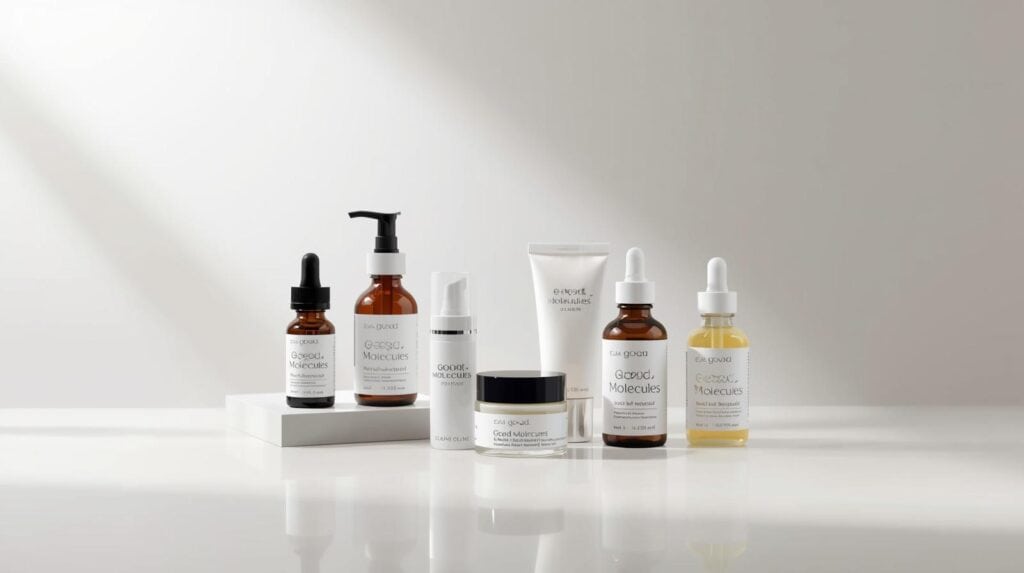
The clearest visual difference between Good Molecules and The Ordinary is the packaging.
Good Molecules generally uses brighter colors and more varied packaging, which can make products easier to distinguish at a glance.
That can be convenient if you keep several serums or treatments in the same routine.
The Ordinary uses a more minimal, clinical-looking design with neutral labels and familiar dropper bottles, tubes, and jars.
The restrained design fits the brand’s ingredient-first identity, but packaging varies according to the stability and format of each product.
Because many The Ordinary products have ingredient names and percentages on the front, the labels can look information-heavy to beginners.
Good Molecules also uses droppers, pumps, jars, tubes, and patches, but the visual design is generally more colorful.
Its product names often describe the function more directly, which may make browsing easier if you are unfamiliar with individual actives.
Packaging should still come after formula, suitability, and directions when you are deciding what to put on your skin.
A product that looks more luxurious is not necessarily more effective, and minimalist packaging does not make a formula more clinical or medical.
3. Price
Price is one of the biggest reasons shoppers compare these brands.
Both brands remain in the affordable skincare category, but the exact price difference depends on the product, size, country, and retailer.
Some comparable serums are priced close together, while others differ more noticeably.
A higher price does not automatically indicate a better formula. Compare size, ingredient list, concentration, packaging, and how often you expect to use it.
The peptide comparison is a good example: Good Molecules Super Peptide Serum and The Ordinary Multi-Peptide + HA Serum use different peptide blends and supporting ingredients, so they are not direct duplicates.
For value, focus on the formula that best matches your goals, tolerance, and routine rather than trying to choose a single “better” brand.
4. Product Line Variety
The Ordinary generally has a broader product catalogue, including multiple strengths and formats for several popular active ingredients.
That is partly because The Ordinary has been established longer and has had more time to expand its range.
Good Molecules has a smaller catalogue but includes formats such as hydrogel eye patches, cleansing products, serums, creams, and targeted treatments.
Each brand also carries products that do not have a close equivalent in the other line.
For example, The Ordinary sells Resveratrol 3% + Ferulic Acid 3%, a water-free antioxidant serum.
Resveratrol and ferulic acid are antioxidants used in skincare to help address the visible effects of oxidative stress. They should not be described as proven to “reverse ageing.”
Good Molecules, meanwhile, offers products such as its Caffeine Energizing Hydrogel Eye Patches.
The Ordinary also sells caffeine-based eye products, but a serum and a hydrogel patch are different formats and may suit different routines.
The Ordinary offers more ways to build a highly customized active-based routine, while Good Molecules often packages concerns into more immediately recognizable product formats.
There is still considerable overlap, so compare the current ingredient lists, concentrations, and directions before assuming two products are exact alternatives or “dupes.”
5. Ownership, Cruelty-Free Status & Values
Ownership and animal-testing policies are worth separating, because they are not the same question.
The Ordinary is owned through DECIEM by The Estée Lauder Companies. DECIEM states that it does not test on animals or ask others to do so and that it is Leaping Bunny certified.
The Ordinary also states that its formulas are updated from time to time, which is common in cosmetics and makes the current ingredient list more useful than an older review.
There is no good basis for assuming a reformulation is automatically worse, cheaper, or lower quality unless the specific change and its effect are documented.
If parent-company ownership matters to your purchasing decisions, treat that as a separate preference from the cruelty-free, vegan, or certification status of the individual brand.
The Ordinary continues to operate as a globally distributed skincare brand under DECIEM.
Good Molecules identifies its products as cruelty-free and provides vegan labeling on qualifying formulas.
Both brands currently market cruelty-free products, but certification, ownership, and vegan status are separate details, so check the latest brand information if these factors are important to you.
Vegan status should also be checked by product or through the brand’s current policy rather than assumed from “cruelty-free.”
Both companies also discuss packaging or sustainability initiatives, but these programs can change and are best evaluated using their current published policies.
From a skincare perspective, both brands emphasize ingredient-led, accessible formulas rather than traditional luxury positioning.
Their ownership structures and corporate relationships are different, which may matter to shoppers who include company ownership in their buying criteria.
For most routines, however, the more practical questions are whether a product suits your skin, fits with your other actives, layers well, and is comfortable enough to use consistently.
6. Beginner-Friendly
If you are completely new to skincare, the easier brand to start with may depend on whether you prefer shopping by skin concern or by active ingredient.
Good Molecules can feel straightforward because many product names describe the intended concern or format in familiar language.
Its labeling and ingredient-percentage disclosures can also make comparison shopping easier.
The Ordinary can require more ingredient knowledge because products are often named after actives such as niacinamide, azelaic acid, resveratrol, or peptides.
The benefit is that once you know which active you want, the naming system makes it relatively easy to identify the formula.
Good Molecules tends to combine ingredient-led names with more descriptive product categories, which some beginners may find easier to navigate.
Neither brand removes the need to read directions, watch for irritation when combining strong actives, and introduce new products gradually.
For a first routine, a gentle cleanser, moisturiser, and broad-spectrum sunscreen are usually more useful than buying several active serums at once. Add targeted products only when you know what concern you are trying to address.
7. Availability & Brand Reach
In terms of global brand recognition and distribution, The Ordinary generally has a larger international retail footprint.
The Ordinary is sold through its own channels and multiple beauty retailers in many markets.
Good Molecules began with Beautylish and has since expanded its retail availability beyond that original launch channel.
Its connection to Beautylish remains part of the brand’s history, but its distribution is no longer limited to the Beautylish website.
Good Molecules is also available through additional retailers in the United States, including Ulta, although availability can vary by location and country.
If you are shopping internationally, check local authorized retailers, because the easier brand to buy may depend on your region.
Product Breakdown
Two useful product categories for comparing the brands directly are niacinamide serums and peptide serums, because both brands offer versions with similar headline goals but different supporting formulas.
Both ingredients are popular, but the percentage on the label is only one part of how a formula behaves on skin.
1. Niacinamide
Niacinamide is a form of vitamin B3 used in skincare to support the skin barrier and help improve the appearance of uneven tone, excess oil, enlarged-looking pores, and texture.
It can be useful in many routines, but higher concentrations are not automatically more effective and may be less comfortable for some sensitive skin types.
The standard Good Molecules Niacinamide Serum and The Ordinary Niacinamide 10% + Zinc 1% both contain 10% niacinamide.
The formulas differ in their supporting ingredients, which can affect texture and how they layer with other products.
Good Molecules currently lists glycerin and betaine among the supporting ingredients in its 10% serum. The Ordinary combines 10% niacinamide with 1% zinc PCA.
Prices can change, so compare the current cost per size rather than relying on an older price difference.
2. Peptides
Peptides are short chains of amino acids used in skincare formulas that may help improve the appearance of firmness, fine lines, and overall skin texture, depending on the specific peptide and formula.
They are not a substitute for sunscreen or prescription treatments when those are indicated, but they can fit into a supportive anti-ageing routine.
Different peptide blends are not interchangeable, so the complete formula, concentration, stability, and directions matter more than the word “peptide” on the label.
The Ordinary’s former “Buffet” is now sold as Multi-Peptide + HA Serum, while Good Molecules sells its Super Peptide Serum.
The Ordinary formula contains glycerin, multiple peptides, amino acids, and forms of hyaluronic acid among its supporting ingredients.
Good Molecules Super Peptide Serum is also formulated with glycerin and a blend that includes acetyl hexapeptide-8, acetyl octapeptide-3, and copper tripeptide-1. The current formula is listed as fragrance-free and does not list the citrus oil described in older comparisons.
As with any serum, discontinue use if you develop persistent burning, redness, itching, or swelling, and avoid assuming that a longer ingredient list is automatically better.
The Ordinary Multi-Peptide + HA Serum is typically priced above Good Molecules Super Peptide Serum in the U.S., but prices and promotions change, so check the current listings before buying.
Final Thoughts
Both Good Molecules and The Ordinary make it possible to build an ingredient-focused skincare routine without prestige-level pricing, but that does not mean you need several active serums at once.
The useful difference is not that one brand is universally higher quality, but that their formulas, textures, ranges, directions, and presentation suit different preferences.
Good Molecules stands out for clear ingredient-percentage disclosures on many products, colorful packaging, and concern-based product names.
Its formulas can be appealing if you prefer supporting ingredients and a more conventional skincare presentation.
Because the brand has a smaller catalogue, it may also feel less overwhelming to browse than The Ordinary.
Availability has expanded over time, but it can still vary more by country than The Ordinary’s distribution.
For beginners, that simpler catalog may be an advantage, but it does not make every Good Molecules formula automatically gentler.
The Ordinary offers a larger selection of active-focused formulas, including several strengths and formats that make it easier to customise a routine.
Some formulas are intentionally minimalist, while others, such as Multi-Peptide + HA Serum, are considerably more complex.
The Ordinary also has broader global recognition and retail distribution.
Its larger catalog includes less common standalone formulas such as Resveratrol 3% + Ferulic Acid 3%.
The tradeoff is that the ingredient-first naming system can require more research if you do not already know what each active does or how it fits with the rest of your routine.
Once you understand the ingredients you want, however, The Ordinary can be straightforward to shop because the key active is often clearly identified in the product name.
Whichever brand you choose, introduce active products gradually and avoid stacking several strong treatments simply because they are inexpensive or popular.
Overall, Good Molecules and The Ordinary overlap more than they differ, but their individual formulas are not interchangeable.
You also do not need to build an entire routine from one company. Mixing brands is reasonable when the products are compatible and each one serves a clear purpose.
Start with your skin concern, then compare the active concentration, supporting ingredients, texture, directions, compatibility, and price of the specific products you are considering.
Packaging, availability, cruelty-free or vegan preferences, and parent-company ownership can also matter, but they are separate from whether a formula is suitable for your skin.
The best routine is one your skin tolerates, that addresses a clear need, and that you can use consistently, regardless of which logo is on the bottle.
Related Articles
Best Drugstore Cleansing Balms
Side Effects Of Not Combing Hair