How Often Should You Dry Brush?
Exfoliation removes some of the dead cells sitting on the skin’s surface, which can make the skin feel smoother and look brighter.
Physical and chemical exfoliants work in different ways to loosen or remove surface buildup. Used too often, either type can also cause irritation.
Facial exfoliation gets a lot of attention, but the body can also develop dry, rough surface buildup.
Dry brushing is one form of physical body exfoliation that does not require a scrub or acid.
It uses a bristle brush on dry skin to create mechanical exfoliation through light sweeping or circular strokes.
Dry brushing is also surrounded by claims about cellulite, circulation, lymphatic drainage, and immunity. The most reliable benefit is physical exfoliation; the stronger health and cellulite claims are not well supported by clinical evidence.
This method of exfoliation has become popular as part of body-care routines, but it should not feel painful or leave the skin raw.
If the skin feels raw, sore, or persistently sensitized afterward, that is a sign to use less pressure, reduce the frequency, or stop.
So, how often should you dry brush?
There is no evidence-based schedule that everyone needs to follow. A cautious starting point is about once a week, using light pressure. If your skin stays comfortable, you can adjust gradually, but daily dry brushing is usually unnecessary and may increase irritation.
Dry brushing can feel stimulating and may leave the skin temporarily smoother because it removes loose surface flakes.
Below, we’ll separate the realistic benefits from the more speculative claims and explain how to dry brush without overdoing it.
What Is Dry Brushing?
Dry brushing is a body exfoliation technique that uses a firm bristle brush (if you don’t already have one, this one on Amazon is designed for dry brushing).
The brush may use natural or synthetic bristles and is moved over dry skin with light pressure. Dry-brushing practices also appear in some traditional wellness routines, including Ayurvedic-inspired body care.
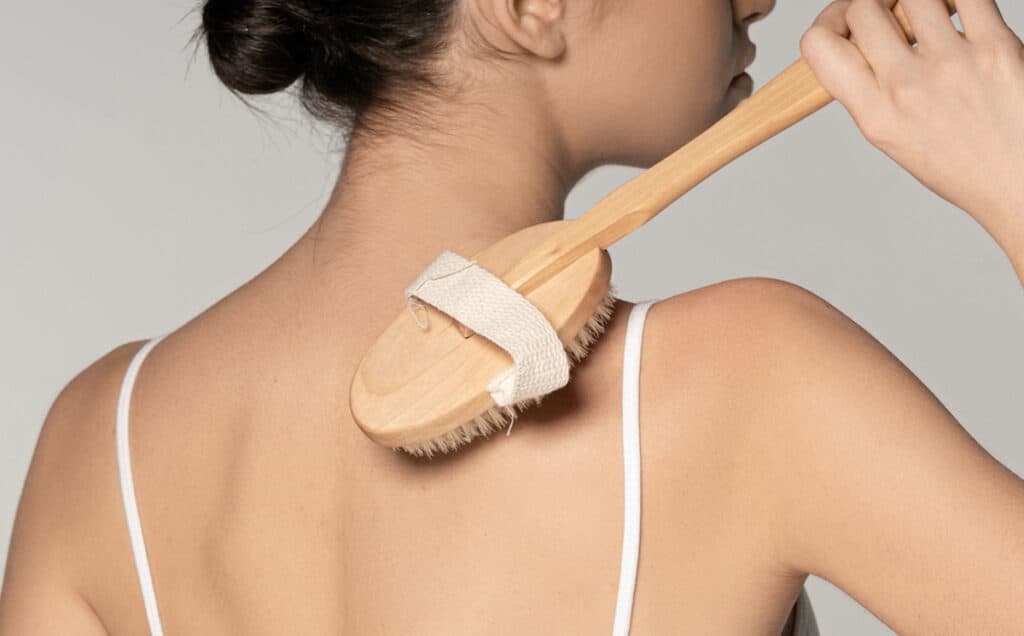
Most dry brushing is done in circular or sweeping motions on dry skin before a shower.
Dry-brushing tools are widely available, but body brushes can be too abrasive for delicate facial skin. A coarse body brush should not be used on the face.
Potential Benefits Of Dry Brushing
Dry brushing is often promoted with claims about immunity, cellulite, circulation, and lymphatic drainage.
Most of those broader health claims are not supported by strong clinical evidence.
Most claims beyond exfoliation are based on anecdotal reports rather than strong clinical evidence. The clearest cosmetic effect is temporary smoothing from mechanical exfoliation.
The most realistic benefits of dry brushing are surface exfoliation and the relaxing sensation of a light massage.
Exfoliation
Exfoliation is the clearest and most predictable benefit of dry brushing.
It can lift loose surface flakes, which may make the skin feel smoother and look temporarily brighter.
Dry brushing is a form of physical exfoliation, so gentle pressure matters. More pressure does not mean better exfoliation.
Because dry-brush bristles are often relatively firm, repeated passes or aggressive pressure can create too much friction.
Many people like to follow dry brushing with a shower so loosened flakes can be rinsed away.
Lymphatic Massage
One common wellness claim is that dry brushing removes toxins or improves lymphatic drainage.
There is no good evidence that dry brushing detoxifies the body. The liver, kidneys, lungs, and other organs handle waste removal, and dry brushing should not be treated as a substitute for medical lymphatic therapy.
If you have persistent swelling or suspected lymphedema, use medically recommended treatment rather than relying on dry brushing to create a slimmer appearance.
Dry brushing can still be a relaxing self-care ritual if you enjoy the sensation and your skin tolerates it.
Increase Circulation
Brushing the skin can cause temporary redness and warmth at the surface, but that does not prove a meaningful improvement in whole-body circulation.
There is no good evidence that dry brushing or its temporary skin stimulation boosts the immune system.
Any temporary flushing should be viewed as a short-lived skin response rather than a long-term health benefit.
Dry brushing may feel relaxing as part of a personal-care routine, but it should not be promoted as an immune-boosting treatment.
You may notice a brief pink flush after brushing. Mild, short-lived redness can happen from friction, but persistent redness, burning, or tenderness means the skin has been irritated.
Reduce Cellulite
Any visible smoothing or flushing after dry brushing is usually temporary, and long-term benefits beyond exfoliation are not well established.
Many claim that dry brushing can reduce the appearance of cellulite.
There is no strong evidence that dry brushing treats cellulite. Any smoother or firmer-looking effect is likely temporary and does not restructure the fat or connective tissue beneath the skin.
Temporary exfoliation or skin flushing may change how the surface looks immediately after a session, but the effect should not be confused with cellulite removal.
The Risks Of Dry Brushing
Dry brushing is not suitable for every skin type or every skin condition.
It can also aggravate irritated or inflamed skin and may be unsuitable over certain skin conditions or injuries.
If you have a chronic skin condition, poor wound healing, or uncertainty about whether mechanical exfoliation is appropriate, ask a healthcare professional before adding dry brushing to your routine.
Dry brushing can feel rough because it is performed on dry skin, but it should not feel painful or leave lasting soreness.
Other risks of dry brushing include redness, abrasions, worsening dryness, and barrier irritation, especially with excessive pressure or frequency.
Harsh On Sensitive Skin
If your skin is particularly sensitive, dry brushing may be too abrasive even with light pressure.
Dry brushing usually uses a firm-bristled body brush. Because there is no water or cleanser providing slip, too much pressure can quickly lead to pain, soreness, or irritation.
If the brush is too stiff or the pressure is too strong, irritation can increase instead of improving the look or feel of the skin.
You may notice temporary pinkness immediately after dry brushing, but it should settle quickly rather than linger.
You do not need to build a tolerance to pain or irritation. Use lighter pressure or stop if the brush consistently leaves your skin sore.
Discomfort
Whether you have sensitive skin or not, dry brushing can cause discomfort.
Some people become more comfortable with the sensation over time and find the routine relaxing.
However, firm bristles can still feel uncomfortable, especially on dry, thin, or recently shaved skin.
If you find that dry brushing causes discomfort, it’s best to stop or limit the frequency of dry brushing.
Can Irritate Skin Conditions
Dry brushing may be unsuitable for people with certain skin conditions or active irritation.
For example, eczema and psoriasis can flare or become more irritated with repeated friction.
This exfoliation method can worsen inflammation or create micro-abrasions when used over active eczema, psoriasis, sunburn, rashes, or other irritated skin.
Avoid dry brushing directly over inflamed, cracked, bleeding, or infected skin. If you have a chronic skin condition, ask a dermatologist whether mechanical exfoliation is appropriate for you.
Do not dry brush over moles, skin tags, warts, or other raised growths in an attempt to reduce them. Friction can irritate or injure these areas.
Infection
Dry brushing over broken or infected skin may irritate the area and can transfer microorganisms on the brush.
Avoid brushing over open wounds, active infections, weeping rashes, warts, or irritated lesions. Do not share a dry brush with other people.
A brush that stays damp or dirty can collect skin debris and microorganisms, so regular cleaning and complete drying are important.
If a brush develops mildew, an unusual odor, damaged bristles, or visible buildup, replace it rather than continuing to use it.
How Effective Is Dry Brushing?
Dry brushing is one form of physical exfoliation. It can remove loose surface flakes and leave some people with temporarily smoother-feeling skin.
However, it is unclear how effectively dry brushing reduces cellulite, boosts immunity, or helps drain toxins from the body.
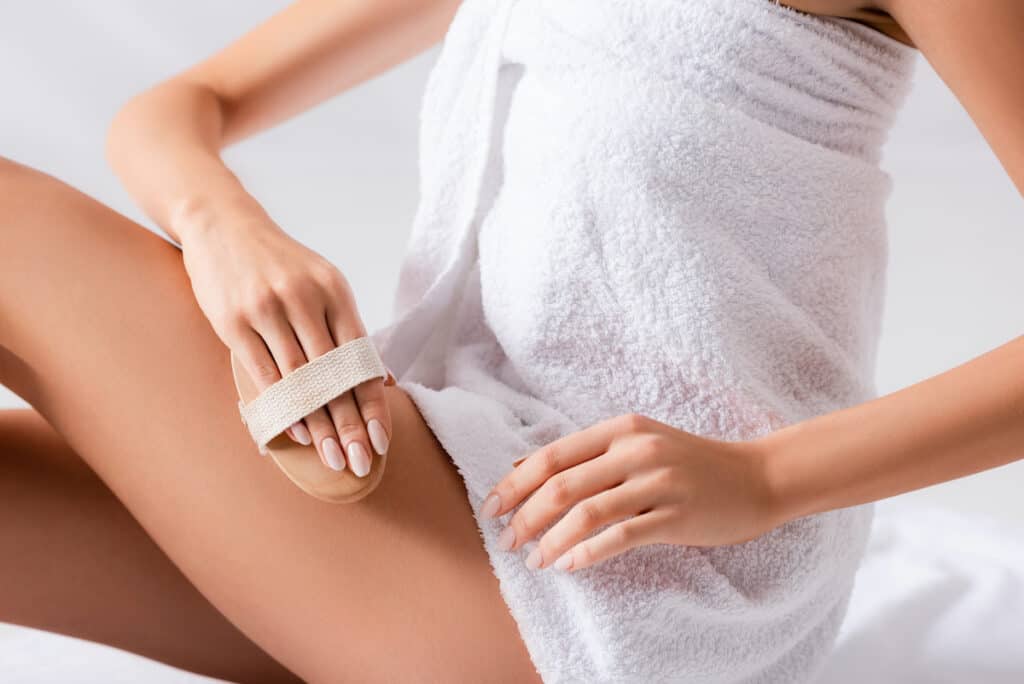
Most evidence supporting these claims is anecdotal, with limited substantiation from scientific studies.
Dry brushing can still feel relaxing, and the skin may look temporarily pink or smoother after exfoliation.
You may consult a doctor before dry brushing if you have a medical or skin concern.
When Is The Best Time To Dry Brush?
Many people prefer to dry brush before a shower because loose skin flakes can be rinsed away afterward, but there is no medically required time of day.
Some people will dry brush first thing in the morning and shower afterward to get ready for the day.
Others prefer evening because the routine feels relaxing before bed.
You can shower at a comfortable temperature afterward. A cold shower is optional and is not needed to make dry brushing effective.
If you prefer to rinse away loosened flakes immediately, dry brushing before a shower is the most convenient timing.
How Often Should You Dry Brush?
How often you dry brush should depend mainly on how well your skin tolerates the friction.
Because dry brushing creates friction, the goal is not to train the skin to tolerate irritation. Adjust pressure and frequency so the skin stays comfortable.
A cautious approach is to start about once a week and see how your skin responds.
If your skin remains comfortable, you can adjust the frequency gradually rather than jumping straight to daily exfoliation.
Many people will not need more than once or twice a week. If you already use scrubs, exfoliating acids, retinoids, or other body exfoliants, dry brush less often or skip it.
The main goal is to avoid over-exfoliating, especially if you already use other exfoliating products on the body.
Where Can You Dry Brush?
Dry brushing is primarily a body-care technique.
Coarse body brushes should not be used on the face. Facial skin is more delicate, and people who want facial exfoliation are usually better served by a product or tool specifically designed for that area.
On the body, use light pressure and avoid repeatedly brushing the same spot.
Dry brushing is meant for the body and can be done on the legs, butt, back, arms, and chest.
Avoid particularly sensitive, thin, recently shaved, sunburned, or irritated areas where friction is more likely to sting.
Additionally, passing over an area once or twice is often sufficient to exfoliate the skin.
Can You Over-Exfoliate?
Dry brushing can be a relatively abrasive exfoliation method, so frequency and pressure should stay conservative.
It can be easy to over-exfoliate your skin with a dry brush, especially if you apply too much pressure on the skin.
Daily dry brushing is usually unnecessary and can increase dryness, tenderness, or barrier irritation in some people.
If the skin feels raw from over-exfoliation, the routine is doing more harm than good. Smoothness should come without persistent stinging, tenderness, or peeling.
How To Dry Brush
Dry brushing is a simple body-care practice for people whose skin tolerates physical exfoliation.
The routine only needs to take a few minutes. Longer sessions do not necessarily exfoliate better and can simply add more friction.
Start Bottom To Top
Start with clean, dry skin. Traditional routines often begin at the feet and move upward, although the exact direction is not what makes exfoliation work.
If that pattern feels intuitive, you can start low on the body and work upward with gentle, controlled strokes.
You can use long, gentle strokes or small circles based on comfort. There is no proven need to follow a precise direction for exfoliation to work.
Traditional routines may recommend strokes toward the heart or lymph nodes, but this should be treated as a brushing tradition rather than a proven method of medically meaningful lymphatic drainage.
Circular Motions Or Light Strokes
Next, choose a brush pattern that feels comfortable and easy to control.
The most common methods include sweeping the brush in circular motions across the body or continuous light strokes.
Either approach is fine as long as your pressure stays light.
You may notice a brief pink flush from surface friction. Keep the pressure light enough that the skin is not burning or sore.
Either pattern can provide physical exfoliation as long as the strokes are gentle and controlled.
Brush Towards The Heart
If you prefer a traditional dry-brushing routine, you can use upward strokes toward the torso, but exfoliation does not depend on this direction.
There is not good evidence that brushing toward the heart drains enough lymph to slim the body or meaningfully reduce swelling.
The more important technique point is to avoid excessive pressure, repeated scraping, or brushing over irritated skin.
Also, apply light pressure while brushing to avoid any unnecessary skin irritation.
Light pressure also makes the brushing process more comfortable and easier to control.
If you’re more of a visual learner, take a look at this tutorial from Goop on YouTube.
Shower
A shower after dry brushing is optional but convenient for rinsing away loosened flakes.
Use a comfortable water temperature. An icy shower is not required for skin health or for dry brushing to work.
A shower can simply be a comfortable way to finish the routine if you enjoy it.
Rinsing afterward can wash away loose flakes, but showering immediately is not a medical requirement.
A quick rinse can remove loosened flakes and leave the skin feeling cleaner and smoother.
Moisturize
After brushing and showering, focus on keeping the skin comfortable rather than trying to extend the exfoliating effect.
If dry brushing leaves your skin needing recovery from an intense session, the session was probably too aggressive. Moisturizer should support comfort, not compensate for over-exfoliation.
Applying a simple moisturizer after showering can help reduce dryness and support the skin barrier (this lotion from CeraVe is one fragrance-free option).
Be careful about layering chemical exfoliants immediately after dry brushing. Combining physical and chemical exfoliation in the same routine can increase irritation, especially on dry or sensitive skin.
A moisturizer helps reduce water loss and can make freshly exfoliated skin feel more comfortable.
When Will You See Results?
The main cosmetic result of dry brushing can appear immediately: the skin may feel softer or smoother after loose surface flakes are removed.
The most immediate result is usually a temporary change in smoothness or surface texture.
There are no well-established long-term timelines for dry brushing benefits beyond ongoing exfoliation.
Rather than waiting for a fixed 28-day “skin cycle,” judge the routine by whether your skin stays comfortable, smooth, and free from persistent redness, stinging, or peeling.
Tips For Dry Brushing
A few habits can make dry brushing safer and more comfortable.
Dry brushing is optional, not essential skincare. If you have a chronic skin condition, poor wound healing, active infection, or another medical concern affecting the skin, ask a healthcare professional before trying it.
Keep the technique simple: use a clean brush, light pressure, short sessions, and enough recovery time between exfoliating routines.
Stop immediately if you notice any adverse reactions from dry brushing.
Also keep your brush clean and fully dry between uses.
Stop If Pain Occurs
Dry brushing should not hurt. A firm texture from the bristles is normal, but pain, burning, scratching, or lingering soreness means the technique is too aggressive.
A little temporary pinkness may settle quickly, but persistent redness, tenderness, swelling, abrasions, or itching are reasons to stop.
If you experience adverse reactions to dry brushing, discontinue exfoliating your skin and consult a doctor.
Keep Your Brush Clean
Keep your dry brush clean according to the manufacturer’s care instructions, especially if skin debris collects in the bristles.
Many brushes can be cleaned with mild soap and water, but check the care directions first. Let the brush dry completely in a well-ventilated area before using it again.
A dirty or damp brush can accumulate skin debris and microorganisms, which is another reason not to use it over broken or infected skin.
Natural-bristle or wooden brushes may hold moisture, so proper drying helps reduce the chance of mildew or odor.
Keep the brush clean, fully dry, and for personal use only, and replace it if the bristles or base become damaged.
Takeaway
Dry brushing is an optional physical exfoliation technique that some people enjoy as part of a body-care routine.
It should feel firm but not painful. If your skin repeatedly needs time to recover, use less pressure, brush less often, or stop.
Its main benefit is removing some loose surface buildup, which can leave the skin smoother and temporarily brighter-looking.
Dry brushing may not be ideal for people with very sensitive skin, active eczema or psoriasis, sunburn, open wounds, infection, or other irritated skin conditions. If you are unsure whether it is suitable for a medical skin concern, ask a healthcare professional.
If you decide to try dry brushing, start gently and let your skin’s response determine whether it deserves a place in your routine.
Related Articles
Can You Use Exfoliating Gloves On Your Face?
Best Exfoliating Brushes For Ingrown Hair