
Is Coconut Oil Good For Curly Hair?
Curly hair can have beautiful shape and volume, but every curl pattern behaves differently when it comes to dryness, oiliness, shrinkage, and styling.
But curly hair comes with its own set of problems, like frizz and dryness.
There are countless products marketed for frizz and dry curls, including shampoos, leave-in conditioners, serums, oils, creams, and gels.
Some people prefer simpler routines or want to avoid fragrance or certain styling ingredients, while others get excellent results from silicones and conventional haircare formulas.
If you prefer simple, single-ingredient haircare options, coconut oil is one of the most widely discussed choices.
You’ve probably explored the option of using natural oils, such as coconut oil, to help care for your beautiful curls.
There’s a lot of information out there about coconut oil – whether it’s good or bad, and whether it actually works on your hair.
So, is coconut oil good for your hair?
Coconut oil can be useful for curly hair because it can penetrate the hair fibre and reduce protein loss during grooming. It can also add slip and shine, but it is not ideal for every curl type and can feel heavy or greasy if you use too much.
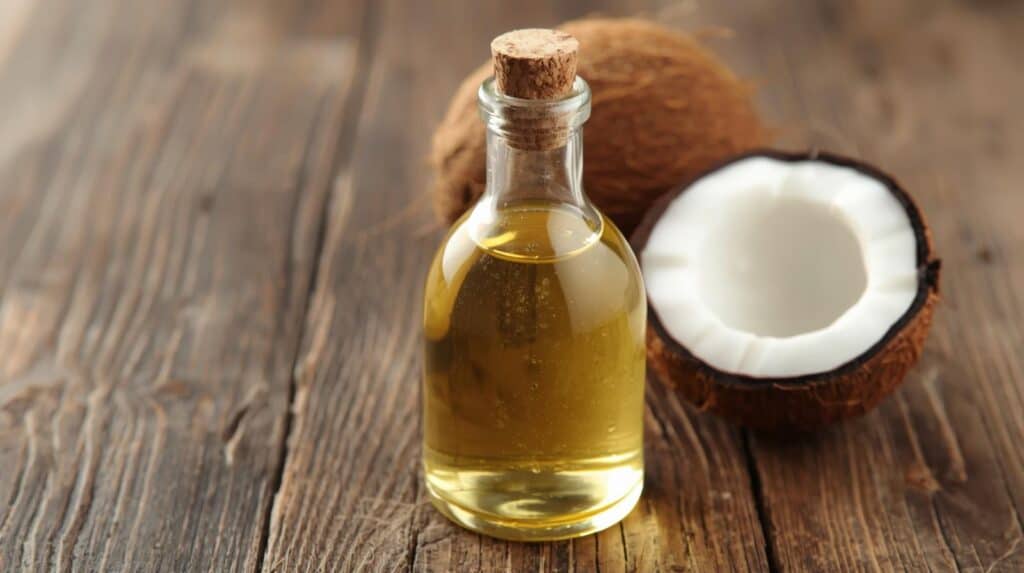
Coconut oil is rich in fatty acids, especially lauric acid, which is one reason it behaves differently from many other oils on hair.
Below, we’ll cover what coconut oil can realistically do for curly hair, where the evidence is strongest, and how to use it without weighing down your curls or irritating your scalp.
Why Coconut Oil Is Great For Curly Hair
Coconut oil contains a high proportion of fatty acids, particularly lauric acid, which gives it a strong affinity for hair proteins.
Lauric acid has a relatively low molecular weight and a straight structure that allows coconut oil to penetrate the hair shaft more readily than some other oils.
That penetration helps explain why coconut oil has been studied for reducing protein loss from both damaged and undamaged hair.
Penetration does not mean the oil will disappear completely. Fine, low-porosity, or easily weighed-down curls may still look oily if too much is applied.
Curly and coily hair often feels drier because natural scalp oils do not travel down bends and coils as easily as they do on straighter hair.
Frizz can be influenced by dryness, humidity, cuticle damage, styling technique, and individual hair structure.
Dryness is one contributor, but it is not the only cause.
Coconut oil is better described as a conditioning and protective oil than as a source of water-based hydration.
Used in a small amount, it can help smooth frizzy-looking hair, reduce friction, and add shine. It does not literally replace water lost from the hair, so it works best alongside a hydrating conditioner or leave-in when your curls feel dry.
A study comparing coconut, sunflower, and mineral oils found that coconut oil reduced protein loss from both damaged and undamaged hair when used before or after washing.
Hair can become structurally weaker through bleaching, coloring, repeated heat styling, washing, UV exposure, and mechanical friction.
With fewer proteins, the hair becomes weak and brittle.
You might experience a lot of breakage or split ends when your hair loses protein.
Hair is nonliving fibre, so damaged sections cannot biologically heal themselves. Conditioners, proteins, bond-building products, and oils can improve strength, feel, and manageability, but they do not return severely damaged hair to an untouched state.
Among the oils compared in the cited study, coconut oil performed best for reducing protein loss. More is not always better, though, because frequent heavy application can cause buildup or make some curl patterns feel stiff or greasy.
Its most practical hair benefits come from lubrication, reduced friction, shine, and its ability to penetrate the fibre.
Coconut oil may soothe a genuinely dry scalp for some people, but it is not a standard treatment for dandruff, seborrheic dermatitis, psoriasis, or scalp infections.
There is not strong evidence that applying coconut oil to the scalp prevents hair loss or stimulates new hair growth.
To summarise, here are some of the excellent benefits of coconut oil on curly hair:
- Can penetrate the hair shaft more readily than some other oils
- Adds lubrication, softness, and shine when used in an appropriate amount
- Can smooth frizzy-looking hair and make split ends temporarily less noticeable
- Has evidence for reducing protein loss during grooming and washing
- May soothe a dry scalp, but should not replace proven treatment for dandruff or psoriasis
- Helps detangle the hair
- Can reduce friction-related breakage when used carefully
- May help you retain length if reduced breakage is one of your main problems
For an excellent example of a curly hair routine, take a look at this helpful video from Gabriella Rest on YouTube.
How To Use Coconut Oil On Curly Hair
There are many ways to use coconut oil on curly hair.
Some methods are useful for reducing friction or protein loss, while others mainly add softness, shine, or slip.
Below are practical ways to experiment with coconut oil while adjusting the amount to your curl density, porosity, and tolerance:
Overnight Mask
An overnight coconut oil pre-wash is one option if your hair tolerates oils well, although leaving it on overnight is not required to get a conditioning effect:
- It gives the oil extended contact time with the hair before shampooing, which some people find helpful for reducing the stripped feeling after washing.
- Used as a pre-wash, it can reduce friction and may help limit protein loss during washing. Your shampoo itself is not necessarily “harsh” simply because it contains cleansing ingredients.
- Research supports a reduction in protein loss, but it cannot guarantee that breakage or damage will be completely prevented.
You only need a small amount of coconut oil for a pre-wash. Start with the mid-lengths and ends rather than saturating every strand and the scalp.
Here’s what you’ll need:
- Coconut oil
- An old t-shirt or scarf that you can wrap around your hair while you sleep
Here are the steps:
- Pick a night when you know you’ll be washing your hair the next morning.
- Start with 1 teaspoon to 1 tablespoon of coconut oil, depending on hair length and density, and warm it between your palms until it spreads easily.
- Work the coconut oil through the mid-lengths and ends. Apply it to the scalp only if your scalp is dry and you already know oiling does not worsen itching, flakes, or buildup.
- Pick up more coconut oil as needed and warm it up before applying.
- Wrap your hair in an old t-shirt or an old scarf to protect your pillowcases while you sleep. Coconut oil can leave permanent oily stains.
- In the morning, wash your hair as usual.
Your hair may feel softer and easier to detangle after shampooing, but curl definition and frizz control depend on your full routine and how your particular hair responds to coconut oil.
Try it occasionally and adjust based on your results. If your hair starts feeling coated, limp, stiff, or difficult to cleanse, reduce the amount or frequency.
Anti-frizz Serum
A tiny amount of coconut oil can work as a simple finishing oil on dry hair.
If you’re about to go out the door and notice that your ends are a little frizzy, you can use a bit of liquified coconut oil to spread it over the frizzy parts of the hair.
All you need is:
Here are the steps:
- Start with an amount smaller than a dime, especially on fine or low-density curls
- Warm it up by rubbing it in your palms until the coconut oil is fully liquified
- Gently run your oily fingers over the ends of the hair and other areas that are particularly frizzy.
- Wash your hands – you’re ready to go!
The key to using coconut oil as an anti-frizz serum is to start with a small amount of oil.
You can always add more if needed.
Different people have different hair structures. Even curly hair varies from person to person.
This means the amount of coconut oil that feels comfortable will vary too.
Your goal is to use just enough to smooth flyaways and add shine without making the curls visibly oily or heavy.
Coconut oil can lubricate the surface and make curls look smoother and shinier. It can make split ends look temporarily less obvious, but only trimming can remove a split end.
If your hair likes coconut oil, a small amount may make it look smoother and less frizzy.
There is no need to use it on a fixed schedule. Reapply only when your hair needs it, and clarify or shampoo when buildup becomes noticeable.
Detangler
A coconut oil pre-wash may reduce friction and make detangling easier for some curl types.
But on days that you didn’t have coconut oil in your hair all night, your curls may start to get knotted up. Thankfully, coconut oil can help with that, too.
The best time to use a detangler is right after washing your hair, while it’s still a little damp.
Using slip while detangling can reduce tugging and unnecessary breakage, especially on fragile curls.
Work slowly from the ends upward and stop if the brush catches rather than forcing it through knots.
If you’re looking to detangle your hair without washing it first, we’d recommend using a spray bottle to get your hair a little damp before detangling.
All you need is:
Here’s how you do it:
- Begin with slightly damp hair.
- Warm up a small amount of coconut oil in between your palms to liquefy it.
- Rub some of the oil in areas of your hair that are tangled.
- Use the detangling brush to brush out the tangles, starting at the ends and slowly working your way up.
The oil may add enough slip to help release knots, but a water-based leave-in conditioner or dedicated detangler may work better if your hair needs more hydration.
Think of this as a light oiling step rather than a replacement for every leave-in or detangling product.
Deep Conditioner
Coconut oil can be added to a conditioning routine, but it is not a complete deep conditioner by itself because it does not provide the water, humectants, cationic conditioners, and other ingredients found in a formulated mask.
A deep conditioner is usually a richer rinse-out formula designed to stay on the hair longer than a regular conditioner.
You can do this when you have a little extra time in the shower.
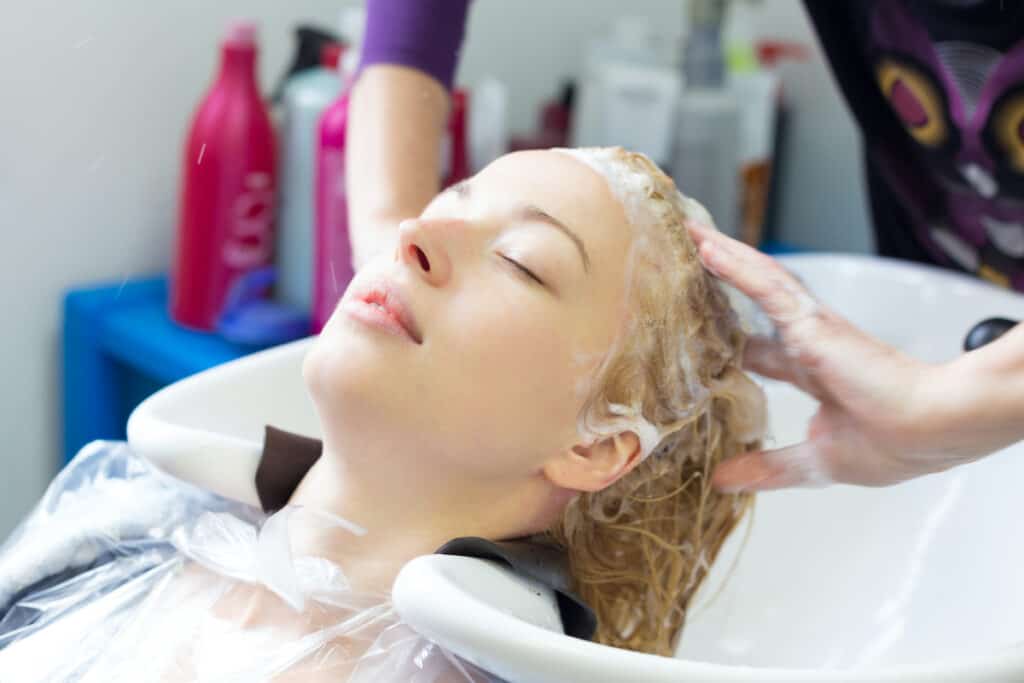
Deep conditioning doesn’t need to be done every time you wash your hair.
How often you deep condition depends on your hair. If adding coconut oil makes your curls heavy or stiff, use less or skip the oil entirely.
Here’s what you’ll need:
- A jar of coconut oil
- Your regular hair conditioner
Here’s how you do it:
- Begin by washing your hair with shampoo like you usually would.
- Make sure all of the shampoo has been rinsed out of your hair, and you are left with damp hair.
- Squeeze out extra water.
- Start with 1 teaspoon of coconut oil and warm it between your palms. Use less for fine or low-density hair.
- Add the coconut oil to an amount of conditioner appropriate for your hair length, then mix in your hands before applying.
- Spread the mixture over your hair, focusing on the ends first and working your way towards the scalp.
Avoid putting it directly on the scalp, especially if you have an oily scalp. - Leave the mixture on for the amount of time recommended for your conditioner, then rinse thoroughly.
- Rinse thoroughly. If the hair feels coated afterward, use less coconut oil next time.
- Dry hair as usual and enjoy your conditioned curls!
Scalp Treatment
Coconut oil is sometimes used on a dry scalp, but an itchy or flaky scalp is not always caused by dryness.
If you have true dandruff, medicated dandruff shampoos have better evidence than coconut oil.
Flaking can come from dandruff, seborrheic dermatitis, psoriasis, eczema, product irritation, dry skin, or other scalp conditions.
Although coconut oil has antimicrobial properties in laboratory settings, that does not make it a proven treatment for dandruff or scalp infection. If flakes are persistent, itchy, inflamed, or recurrent, use an evidence-based dandruff treatment or see a dermatologist.
If your problem is simple scalp dryness rather than dandruff, you can cautiously test a small amount of coconut oil:
- Warm a small amount of coconut oil between your hands
- Apply a very thin layer only to the dry areas of the scalp
- Leave it on briefly at first rather than automatically sleeping in it overnight
- Wash it out with your regular shampoo.
If oiling makes your scalp itchier, greasier, bumpier, or more flaky, stop applying coconut oil directly to the scalp and focus it on the hair lengths instead.
Do not use coconut oil several times a week as a default treatment for persistent scalp symptoms.
If you have recurring dandruff, an anti-dandruff shampoo with ingredients such as ketoconazole, selenium sulfide, salicylic acid, zinc pyrithione, sulfur, or coal tar is a more evidence-based approach.
Can Coconut Oil Work As A Heat Protectant?
Coconut oil should not be treated as a complete substitute for a formulated heat protectant.
A heat protectant is formulated to spread evenly through the hair and reduce thermal damage during blow-drying, flat ironing, or curling.
Coconut oil may reduce protein loss and friction, but that does not prove that plain coconut oil provides reliable protection at the high temperatures used by hot tools.
If you use heat regularly, choose a dedicated heat protectant and keep tool temperatures as low as practical for your hair type.
Instead of making an oil-and-water heat-protectant spray, use:
- A tiny amount of coconut oil only if your hair tolerates it, used separately from heat protection
- A formulated heat protectant suitable for your hair type
- A comb or brush to distribute the heat protectant evenly
For safer heat styling:
- Apply your dedicated heat protectant according to its directions.
- Distribute it evenly through the sections you plan to heat style.
- If you also use coconut oil, keep the amount very small and use it for conditioning or finishing rather than relying on it as your only thermal protection.
Oil and water do not stay uniformly mixed without an emulsifier, which is another reason a homemade coconut-oil-and-water spray is not a reliable heat protectant.
What Type Of Coconut Oil Should You Use For Curly Hair?
Refined, fractionated, virgin, and hydrogenated coconut oils differ in processing, texture, scent, and fatty-acid profile.
For haircare, texture and fatty-acid composition matter more than whether the jar was originally marketed for cooking or beauty use.
Virgin or refined coconut oil from a reputable source can be used on hair. Fractionated coconut oil remains liquid but is processed differently and does not have exactly the same composition as standard virgin coconut oil.
Organic
Organic certification is optional. It may matter to you for sourcing reasons, but there is not good evidence that non-organic coconut oil is inherently harmful to hair.
If you want one jar for both food and beauty use, choose a food-grade product and store it cleanly to avoid contamination.
Refined Vs. Unrefined
If the coconut scent bothers you, refined coconut oil generally has a much milder aroma than virgin coconut oil, although it may not be completely odorless.
Virgin and refined coconut oils can both work for hair. There is no universal evidence that unrefined oil will give every curl type better cosmetic results.
Heated Up
You’ll notice that coconut oil appears solid most of the time.
This is because it solidifies at room temperature. Heating it just a little bit will make it liquid and oily.
Warming a solid coconut oil slightly can make it easier to spread, but it does not need to be hot.
The safest option is usually to rub a small amount between your palms until it softens. If you warm it another way, test the temperature carefully before applying it to your scalp or hair.
Coconut Oil For Curly Hair FAQs
Can Coconut Oil Make Curly Hair Feel Dry Or Stiff?
Yes. Some curls, especially fine or low-porosity hair, can feel coated, stiff, or heavy after repeated coconut oil use. If that happens, use less, reserve it for pre-wash treatments, or switch to a lighter oil or leave-in conditioner.
Does Coconut Oil Actually Moisturise Hair?
Coconut oil does not add water to the hair. It mainly conditions, lubricates, and can penetrate the fibre. For dry curls, pair it with water-based conditioning products rather than relying on oil alone.
Can Coconut Oil Treat Dandruff?
Not reliably. It may soothe simple scalp dryness, but dandruff and seborrheic dermatitis generally respond better to dandruff shampoos with proven active ingredients. Persistent flakes, redness, sores, or hair loss are reasons to see a dermatologist.
Does Coconut Oil Help Curly Hair Grow?
There is not strong evidence that topical coconut oil stimulates new hair growth. Its more realistic benefit is reducing friction and protein loss, which may help some people retain length by limiting breakage.
Related Articles
Coconut Oil And Aloe Vera For Hair Growth
Macadamia Oil Vs. Argan Oil For Hair
Essential Oils For Frizzy Hair